Interview (Part 4): Renee Pillai
My interview with the 2019 Nicholl Fellowships in Screenwriting winner.
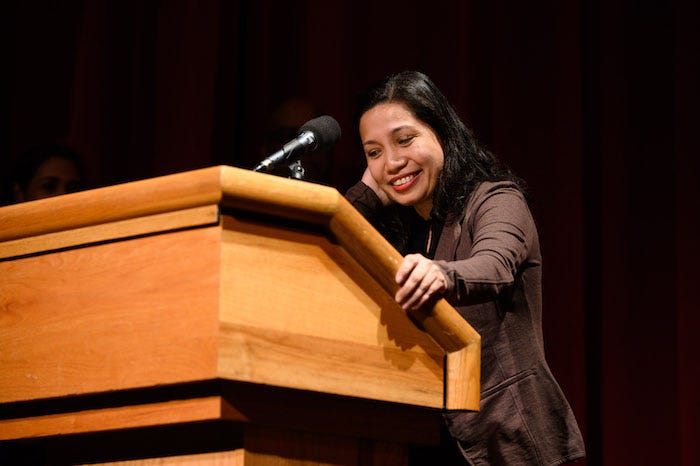
My interview with the 2019 Nicholl Fellowships in Screenwriting winner.
Renee Pillai wrote the original screenplay “Boy With Kite” which won a 2019 Nicholl Fellowship in Screenwriting. Recently, I had the opportunity to chat with Renee about her background as a screenwriter, her award-winning script, the craft of screenwriting, and what winning the Nicholl has meant to her.
Today in Part 4 of my interview, Renee talks about the challenges of writing a script which is “driven” by the characters and how she was concerned to avoid having the story slip into melodrama.
Scott: Another art thing, obviously, you talked about Stella’s work as a painter. She has turned her back on it. There’s a symbolic thing going on there where she’s got this place where she stores these cell phones, which I’m taking is her turning her back on the modern world. Could you make me unpack her character a little bit for us?
Renee: Well, this person, obviously she’s trapped in whatever situation that went on with Gabe years earlier. Because she’s very different from the young girl that we see, that 12‑year‑old at the very beginning.
She has reached this point where she has sacrificed so much, and I think part of her anger with Gabe was that he wasn’t willing to do that. And she does accuse him of selfishness. I think, in a way, Stella has some form of guilt, some form of resentment in her that has caused her to become this hermit, to become this loner.
In addition to that drawer full of cell phones, she doesn’t even want the news on a daily basis. She gets papers delivered once a month and she’s just using that for her art work. There’s also awards that she’s won. Her pieces have been shown all over the world.
It’s all very prestigious, and it’s not that she doesn’t care for it, but what I wanted to show was that it’s come to a point where she perhaps believes she doesn’t deserve it.
Scott: There’s another art angle here, too, and that’s with Ben. The artistic way of looking at the world is in the DNA of the family. You have what you referred to as a sequence in which we see the world through Ben’s eyes several times. Is that out of his DNA?
Renee: Yeah, definitely. You talked about Jenkins and Roche and they have an exchange about this — about those families where everybody’s an artist like the Peales and the Brueghels. And while they might be talking about Gabe, rather than Ben, it does hint at this.
There’s also another scene where Stella talks to Ben about art. I think it’s the first time he ventures into her greenhouse, and she asks him, “Do you like painting?” and he nods. And she goes, “I’d be surprised if you didn’t, but you’re half your ma, so I didn’t wanna assume.” So yes, obviously, this boy has an artistic slant. That’s what is hinted at and that’s why eventually she starts teaching him.
Scott: There’s a screenwriting mantra I love: “Simple plot. Complex characters.” There is a simplicity in your script. The underlying questions are: Stella and Ben, are they going to connect at some point? Is she going to warm up to him? There is that arc that it develops.
Then interestingly enough, in some respects, it’s like the arc, the bond between Linny and Ben is in even more important at the end of the day. Is that fair to say?
Renee: Yes, absolutely, because Linny was always the one who reached out to Ben in as many ways as Stella initially held him at arm’s length. Linny was always the bridge between the both of them.
Gradually and rightly so, Ben and Stella have to come together, but what I wanted to leave behind was the fact that Ben, as our protagonist, was going to be OK. He was going to heal. Because the healing wasn’t just for Stella or Linny, it had to be for Ben and Linny was a very important part of that process.
Scott: Almost as if he’s a surrogate father figure to counterbalance what happened with Gabriel.
Renee: Yes. This is what a father should be like.
Scott: Let’s talk about Gabe because all these mysteries, why is Ben so attached to the tree, why does he not want to take a bath, but insist on a shower, why does Stella have this disaffection for cell phones, why won’t Ben talk, all of them circle back to this metaphorical ghost, Gabriel.
His specter reminded me of the movie, The Big Chill. I don’t know if you remember that movie, but it’s a gathering of a group of people who are there because one of their friends, Alex, has died. He actually committed suicide. He’s there but not there, present in their memories and feelings about him.
I’m curious about, how important is it for you that Gabriel exists as this kind of ethereal emotional presence?
Renee: Gabe’s presence was necessary from almost the outset. Because he’s the reason why Stella has become the way she is. It was the reason, like you said with the cell phones, why she turned away from communication, she didn’t want to talk to Gabe. This was the way she was going to do it.
Her loathing of Ben comes from the fact that she blames Ben for what happened to Gabe. So if Ben was there, Gabe had to be a presence throughout. What I thought was interesting was that she had effectively, completely tried to forget their existence. The fact that Linny has been with her for a good long time and she’d never told him that she had a brother established that. Even before he became a ghost, she’d turned him into one.
Scott: One last question for you on the script, because I don’t want to give away too many of the plot elements. There’s one significant, surprising twist. I don’t want to reveal, but you succeeded in doing something I think would be a challenge for most writers, which is the story could have easily veered in a melodrama, and it doesn’t. I think mostly because the characters are honest and authentic and unique to themselves. Was that a concern for you? Did you have any struggles with that in terms of not wanting to become too maudlin?
Renee: Oh yes. Because when you’re handling a subject matter like this and you’re handling a story like this, that is very much driven by the characters, and the story itself is a drama, it can go down a path you don’t want it to.
I remember telling a friend about this story and bear in mind no one in Malaysia has read my scripts. Because those friends who understood English enough to read it weren’t interested in reading screenplays while those friends who were screenwriters, well… English wasn’t their language of choice. So it was tough finding anyone to talk to about it.
Anyway I remember telling a friend, “Yeah, well this story — it’s kind of like this and that and then this happens. And you know what? I’m going to make it funny. And they go, “No, no, it’s a drama, that’s going to ruin it.” But I’m like, “No, no. It’ll be good.”
Because honestly, as human beings, we’re such a dichotomy of these things — we’re as tragic as we are comic. That’s my approach to it, to make it as honest as possible. One of the things I discovered was, yes, it needed a vein of humor to it and it needed to be as honest as possible.
I remember there was one scene. Like you said, we don’t want to give it away, but when she’s talking to Ben, trying to make him see… and I thought, “Look, I cannot let this get to a melodramatic place because it could very easily go there and that’s not who these people are, that’s not how they would react to this, how they would handle this.”
And this means listening to them, sometimes just letting the characters be. And I’ll be very honest about this… they’re not very attractive all the time. They’re not even likable. But they are very human. My mandate was to make them as real as possible.
Scott: What’s the status of the script right now?
Renee: Well, it’s being read and it’s attracting producers who’d like to attach to the project, and I believe it is being sent out to actors, possibilities for Stella and Linny.
Scott: I assume then that you landed some representation of this.
Renee: I haven’t yet.
Scott: How’s the material getting sent out?
Renee: Well, I haven’t got representation yet because I haven’t signed with anyone yet, but I’ve met several people. It’s making the rounds, shall we say.
Scott: Fingers crossed on that.
Renee: Yes, hopefully.
Tomorrow in Part 5, Renee takes on some questions about the craft of screenwriting.
For Part 1 of the interview, go here.
Part 2, here.
Part 3, here.
For my interviews with every Nicholl Fellowships in Screenwriting winner since 2012, go here.
For my interviews with 53 Black List writers, go here.