Interview (Part 4): Miguel Flatow
My interview with 2022 Black List writer for his script Viva, Mexico!
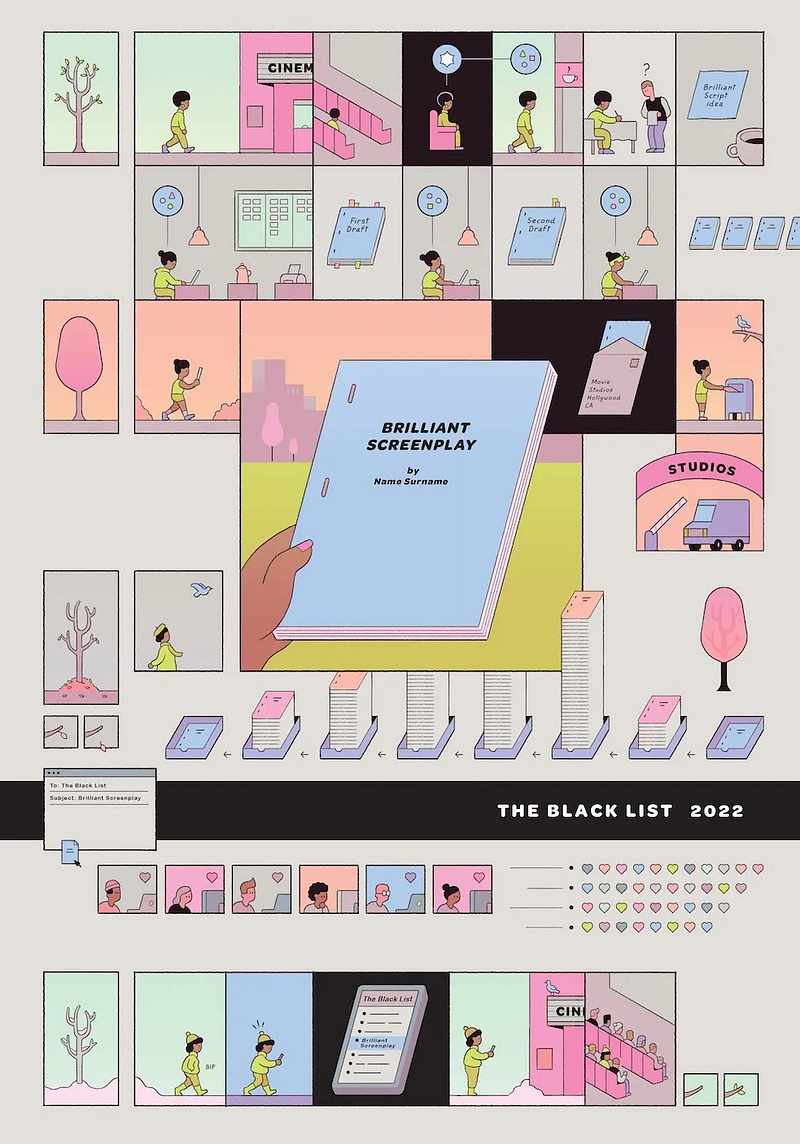
My interview with 2022 Black List writer for his script Viva, Mexico!
Miguel Flatow wrote the original screenplay Viva Mexico! which landed on the 2022 Black List. I had the opportunity to chat with Miguel about his creative background, writing a Black List script, and the craft of screenwriting.
Today in Part 4 of a 6-part series to run each day through Sunday, Miguel discusses the inspiration for a memorable speech given by the Protagonist in Viva Mexico! and what his experience has been like when the script landed on the 2022 Black List.
Scott: I want to talk to you about the violence. I’m smiling because it’s just so interesting to me. Normally, when you read these superhero movies or action movies, there are pages and pages of descriptions of the action.
There are a couple of times where you do a pretty detailed thing, but occasionally you’ll just literally write in caps and with an exclamation, “ACTION SEQUENCE!”
Could you talk a bit about your attitude toward the use of violence in the story?
Miguel: To be totally candid, I’m not the biggest fan of violence in film. Even the new Game of Thrones, I was like, “It’s such good writing, but it’s too violent for me.” Honestly, I don’t know if I need that in my psyche. At this point, the world is just a little bit too much.
I’m in the mountains here. I’m trying to play with the butterflies and smell the roses, and even from here, I can feel it. So I’m not the biggest fan of violence, but I think it was important in the script. You have to have a reason for it.
It’s an important part of the story and the thematics I’m delving into — the Narco struggle, what the coalition is trying to accomplish, what they’re fighting against, what they’re literally trying to achieve, so yeah, the script can get quite violent at times.
I even write in the script that it has to be “graphic” because you have to realize what the stakes are. Again, it’s a tricky script because there’s a superhero, which has a pg-13 nature to it, but the violence is a way to pin down the reality of the situation.
Even doing some research for the script, I saw a lot of images of what the Nacros are doing. Rooms with dozens of people and children decapitated and people hanging from bridges. I did like two days of research on that, and afterward, I just went out to my garden and stared at a flower for a while because it’s insane. There’s no way I could diminish that. Otherwise, what’s the purpose of telling this story?
Scott: There’s a side of dialogue that Sordomudo says, “This is not Hollywood, Captain. This is Mexico. We cancel people a different way here.”
Miguel: It comes back to your first point, which is the problems that you have in the US, it might seem huge but trust me, there are other problems in different parts of the world. Even the canceling thing. It’s different to be canceled because you said something politically incorrect than to be canceled in Mexico because you looked at someone the wrong way.
I think it’s the most violent country in Latin America now. It’s really a shame.
Scott: I don’t want to give away the ending, but Juan does gain control of a TV broadcast-type thing. He gives an eloquent and inspiring speech. I’m imagining that comes from a place that’s pretty personal to you. Is that fair to say? The content of that speech?
Miguel: The idea, I stole it from…What is it? Chaplin’s… What is it? The…
Scott: Oh, The Great Dictator.
Miguel: The Great Dictator. Yeah. I’ve always loved that one, and I was thinking about it often. I watched it a few times before I wrote it so it was definitely a rip-off. I’m sorry I’m being so poorly eloquent talking about my script.
But yeah, I needed an impactful speech. Something that made me think, “Would I leave the house if I heard that?” Again, it functions both as a thematic thing, and a practical thing, it works for the film because it needs to galvanize everybody to go fight, including the mariachis.
Scott: It stands in the tradition of V for Vendetta.
Miguel: Great film.
Scott: Also even Network. Howard Beale.
Miguel: Network. Probably one of my top five films of all time, for sure. Sidney Lumet.
Scott: You mentioned you wrote the script, and you set it aside. Because you’re at Rain Management, but then you signed with CAA, and then that’s when you said, “Oh, okay, let’s pull this thing out.” Is that how that worked?
Miguel: No. I signed with Rain Management, and then I gave them the script. Then I think they used that as leverage to get CAA to sign me. But I don’t really know.
Before I even signed with Rain, I sold a big TV show to a studio. It’s in development right now. I actually turned in rewrites today. That’s why my brain’s a bit toasted cause I just finished writing. But yeah. That’s probably what got me my reps, more that my film. The show’s in English, about finance, set in New York. I sold it as a spec script before I had any reps.
That got me Rain, and then CAA evolved from that, and then I don’t know exactly what needs to happen to get a script on the Black List, execs vote, I’m not sure, but they were obviously involved.
Before I had reps I had a lot of material because I’ve been writing my whole life. I’m 31 now. And I’m writing in my second language, so it took a while to get good enough in English where I can be competitive. And I live in Mexico. The whole thing just seemed so quixotic, so I was just writing a lot and shooting my little film and doing my thing.
Then before I premiered my film at the Morelia Film Festival, which was already a big accomplishment because, again, we shot the entire thing on an iPhone, literally like two weeks before Peacock said they were buying my script. So everything happened at the same time. We’ll see if the show gets made. So far so good.
Scott: The annual Black List was something you had some familiarity with, but it doesn’t sound like you were sitting there on December 13 whenever it was rolling out at 10 o’clock in the morning, checking your Twitter account. How did that play out? Where were you when you found out that you made the Black List?
Miguel: Well, I’m on Instagram more than on Twitter. [laughs] Twitter has the writers and the managers, but Instagram has the execs and producers. But no, I didn’t even remember it was that day. Nobody told me. I think maybe my manager mentioned something about the Black List, but very much in passing. I’m pretty green to the industry, less so now because I’ve been in development for a show for a while and now being with CAA and prepping another show with a producer so getting the hang of it and figuring out how everything works. I knew about the Black List in the sense that it hosts scripts and it’s a service that you can pay for. That’s it. But not about this specific Black List.
I know script competitions are a big thing. I never tried one. My whole life I’ve always thought, “I’m just going to do my thing. Everybody’s doing that. I’m going to do the opposite.” That’s always been my philosophy.
Then all of a sudden, I went for a walk in the morning, and when I came back my phone was blowing up. Like 20 missed calls and all these messages congratulating me. And I was like, “Oh, what happened?” [laughs]
That was a busy day. Very cool. As the days progressed, I realized what a big deal it is. I have friends who have been actively trying to get into the Black List for several years and still haven’t been on it.
I’ve been interacting with more writers and execs recently and have a better understanding of what it really means, but ultimately what it has given me is more confidence in my craft. Which is always the best gift. A good Christmas gift. Because when you start out, and I’m not starting anymore, but when you are, making a living as a writer is a daunting task. Suicidal, almost. As they say, writing is a race against your own enthusiasm. Self-doubt can always cripple that. I’m writing a lot these days because I’m writing with confidence. The Black List is a big part of that, for sure.
Tomorrow in Part 5, Miguel offers some thoughts on the craft of screenwriting.
For Part 1 of the interview, go here.
Part 2, here.
Part 3, here.
Miguel is repped by CAA and Rain Management.
Instagram and Twitter: @miguelflatow
For my interviews with dozens of other Black List writers, go here.