Interview (Part 4): Max Taxe
My interview with 2022 Black List writer for his script Ripple.
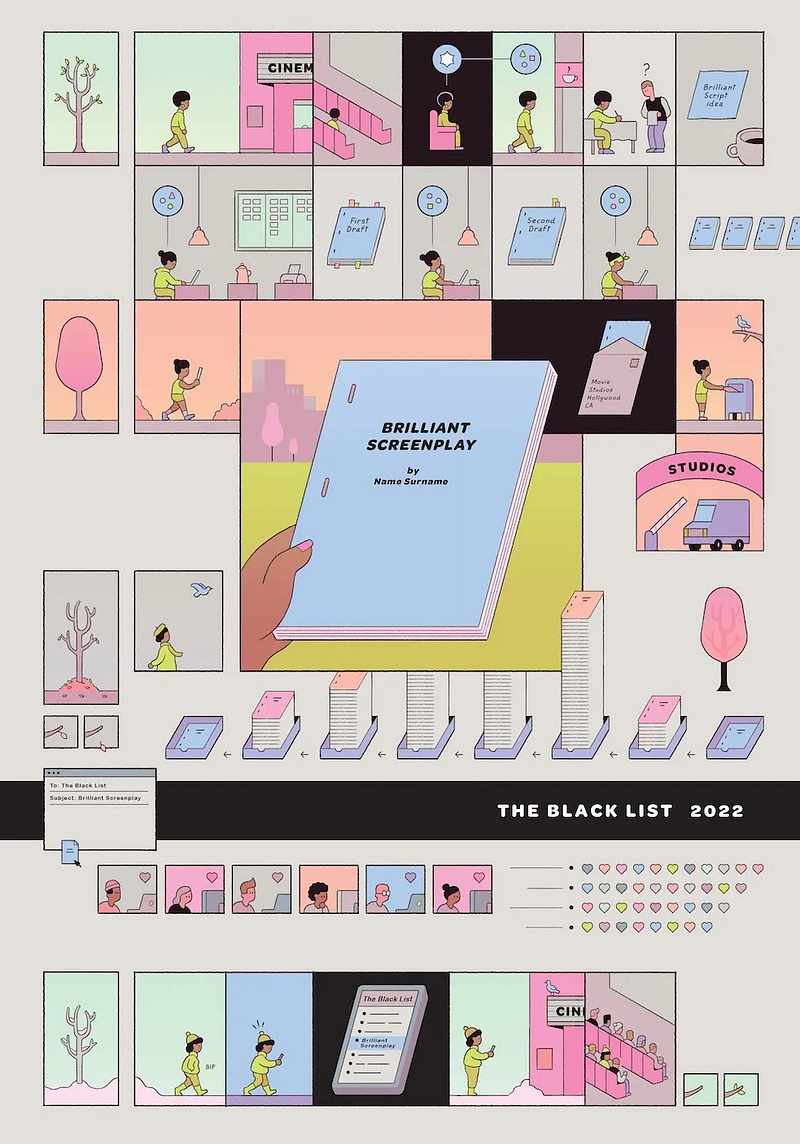
My interview with 2022 Black List writer for his script Ripple.
Max Taxe wrote the screenplay Ripple which landed on the 2022 Black List. I had the opportunity to chat with Max about his creative background, writing a Black List script, and the craft of screenwriting.
Today in Part 4 of a 6-part series to run each day through Sunday, Max discusses the love story which lies at the heart of Ripple.
Scott: It’s a narrative device, this ripple that provokes these changes and forces characters to confront stuff. Could you describe the physics of the ripple like “The Time Traveler” and how that impacts and created that?
Max: Sure. The basic conceit of it is — someone goes back in the past, does something, let’s just say Marty McFly, like he goes back, accidentally hits on his mom. [laughs]
All of that has a major impact on his life, his future, and those in his immediate circle. His family, friends, so on and so forth.
But for people who are far removed from him… You know, Marty’s parents not meeting probably won’t have any impact whatsoever for someone halfway around the globe. But everything is connected on some level, so maybe that will have some ripple effect far away where this little change led to this tiny change and…maybe someone unrelated adopts a different dog because of it. They put on a different shirt that day. Whatever. Small changes.
Now, of course, the more changes someone like Marty makes in the past, the bigger than changes and the scope of the ripples would get. And for some people, like Miles and Sadie, they just happen to be impacted more than others. They’re caught in the web.
So the idea is — when one of those changes happen, in the future, the changes are immediate. That dog changes right in front of you. But your brain is a mysterious thing, and it can hold on to what was — before. Kind of like a dream you wake up from where it feels so real in that second, but the more time passes, the more it fades away, until you can’t even remember it.
So there’s a sort of overlap period before the previous version of your life, if you happen to notice the change, is still there in your mind, like a memory. And it’s through this overlap period that Miles finds a way to game the system and attempt to hold on to as many memories, even ones that have since disappeared into timelines that don’t exist, as possible.
Scott: He meets this guy, Oz, who creates a way of managing to hold on to a version of the life that’s now right when the Ripple happens, that changes. There’s a funny aside that HAIM doesn’t exist anymore. They were this band, three sisters, great harmonies, folks with good stuff. A couple of ripples ago, they ceased to exist.
During the overlap period, their fans went online and said, “Hey, did I make this band up?” Collectively in that hour, we wrote up the music, the lyrics, and as many songs as we could. We saved something wonderful from disappearing.
Everyone can now learn about these three sisters from the San Fernando Valley and hear their cover songs, even though they never existed. He’s created this little program, I guess, or system or whatnot. Miles starts to do that because they do start having some changes.
He and Sadie move along in the relationships. Could you describe how this becomes almost an obsession for Miles?
Max: The short story got a little more into it, kind of the fun and sometimes goofy ramifications of the whole thing. Like in the overlap period, we would all have a moment where we’d collectively be like “oh my God, did the President just change?”
And there’d be this feedback loop where we’d be able to “preserve” a different timeline, even as we’re forgetting it. We would remember if we went from Biden to, I don’t know, Kermit the Frog. We’d all use that overlap window to make note of it, to note that that’s different, and we’d build out this strange history of timelines that no longer exist.
The question was, okay, that’s helpful because the world would be able to jump onto Wikipedia and start typing out what they remembered, and it would be crowdsourced and verified by thousands of other people, giving us this historical document, but… How do you do that for yourself? For your own history that doesn’t have thousands upon thousands of people verifying and remembering in real time. So this character, Oz, finds a way to create that for himself, a kind of journal.
Miles gets very obsessive about it. He knows the most important thing in his life is this person who he met, who fell in love with, and moved in with. And it’s not just about…preserving a historical event, it’s not just facts, you’re preserving the memory of a person and… How do you do that?
Like what if the person you fell in love with changed a tiny bit? What does that mean? What you’re trying to preserve is this ever-changing person who you’re still in love with. How do you even say she did change? How do you prove that? What if it’s something subtle and impossible to pin down?
If you read this journal later, if she did disappear, would it convey to you everything it needed to? Would you understand who this person was, and why they were so important to you, would you be able to capture the intensity of this emotion?
It becomes this rabbit hole for Miles that he can never really get out of because he gets to a point where every small gesture, every feeling, every detail feels crucial to capture. He transcribes everything. Everything feels more important with every second because he’s like, “Well, I don’t want to lose the way that look made me feel.”
Preserving the past becomes more important to him than living in the present with her.
Scott: It’s kind of that enigma about what John Lennon said, “Life is the moments that go by when you’re…”
Max: Not paying attention.
Scott: Attention. How do you live in the present? It is, I think, reflective of these personalities, the way you described it upfront. He’s stuck in the past because of this relationship he had with this nine‑year‑old relationship with Grace.
He’s desperate to try and remember the relationship he has with Sadie, which it’s a very positive, affirming, life‑altering experience he has with this woman. He’s trying to save that. Again, it’s like he’s creating the past with a positive version of it.
Meanwhile, she is not at all affixed to the past. She’s more free spirit. In fact, she even says about him when he’s writing this stuff down, “You’re never here anymore. You’re always off somewhere in your journal working on your project.” What relationship? The only one that exists right now is written on these little napkins.
Is this a reflection of the two worldviews?
Max: Yeah. Though the trick for her is that she acts untethered to any past, she is in the moment, she’s enjoying what they have right now, but she’s watching all of these changes happening around her and harboring this hope that maybe, just maybe, one of these ripples will change what happened to her dad.
She doesn’t really want to speak that into existence, she keeps it at arm’s length, but even having that hope is impactful, because if this incredibly painful thing in her past was undone, it would mean that she and Miles would’ve never met. She would’ve been someone totally different.
Miles totally understands her wanting that though. Who wouldn’t want to get rid of the most painful moment in their life. It sounds nice. He has something in his past he’d love to have erased, all of that pain. But then again, without those things, they wouldn’t be here, together. So there’s the tradeoff. So they each have to grapple with all of that, all of the conflicting emotions this new reality brings them, while trying to stay present in their lives.
Staying present is hard enough, with all of the baggage and chaos we always have. But those pasts are at risk of changing at the snap of someone’s fingers, it heightens that awareness.
Scott: Some of these movies that popped to mind when I was reading the script. There is this dynamic that runs through the story about finding love and the rapture, the joy and fun of it. Then the potential of losing love and also playing around with time. I was reminded of (500) Days of Summer.
Then also, I don’t know if you remember, Heaven Can Wait with Warren Beatty and Julie Christie. Did those percolate in your consciousness when you were thinking about this story?
Max: Yeah, I love both of them. 500, it was interesting. I think this started out more 500 Days of Summer with a little more non‑linearity. Then, once the structure was in place, it became a lot more of Eternal Sunshine. Those kinds of movies that delve into memory. The producers I think said it was 500 Days meets Eternal Sunshine with some 50 First Dates sprinkled in.
None of those were intentional, or conscious, on my part, but… Once we got into it, the one we kept coming back to, both tonally and even structurally, and just in terms of sheer conceptual and emotional ambition, was Eternal Sunshine. That was probably the biggest. Just because it did it so well and also got so real and specific, and — you just know how thin that line is between that masterpiece version and one where it just went off the rails.
It went into places emotionally that, that concept merited. It utilized every nook and cranny of their concept. And I was trying to make sure we did the same thing with our concept, and these characters, and not holding anything back.
Scott: Eternal Sunshine was another one that came to mind. You make a really important point. I make this with my students whenever they come up with a high‑concept conceit, like Ripple, this kind of thing.
I always tell them that, “Look, OK, that’s great. You got the big story, so that’s your plot line. You got this thing going on. What’s going to sell it is this small story. You got to have the character relationship, the characters, and the relationships nailed down because otherwise, that stuff doesn’t mean anything.”
You did it so well in the script. The relationship between these two. I was so invested in them. Where did that come from? The dialogue between them is so wonderful, it’s like sparkles on the page. I guess that’s a silly question to say, where did that come from, Max?
Max: Well, the dialogue and stuff, I started out…When I say started out, I was very amateur high school level. I started out with playwriting, that was my go-to form. So dialogue, and that rhythm, the voices, those were at the forefront of my mind in my early writing days. And now, I do think I generally find the characters through way they talk and the way they talk to each other and their own private conversations. They become a little more real in my mind once I know what they sound like.
The big thing I always ask myself and try to remind myself on every script and concept is, who are the best characters for this story or for me at least? And I just drew on a lot of personal stuff, especially my fears. I’ve been with my now wife… We’ve been together for 11 years. So a lot of Sadie and Miles started from a place of… What would be the worst thing that could happen to us? What would it feel like to have this scenario play out for us? What was it like meeting her the first time? All those hopes, fears, all the most extreme versions of what could happen to us. It almost immediately moves out of the autobiographical realm, because you want to do what’s best for your characters, or what’s worst for them, but digging into my own relationships, the things that freak me out the most, that would rattle me the most, lets those characters be so much more accessible.
All the things I write are in the end, nakedly autobiographical. Even if no part of the plot has ever, or will ever, happen to me. Just those base emotions.
Tomorrow in Part 5, Max reveals what it was like to make the annual Black List for the second time.
For Part 1 of the interview, go here.
For Part 2, go here.
For Part 3, go here.
Max is repped by Entertainment 360.
Twitter: @taxe
For my interviews with dozens of other Black List writers, go here.