Interview (Part 4): Laura Kosann
My interview with the writer who not only was named a 2021 Nicholl Fellowships in Screenwriting recipient, but also had two scripts make…
My interview with the writer who not only was named a 2021 Nicholl Fellowships in Screenwriting recipient, but also had two scripts make the 2021 annual Black List.
Laura Kosann made quite a splash in Hollywood in 2021. In November, she was named a Nicholl Fellowship in Screenwriting winner for her original screenplay An Ideal Woman. Then in December, that script plus another screenplay Laura wrote (From Little Acorns Grow) were named to the annual Black List. If that weren’t enough, the good news continued when in April 2022, it was announced that Laura had been hired to adapt the female-driven comic book Mercy Sparx for MGM.
Laura was kind enough to carve out some time for us to talk about her background, the craft of screenwriting, and her screenplay An Ideal Woman.
Today in Part 4 of a 6-part series to run each day this week through Saturday, Laura talks about the importance of a deer, an Ella Fitzgerald song, and synchronicity in the writing of An Ideal Woman.
Scott: Joseph Campbell talks about the reluctant hero where they reject the call. Susan has said this thing in class, this whole duck and cover is bullshit. Basically, you’ve got fifteen minutes to live, that’s it.
Her daughter brings this information home to Ann. Ann, at first, is pissed off at Susan. She confronts Susan and says, “Why are you staying there?” That’s almost like saying Susan represents someone who is really struggling to forge her own identity.
Ann, at the beginning of the story, set aside the opening image, she’s not fully engaged in that. It’s like she’s rejecting that. Then, by the end, she has that thing, where like you said, she says to Susan, “We should have been best friends.” She’s gone through this process where she’s embraced that.
Does that ring true? That Susan, in some respects, represents, “Ann, you need to start telling the truth about yourself. You need to go on this journey and embrace who you really are.” Does that feel like something that’s going on there in that relationship?
Laura: I think Susan sees through the bullshit. She does. As I even said about Jackie, Susan asked questions that nobody else asks. Also, Susan is more liberal at a time when being more liberal was construed with communism. It’s why she’s fired.
And Ann probably would agree with everything Susan does, but Ann is playing along with society for a while. Whereas Susan doesn’t play along.
I think, in a way, they’re reflections of each other. But sadly, there’s not a moment Susan challenges Ann to break out of what’s she in. That’s the tragedy really — that they don’t have that. Sadly neither really knows what the other is going through. But we as the audience are aware…and it’s heartbreaking in a sense.
Susan just sees Ann as some housewife, and, Ann sees Susan as this teacher that’s being hard on the kids, who Ann also thinks is judgmental of her. Ann is projecting her own insecurities in a lot of ways. All in all both women are human, and they just make assumptions about each other.
Scott: That’s why I thought that you could tell the story without the Cuban Missile Crisis, but it wouldn’t have that same thing that the threat of death, basically, forces us to look at things at a deeper level. What happens to Susan, I think is a contributing factor for Ann, in a deepening self-reflection.
Another thing: You’ve got an interesting little subplot with a deer. It reminds me of the ducks in The Sopranos.
Laura: I love The Sopranos.
Scott: Let’s talk the deer subplot and how that folded into the story.
Laura: In that rental house, that I’m telling you about, the backyard was this square, manicured plot. It was all enclosed and fenced in. I was standing in the kitchen. I swear, sometimes when you’re writing, stuff happens, that’s extremely kismet. You’re like, “Whoa, that happened because that was meant to occur.”
Anyway, this deer came barreling up behind the house, from the front. I don’t even know where he came from. He was huge, and seeing him in this fenced in plot was very odd and unsettling. And I watched him and suddenly was like… “That’s Ann.”
He was running in these little circles and looking back and forth. I was saying “just go out the same way. Go out the way you came.” At some point he did. But that’s when I realized Ann couldn’t do that. She couldn’t go out the way she came. And that’s why she says it to the deer. “Go out the way you came.” That’s why it’s a scene.
And my dog in that house too, he’d always go to the corner of the yard and try to find a way out of the bottom of the fence. That’s why there’s Charlie, in the screenplay, the little dog trying to constantly dig his way out. Everyone wants to get out but they can’t.
Scott: I’m a big Carl Jung fan. He talks about synchronicity. I think that’s true. If you’re a writer, things like that, potentially anything that happens, you can use it in your writing.
Laura: It’s true, things really start to fall into place. Sometimes at 40 pages in I am still saying to myself, “Am I crazy with this story?” But usually something happens, that little spark of magic every now and then that keeps you going. Points you in those right directions.
Scott: You’re in sync.
Laura: Yes!
Scott: That’s the whole point of the hero’s journeys. It’s to follow it to find your bliss, follow your bliss, find that thing. If you align yourself with that then, it may not be the easiest life, but at least it’s an authentic one.
I want to mention this. You’ve got this song, Paper Moon by Ella Fitzgerald. There’s a line of lyrics in there:
“It’s a Barnum and Bailey world, just as phony as it could be, but it wouldn’t be make-believe if you believed in me.”
Had you heard that song? I mean, it’s so perfect for your story, right?
Laura: I had heard that song. And I’m a really immersive writer. That’s part of my process. If I’m writing something about, this time, for example, it’s everything I listen to, consume. I buy so many old newspapers and magazines. I bought all the Life magazines from 1962 and 1963. I don’t remember exactly, but I’m sure I was just listening to a lot of music like that.
I’ve always loved that song. I just remember I was walking down the street, and that song came on. I just thought it was so perfect. I never realized how tragic those lyrics are. They’re very sad lyrics. They were perfect for this because — like I said before — it made me think of Ann and Stan. “It wouldn’t be make believe if you believe in me.”
Stan stopped playing make believe with her. She stopped playing make believe with Stan. Both people have to be fully committed to playing make believe for the house of cards world to stay standing. There was just something very poignant about that.
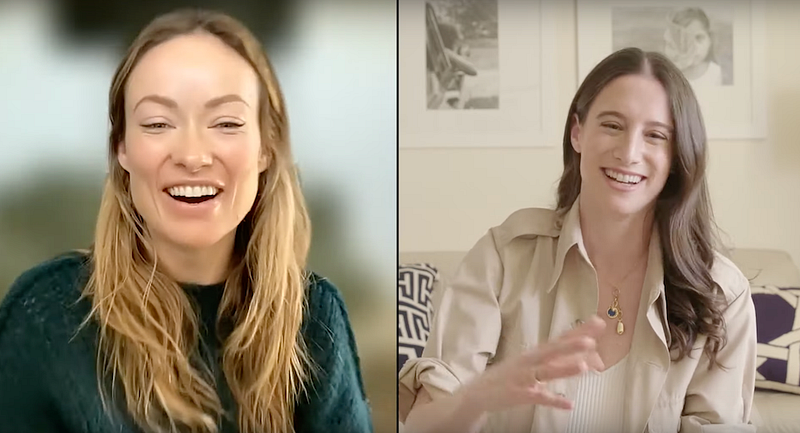
Here is Laura’s conversation with actress, director, and producer Olivia Wilde who directed one of my favorite comedies from the last couple of years: Booksmart.
Tomorrow in Part 5, Laura talks about what it was like having two of her screenplays make the 2021 Black List.
For Part 1 of the interview, go here.
For Part 2, go here.
For Part 3, go here.
Laura is repped by CAA and Heroes and Villains Entertainment.
Twitter: @LauraKosann
For my interviews with every Nicholl Fellowships in Screenwriting winner since 2012, go here.
For my interviews with Black List writers, go here.