Interview (Part 4): Kristen Tepper
My interview with 2022 Black List writer for her script Better Luck Next Time.
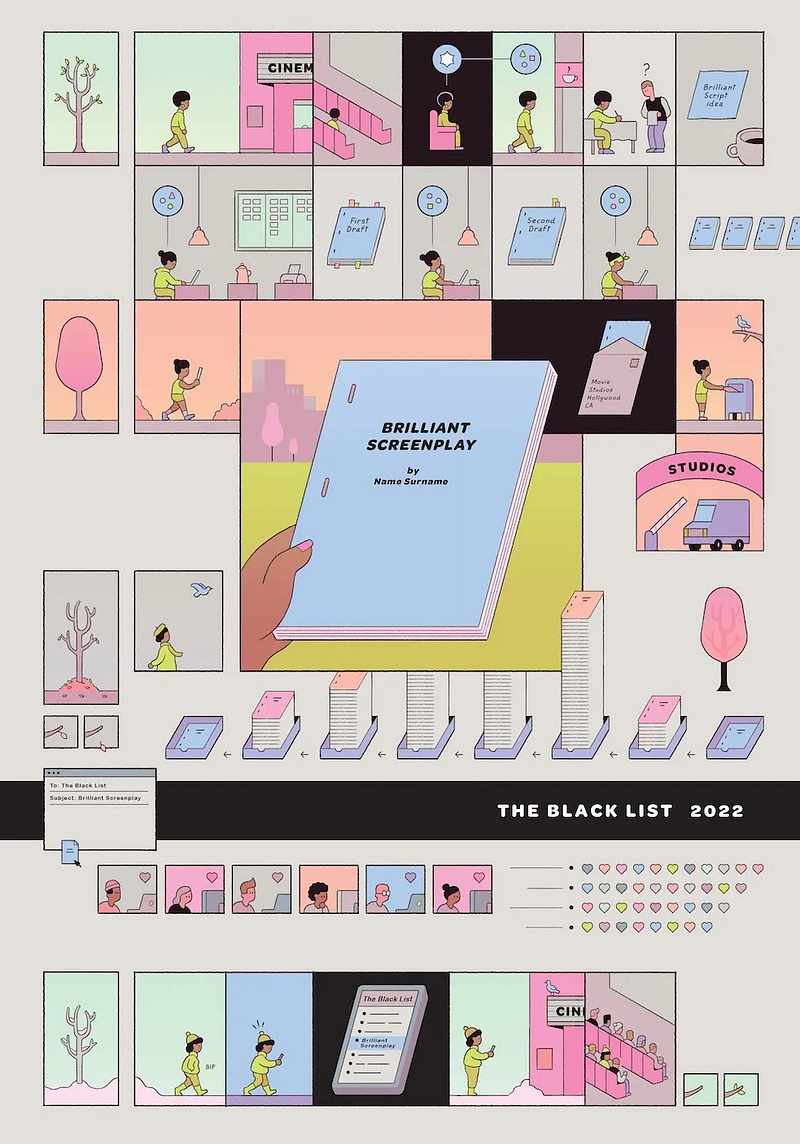
My interview with 2022 Black List writer for her script Better Luck Next Time.
Kristen Tepper wrote the screenplay Better Luck Next Time which landed on the 2022 Black List. Remarkably, Kristen’s script made the Black List before she had signed with a manager.
I had the opportunity to chat with Kristen about her creative background, writing a Black List script, and the craft of screenwriting.
Today in Part 4 of a 6-part series to run each day through Sunday, Kristen digs into other characters in her Black List script as well as key plot elements.
Scott: When I was reading this, and as soon as she said something about moving out to Naperville, I was going “OK,” because I have quite a few friends who live in Naperville. I go out there like, “I don’t know, man.”
Kristen: That’s a very specific lifestyle choice. [laughs]
Scott: Oh yeah. No knocking them. They got kids and stuff that are of age, that’s definitely the suburbs. What’s interesting to me about that is I think that stories, fundamentally, are about characters, particularly protagonist characters, who are trying to find themselves.
They don’t know this necessarily, but it’s about self‑identity. “Who are you?” In fact, at some point, I think you even have in one of your, enter in a big blow‑up fight, basically. It’s like, “Who the fuck are you?” Both of these characters are distanced a bit from that question. They’re not being honest with each other, or themselves.
Their job is like that too, they put on these masks to do this thing. How much of that synergy between this gig that they do where they put on these schemes to sting these guys, which is make believe, make‑up, masks, metaphorically. Yet also at the same time they’re doing a similar thing with their own lives, whether they realize it or not.
Were you aware of that synergy when you were writing it?
Kristen: No, I think now that you say that, I definitely see that. I was so hyper‑fixated on their relationship and the idea of not knowing who you are in your late 20s, and thinking I need to know this. This should be figured out. If I can’t then I’m going to keep running and not stop to think about it.
It’s the way that I can’t sit in a room and just think, “I have to be looking at my phone,” even if I don’t realize it I pick it up. It was this avoidance of self that I think a lot of people feel, especially now that we have technology to allow us to do that.
That was my hyper‑fixation with them, but I love that because I guess that is that when they’re in their job they are so focused on they commit on this bit. They committed to this bit beyond belief and I think they’ve just done that in their lives too. I’m committing to whatever this version of me is, whether it’s good or bad.
Scott: That probably explains in part why they’re good at it, because they do have practice at it because they practice it in their real lives, unconsciously or not.
I can see how Annie because she likes to do things and do them well, and she is good at it, where she could over time been sucked into this. Then once she started to lie with Jesse how that just built. She’s trapped in a way, in that web of business and life with Jesse, at the beginning.
Kristen: Yeah. I think definitely they obviously need to make a certain amount of money in this, but I think that’s also a thing, it’s like what I was saying, “I don’t want to be an assistant and work for $15 an hour when I’ve got a decent gig over here. It’s scary out here with money and funds and where’s it coming from next?”
Scott: You make a critical narrative decision, which is they lose the money they’ve saved. That’s BJ’s fault. That was probably intentional on your part to put pressure on them, right?
Kristen: Oh, yeah. I think this is the part when sometimes I don’t want to put a hat on a hat, but I’m like, “You want to make it as terrible as possible for these people.” You need to put them in a hole 30 feet in the ground and figure out…Then they have to climb out themselves, whether they use each other or they use anything else.
I don’t know what writer said that, but it’s like, “If you think it’s bad, make it worse.”
Scott: Sure. We want to see our protagonist characters go through one obstacle or another after another, tests, reversals, and that sort of thing. You get them into a real big mess in the story.
How much of their focus on this gig, where they’re getting back at these jerks, they call them “dicks”, how much of that is business opportunity and the general sense of toxic masculinity and the patriarchal system, which exists horribly in Hollywood.
Kristen: In the TV version, there is a whole backstory as to BJ being very wronged in college and the college doing nothing about it. That’s the precipice of Annie and BJ. Annie’s like, “He doesn’t know me. I’m going to go off him up.”
It’s Annie in this made‑up world, that doesn’t exist, in the prequel, where all this happens. That’s why they start it, but we see them a little bit more down the road where it’s BJ, I think she might say Jeff Bezos, I don’t remember who she calls out in this, but she definitely has this chip on her shoulder about getting back at men, at large, for what has happened.
It’s her baggage that she’s carrying. “I want to keep getting back at people, these men deserve it.” Then, it becomes just more of the business to Annie, and I think that’s when Annie also gets a little bit less…She falls out of love with it. She’s like, “This can’t be how we solve this problem. This isn’t it.”
Scott: Let’s talk about some of the other characters, there’s a mystery man. You drop us in, there’s an immediate sting, which is fine. Open a thing, we can see what they do. BJ’s just very clever at it. There’s this mystery man tailing them and it turns out later to be Ben. When he’s introduced later, he’s got a name now.
Meet, Ben Reynolds, 32, up‑and‑coming junior detective from Chicago P.D. What’s his basic deal at the beginning of the story.
Kristen: Yes, Ben went through a lot of iterations. There were a lot more characters which is one of my guilty pleasures in scripts and I have people that are cut three. Like, mesh two, cut three. I don’t care, get them out of there.
Ben, he was a lot more dopey in previous versions. He was kind of haphazard and hapless and didn’t really know what to do, but the more that I started writing it, I think he changed.
I had to go back into act one and be like, this isn’t who you are. You’re smarter than this and you’re not a bad guy because that can be a really easy thing to fall into, all men are bad.
The essence of that makes sense, but for these characters and real people, he’s not. He really does want to do something and he’s confused by his boss. He just grew to being the call you need when you need to fix a scene. You know what I mean?
When you’re like someone needs to call and break up whatever’s going on. It was always Ben being he’s perfect for this. He can put the mic on them and he can listen in the car and he can make the funny comment. Then becoming the love interest, I didn’t want to go too rom‑commy, it’s just not my specialty, but I couldn’t help it.
These two characters just vibe together, whenever they’re near each other or something happens. That’s where he ends up coming into play and I really like that it turned out like that for him.
Scott: Well, if he’s a cop and he’s spying, he’s tailing them and putting microphones and all this stuff. He’s a little bit living on the edge. BJ’s got that thing going on there too. I can see where there would be an instinct that would maybe draw them together.
Of course, it’s very convenient for you, and I’m sure it speaks to your writing skill that you do have him as a cop with this guy, Dennis, who is the police chief.
Kristen: Dennis is like…I don’t know. I don’t remember how I used to describe him. He’s like the epitome of every problematic dude that you know at an office, like Steve Carell’s character in…What’s on at Apple right now, not “The Newsroom?” Maybe it is The Newsroom. Like the Harvey Weinstein. He is that guy who has gotten away with it because he can. He’s way too smug and comfortable.
One of my favorite lines is still when he’s…I think Ben goes like, “I have a lot of missing persons cases.” He’s like, “Those aren’t going anywhere though, are they?” Like murders, he’s like, “They’re not going anywhere.” It’s the most self‑serving character that I had a lot of fun writing him, though. He’s a little bombastic.
Scott: There’s an interesting twist on a twist because while you’ve got BJ and Annie who are…They’re the sting masters in terms of their gig. Well, they’re going to be stung because there’s this whole other plot going on. There’s this woman, Cassondra. What’s her role in the story?
Kristen: I think like day one, she was like the Midwest Gwyneth Paltrow. That’s why she’s got her chain restaurants and she’s this weird, out‑there, outlandish, all very much…It’s so absurd that you’re aware that this is absurd, campy. She initially was the main person pulling all of these strings.
She was like, “I need this done, and this is how this is going to happen.” She’s one of my favorite. I write a version of her as a female character into a lot of things because I think women like this are MLM. Women are fascinating and women in power who are into thinking like the crystals are going to solve everything for them.
I love those people. They’re so interesting and they have so many layers in how did you get there. That is where she came from. She does remind me a little bit of my best friend. Not in the bad ways, but more in the [inaudible 43:40] ways, and wearing a cape that would be all of those things.
Tomorrow in Part 5, Kristen shares what it was like to learn that her script made the 2022 Black List.
For Part 1 of the interview, go here.
For Part 2, go here.
For Part 3, go here.
Kristen is repped by Agents First.
- Instagram @Kristentepper — https://www.instagram.com/kristentepper/
- Twitter: @kristentepper — https://twitter.com/kristentepper
- Tiktok: @teppertoks — https://www.tiktok.com/@teppertoks?_t=8dWXLH7ZkIU
Note: Kristen has 18.7K followers on Tiktok and 1M+ likes.
For my interviews with dozens of other Black List writers, go here.