Interview (Part 4): James Acker
My interview with the 2020 Nicholl Fellowships in Screenwriting winner.
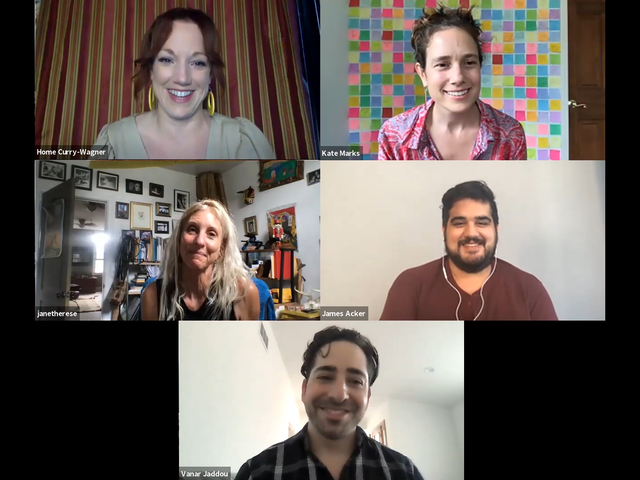
My interview with the 2020 Nicholl Fellowships in Screenwriting winner.
James Acker wrote the original screenplay “SADBOI” which won a 2020 Nicholl Fellowship in Screenwriting. Recently, I had the opportunity to chat with James about his creative background, his award-winning script, the craft of screenwriting, and what winning the Nicholl Award has meant to him.
Today in Part 4 of a 6 part series to run each day through Saturday, James talks about a poem he wrote to include in a fictional book referenced in the script which speaks to one of the key themes in the story.
Scott: Ronny’s from a very, very wealthy family. There is a socio-economic thing going on between, I guess you’d say, have and have‑nots. Was that always part of the story background for you?
James: Yeah. I wanted to ping‑pong back and forth on that. Because the town I grew up in had a real class divide depending on where you were. Truly, one neighborhood to another, you could go from these huge gaudy McMansions to… I mean, we had a literal “other sides of the track” in my hometown in Jersey.
In school, it wasn’t as apparent. You’d go to someone’s house for a project or something and realize, “Oh, you’ve been a secret millionaire this entire time. Weird.” Or the flip side as well. I wanted something like this where you’re going on a tour with Edgar. I wanted to hit the highs and lows.
And I wanted to show the irony in that. Because on one side of the economic scale, a lot of his friends simply don’t have room for Edgar. There’s literally no space for him in their lives. Then on the other side, we see some friends with second, third, fourth guest rooms. But Edgar still can’t find a place to sleep because of how he feels about them or how they feel about him.
Scott: It reminds me of that quote that’s attributed to the Coen brothers where they said every movie is an attempt to remake “The Wizard of Oz.” Your story is very character‑driven. Yet, you do have a hook, which is that he is just trying to find a place. He’s trying to find a home, right?
James: [laughs] Yeah. That was such an important thing for me. I love doing this kind of slice‑of‑lifey, character‑driven dramas, especially coming‑of‑age. I’m always preemptively afraid of the note, “This feels a little too meditative. There isn’t enough plot driving this.”
But once I landed on that engine: “We’re going to tell this in five days. This is going to be essentially real time. He just needs to find a place to sleep. Cool. Objectives. This is a motor that will keep this story going,” the story flowed so much easier. Engines. They truly have changed how I start developing projects.
Because, while I do love a lazy Sunday feel, and I do love something to feel sprawling, you can’t knock a good engine. When something is self‑motivated, when a story can’t not propel itself, it makes writing so much easier.
Scott: Absolutely. The compressed time frame too, because it just lends itself to pace. You doubled down on that goal. Later on, there’s a book which is symbolic of Peter. Edgar loses it, so not only is he trying to find a ‘home,’ he also trying to find the book. That’s another way that you build in that narrative engine.
Let’s talk about that book. I’m imagining it’s fictional, something you made up?
James: Correct.
Scott: OK. What was the inspiration for that? How did that figure in? Was that early on that you knew this is going to be this book, which is basically a play and a whole audition thing for the play, or did that emerge over time?
James: It came in pretty quickly. Originally, it was a book of poetry, but I knew I’d need some sort of timeline built into the story. I also wanted some area for humor. Because I think drama works best when you can rest it. Keeps it from being constantly bam, bam, bam, look how sad his life is. So, the book became a play.
I thought a good way to rest it while still showing Edgar’s inner motivation would be to give him an outlet. Something very counter to what his bigger, more dramatic objective is. So, what if during the worst week of Edgar’s life, it’s also the week of play auditions? I wanted this surprising turn for Edgar where he’s not just worrying about where to hang his hat.
Of course, during all this, he’s working towards the same goal. In life and in the play, he needs to do right by himself and carry that flame that Peter saw in him. Peter encourage Edgar’s dream to be an actor. The play they liked is going onto this high school. He has to try it. He has to keep the flame alive.
The book is something Peter gave him because he knew that the play was coming up. The audition is something Peter wanted him to do. It’s the only thing he thought to grab when he was running away from home.
I wanted to give a very tangible totem for Edgar’s heart in this. Despite all of the sad things that are happening in his life, and all the stress, and all the drama, I wanted the book to be a very clear representation of what Edgar really wants, not just a place to sleep. Overall, what would make him happy is something as simple as auditioning for the school play. Trying.
Scott: It’s that question on the cover of the book, “Are we happy?”
James: “Are we happy?” Yeah. Also, I needed a little vehicle to add some humor in. I needed some glimmers of fun. Because high school theater is inherently — speaking as someone who did it — a joke. I wanted to inject a little bit of levity into the story so it isn’t just constant.
I mean, it eventually ends in a dramatic beat, but I wanted to find little windows of air so it’s not just constant downhill slide for Edgar. It became a great way to find little wins, him getting the callback, him getting recognition.
Then, because the compressed timeframe got me hooked on the idea of stakes, of course the book eventually goes missing. Around page 60 I was like, “OK, let’s amp up these stakes. We’re at Hump Day, something needs to happen.”
Scott: There were several narrative choices you made that I’d like to talk about. In an interview, you said this about the importance of playwriting: “The big ideas and flashy premises will come, but if you can’t make a two‑person, one‑location scene interesting, you’re going to get stuck.”
The script, while it does have that narrative drive, that engine of just trying to find a place to stay to find the book, there’s a lot of what oftentimes are called in Hollywood “talking‑head scenes,” two people in a room or two people standing and talking to each other.
In playwriting, you’ve got to make those interesting. Were you at all concerned about that in this script, or is that just something you feel strongly that you can do well?
James: I’m always aware of my dialogue scenes because I never want to lean on them too hard. They’re something I learned I had a knack for pretty early on in my time in Drexel after they started us out with playwriting classes. I learned that one of my strengths is dialogue and two‑people scenes, those talking‑head scenes.
In a different world, I probably would pursue playwriting more seriously. It is just something I learned as a strength of mine. And with something as open and vague as wanting to be a writer, I’ve found if you can actually zero in on a strength of yours, you might as well lean into it.
There’s so much uncertainty in this career. I’m always second‑guessing what I’m writing. There’s a lot of doubt when it comes to writing.
But if you can find something you know that you are proud of ‑‑ for me, it’s dialogue scenes and being able to write these two‑people, talking‑head scenes ‑‑ it can only help to find your voice and what can set your script apart.
So, dialogue is something I’m very mindful of. It’s also something that inflates my page counts because it’s a lot of people talking to each other. I always give myself that Amy Sherman‑Palladino cushion of, “Yes, when I turn the script in, it’s going to be 30 pages longer than it needs to be, but I promise they’ll say it fast.”
But when you’re writing dialogue, it sometimes helps to go long. Treat it like a little mini play, and then run it back and find what you need. And for what it’s worth, “Sadboi” is a pretty COVID‑friendly script. That’s the power of monologues and talking-heads. You can do them anywhere, anytime.
Here is a video of the moment James and his fellow writers learned they had won the 2020 Nicholl Fellowship in Screenwriting.
Tomorrow in Part 5, James answers some questions related to the craft of screenwriting.
For Part 1, go here.
For Part 2, go here.
For Part 3, go here.
James is repped by The Gotham Group and Fuse Literary.
Twitter: @JamesUmAcker
For my interviews with every Nicholl Fellowships in Screenwriting winner since 2012, go here.
For my interviews with Black List writers, go here.