Interview (Part 4:) David L. Williams
My interview with 2022 Black List writer for his script Clementine.
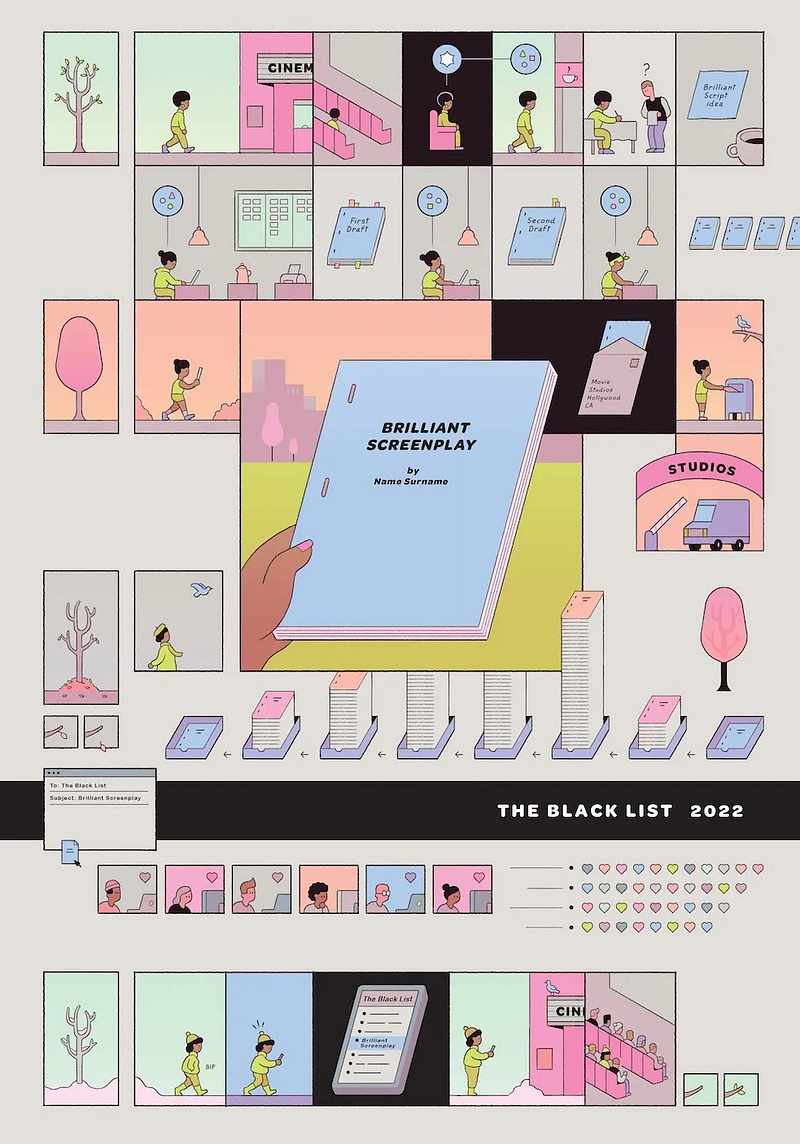
My interview with 2022 Black List writer for his script Clementine.
David L. Williams wrote the screenplay Clementine which landed on the 2022 Black List. I had the opportunity to chat with David about his creative background, writing a Black List script, and the craft of screenwriting.
Today in Part 4 of a 6-part series to run each day through Sunday, David talks about what it meant for Clementine to make the 2022 Black List and the current status of the script.
Scott: I want to talk to you about the scene description, the action writing. Were there any screenwriters that you were inspired by or influenced you, in terms of how you approach the actual prose of the script?
David: There are a couple, two that come to mind. I’ll say the first time I came across a script, the idea, the notion of voice hit me. Also, very effective and efficient prose, not necessarily writing for the sake of writing, not over‑describing things, but the efficiency of words, was the Coen Brothers.
I read Raising Arizona, many eons ago when I was an intern at a post‑production house. I couldn’t believe how quickly I was flying through that script.
I remember, because I have a bad attention span when it comes to reading, and so part of me is always trying to please myself when I’m writing. If I can keep myself invested and engaged, I have a shot at keeping other people invested and engaged. I would say the Coen Brothers, that script specifically, Raising Arizona, did it for me.
The other I would say is Chris Sparling, the guy who wrote Buried, Greenland. Man, his writing is so good…He has that efficiency factor that I talk about. I remember I read a script of his where a plane was exploding, and the way he described it was so magnificent. It definitely had an impact on me.
Also, my friends. I feel like I surround myself with great writer friends. Some of them are working writers as well. I’m always inspired by them. I’d say for sure, though, Coen Brothers, Chris Sparling, a little bit of Taylor Sheridan as well somewhere in there. I would say the Coen Brothers and Chris Sparling, for sure.
Scott: As I was going through your script, I was like, “Oh, there’s a little bit of a Shane Black in here.”
David: [laughs]
Scott: Like this scene description: “Jake snatches owner’s balding head and slam dunks it into the glass counter. Goodbye, glass! Goodbye, nose!”
David: [laughs]
Scott: He does that sort of thing. Another line: “Jake, Disco, Wwner are all down. No telling the status of whatever is behind door number death.”
David: [laughs]
Scott: That feels like something I would’ve read in The Last Boy Scout. Another one: “The muzzle of her handgun creeps up to his temple. A few seconds take a few years to creep by.”
William Goldman said, “You’re not writing a refrigerator manual. You have to be entertaining.” In fact, I was also struck, too, by this little bit of business in your script where you basically make up verbs. “Clementine thunder‑stomps the brake.” Or “Rico crack‑thunders from the apartment complex.”
That reminded me of Butch Cassidy and the Sundance Kid. This is during the Bolivia shootout ‑‑ “Sundance, vaulting through the shattered window, moving out into the sunlight of the patio, two guns in his hands, two more in his holsters. As he comes and fires, starts to turn, and as the first turns happens, Butch, barrel‑assing out of the door.”
David: [laughs]
Scott: Barrel-assing. Just make up words. Make it visual, entertaining. I don’t know, maybe you’ve got some subliminal Shane Black and William Goldman coursing through you, David.
David: Man, I will not complain about being in the same league as those guys. [laughs] I appreciate that. My professor did show us some Shane Black in college, so I wonder if that’s subconsciously stuck with me.
You brought a good point up about being entertaining. It is a goal of mine to entertain with every line. I want every line to feel like its own story, I want every line to be as entertaining as the last, because that’s what helps me get through scripts. Those are the things I enjoy. If I’m writing scripts, I want a reader to have the same feeling.
Scott: With my students, I say, think of it as narrative voice. It’s like the invisible character who’s watching the story. You’re writing it, but they’re telling it. What’s their personality? It’s not like you’re writing an essay in 10th grade. It’s genre plus style equals narrative voice. Your script, consistent, strong narrative voice throughout.
David: I appreciate that.
Scott: Congratulations. I enjoyed it. Let’s talk about this little thing that happened in December 2022. The reveal of the annual Black List. Were you following this at all?
David: Yeah, I was. I was trying not to, because I didn’t want to have anxiety about whether or not I would be on the list. Of course, my group of good friends were all hyping me up. I couldn’t help but pay some attention to it.
Leading up to the Black List, I had absolutely no idea if I was even qualified…I had no idea if I’d be on it at all. That morning was rough. I had to take public transportation to work. The trains were being smelly, the bus had a detour.
I got into work and it was chaos…I had this small thing happen where I had to use the bathroom. I washed my hands, there weren’t any paper towels left.
That was the first time that we never had paper towels… “Why are there no paper towels? I don’t understand this.” [laughs] Then I go to get tea and someone’s pouring water out of the kettle. I was like, “What is happening?”
Meanwhile, my friends were losing their minds because the announcements had started, and scripts were getting announced. By the time I got back to my office, my phone was already ringing, I had about four emails already, within a few minutes, one of which was from my team, so I knew what was going on. It was an amazing feeling.
I also found out, in hindsight, I had a general the next day, and that exec told me that they voted for it, which I thought was cool to know.
That exec voted on their own accord, my reps didn’t even chat with that person about it. They did have a good campaign, I found out later on, and they made that happen. It was a mix of my team being amazing and, fortunately for me, some people being fans of the script, regardless.
Scott: You mentioned that it was optioned. Was that before it made the Black List, or after?
David: Almost a year ago it was optioned, probably about February.
Scott: That explains how the script was already circulating. I’m assuming that your team is getting you out there for meetings based on the script, right?
David: Yeah, I’ve had about 85 generals the past year.
Scott: Holy cow. 85 generals. That’s a lot of bottled water, pal.
David: [laughs] That’s not even counting the pitch meetings and business meetings. It’s meeting people for the first time.
Scott: My blog is the official screenwriting blog of the Black List. I don’t get paid by them. I’m more involved in their educational side as a mentor in these feature‑writer labs.
David: Really appreciate what you do, really appreciate you, by the way. Thank you so much, Scott, for doing this for so long.
Scott: Thanks. 15 years in May, the blog.
David: Yeah, man. That’s amazing.
Scott: People are always asking me, “How do I get a script on the annual Black List?” Well, first you got to write a great script. Then, you got to be in a situation where the script’s in that sweet spot, where it’s not been out so long that people have forgotten about it, that it’s still circulating and it’s got that little bit of buzz to it. It seemed to work out well for you.
Subsequent to the Black List and the blowing up, has it made a difference? Has this project gained a little more heat, for example, or more meetings, or different types of meetings for you?
David: I would say, externally, not that much yet. [laughs] I’m under the assumption that, even if people wanted to read it because it was on the Black List, it might still take them weeks to do so, and get back to my team. I’m sure some people are reading multiple scripts from the Black List.
I’ve always been under the assumption that if there was something to come out of it, it wouldn’t show up for months. With that said, as far as things that are already in the works ‑‑ this is a surprise to me ‑‑ it can move the needle. For instance, we’re still looking for directors for Clementine.
There’s always that chance that, if it’s on someone’s pile, and it’s the only script in that pile that’s on the Black List, it could work in its favor and get read sooner. That kind of thing. I know the producers are very excited about it being on the Black List, probably just as excited as I am, which is great.
Also, when I go into pitches for OWAs, people are like, “Congrats on the Black List.” What if I’m the only writer competing for that job that’s the only one on the Black List? It’s been somewhat beneficial in ways I didn’t really expect. As far as what might be coming in…I’ve had about a dozen execs email me.
People are definitely aware. They congratulate me for being on the Black List. It definitely seems like people are aware, for sure, about it. We’ll see in a few months how that comes to fruition.
Tomorrow in Part 5, David answers some screenwriting craft questions.
For Part 1 of the interview, go here.
Part 2, go here.
Part 3, go here.
David is repped by Verve and Gramercy Park Entertainment.
Twitter: @storytellerdave
Instagram: @davidgem
For my interviews with dozens of other Black List writers, go here.