Interview (Part 4): Daniel Hanna
My interview with the 2021 Nicholl Fellowships in Screenwriting winner.
My interview with the 2021 Nicholl Fellowships in Screenwriting winner.
Daniel Hanna wrote the original screenplay “Shelter Animal” which won a 2021 Nicholl Fellowship in Screenwriting. Recently, I had the opportunity to chat with Daniel about his creative background, his award-winning script, the craft of screenwriting, and what winning the Nicholl Award has meant to him.
Today in Part 4 of a 6 part series to run each day through Saturday, Daniel discusses some of the other key characters in the script “Shelter Animal.”
Scott: Another thing is you’ve got a lot of great female characters in the story. What’s interesting about all the characters is they’re all right. None of them is totally bad and none of them is totally good. It’s like Molly’s got her worldview and it makes sense. Ruth’s got her worldview and it makes sense to her. Diana’s got her worldview. Maybe you could talk about those three characters and who they are and how they emerged in the process.
Daniel: I’m really glad you felt that because that was one of the biggest challenges in the story was finding that balance.
Molly is the one who runs the shelter like you said. She’s a little bit more of a political animal in a sense. She wants to shelter to improve and become a better place, but she has her parameters and her metrics that she considers to be the most important things to focus on. She’s accepted the problems and limitations of what the shelter can do and is not really interested or motivated enough to want to radically rethink the whole system so that they can try and move into a no-kill environment.
The thing is, in researching this and talking with lots of people, I was able to talk to shelter managers, not ones like Molly who are a bit more…I don’t want to say self-serving, I don’t want to be judgmental, but a little less passionate about the actual animal welfare and a little more bureaucratic, but they’re still dealing with bureaucratic issues.
And you do see a lot of rescues who all have the best intentions at heart, but they’re not the ones who have to deal with the unrelenting amount of animals that are coming in. They’re able to help in their own way, but they don’t know what the people who work at the shelter have to deal with all the time.
That’s the Diana character. She’s quirky and she’s an animal lover. She’s a bit more radical in her views on how things should go, but at the end of day, she can only do so much. She can’t fix all the problems.
She is a little bit judgmental of Molly, who is the face of the kill shelter and feels like she’s responsible for these deaths, when in reality, there’s not really a good solution that works all the time, every time. That was really something that I wanted to dig into.
I read books. I read a book on how to make every shelter a no-kill shelter. It was a great book that went through the whole process. It gave me a lot of insight into how these characters would do this if they went on this journey to transform the shelter.
Along with that, too, you see all of the hurdles and all of the pitfalls that come in because you can only hold so many animals in a shelter. If you incentivize not killing, then you might inadvertently also incentivize not picking up dogs that are stray, things like that, that can create other problems for animals and people in the society as a whole.
It’s all very complicated. It was for me this great little metaphor for everything in society that has to find some balance between enforcement and bureaucracy, and the public and solving a problem that everyone wants to solve without creating more problems that could perhaps be worse or simply different.
It was just a weird world for that to play out in that no one had really seen before, and that was something that really interested me.
Scott: You’ve got these three female characters. There’s Petra over here, but you’ve got Molly, who is the letter of the law. Not in an obnoxious, dictatorial way. She’s trying to do the best she can given the horrific situation where there’s the puppy mills and all this stuff, bad human behavior when it comes to animals.
Then you’ve got Diana, who is the spirit of the law, I guess you would say in some respects. Again, they both have legitimate worldviews. It’s not they’re bad or good. Then you got Ruth, who is in the middle, who has lived with this whole thing.
Petra comes in as an outsider immediately sees this is just not right. She identifies with the animals. She could see it, coming out of a prison environment, a similar emotional connection with the animals. It’s a really interesting mix of the characters that you’ve got. Anyhow, I guess I’ve just made that observation. Any thoughts on that?
Daniel: Absolutely. In a way — you said exactly right — Ruth is in between in the sense that she is invested in wanting to do everything she can for the animals, but she’s been defeated by the letter of the law in the sense where she feels like the only thing she can do…It sounds morbid, but it’s like she’s the executioner. She’s accepted that “The best thing I could do is execute them all humanely and not let these other incompetent people get involved,” because there is a bigger harm that she sees in that if I don’t do it, someone else is going to. At least if I do it, I can make sure it’s done right. She’s been defeated by that mentality, and it’s not a wrong mentality. It’s just she’s been beaten down.
It takes Petra coming in to get her outside of her bubble again and think, “This isn’t what we should be doing. We should be trying to do a little better.” You can also have pie-in-the-sky ideas, but ultimately, at the end of the day, you have to figure out a way to apply them and take steps to actually get to what you want. That’s what they’re all trying to figure out together, is how do we make things better without inadvertently making things worse.
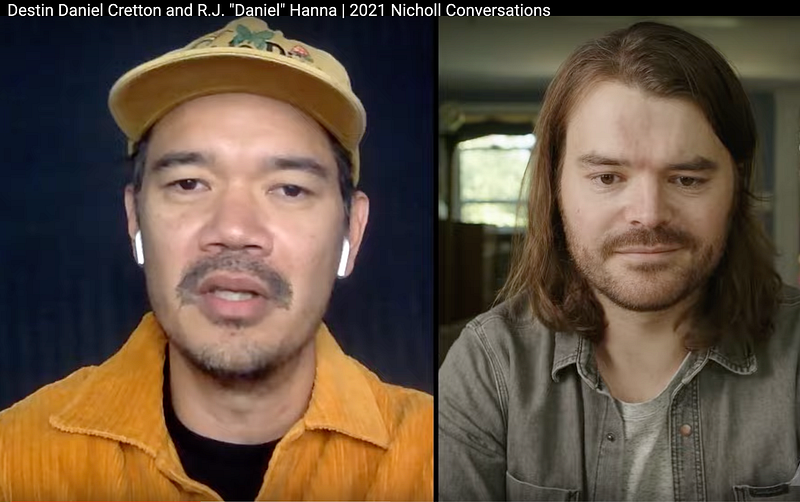
Here is Daniel’s conversation with screenwriter and director Destin Daniel Cretton whose screenwriting credits include I Am Not a Hipster, Short Term 12, The Glass Castle, Just Mercy, and Shang-Chi and the Legend of the Ten Rings.
Tomorrow in Part 5, Daniel shares his thoughts about having been selected for a Nicholl Fellowship in Screenwriting and the short film Shelter, which he wrote and directed.
For Part 1 of the interview, go here.
For Part 2, go here.
For Part 3, go here.
For my interviews with every Nicholl Fellowships in Screenwriting winner since 2012, go here.
For my interviews with Black List writers, go here.