Interview (Part 4): Colton Childs
My interview with the 2024 Nicholl Fellowships in Screenwriting winner.
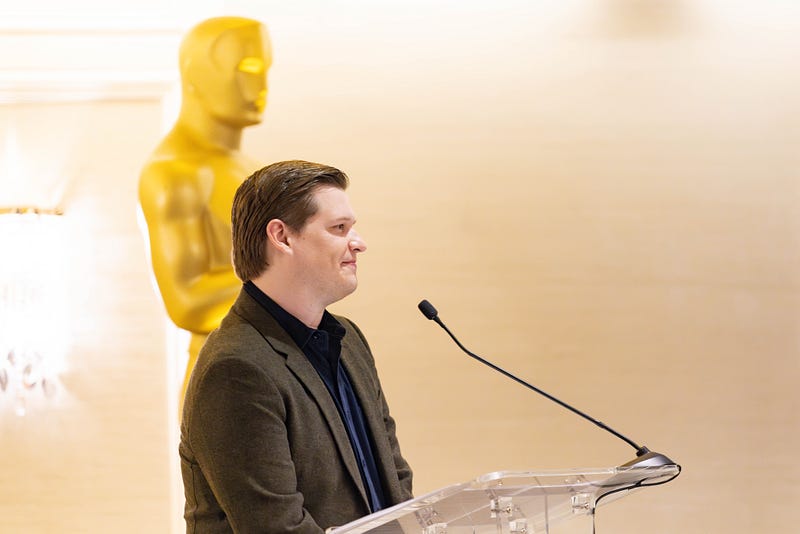
My interview with the 2024 Nicholl Fellowships in Screenwriting winner.
Colton Childs wrote the original screenplay “Fake-A-Wish” which won a 2024 Nicholl Fellowship in Screenwriting. Recently, I had the opportunity to chat with Colton about his creative background, his award-winning script, the craft of screenwriting, and what winning the Nicholl has meant to him.
Today in Part 4 of a 6-part series to run each day through Saturday, Colton talks about how he incorporated some pivotal setups and payoffs into the script.
Scott: On the road, they visit various places. There’s a bug museum, a Waffle House, they go to the Grand Canyon. And that’s where they have the aforementioned discussion about God. You can understand why Noah would be having a pretty negative attitude about religion in general.
Then Cliff, you’d think may be aligning with that, but he has some interesting ideas. On 53, he says, “Even if we’re all molecules and there’s no rhyme or reason to any of it, there’s something holy about simply being a person in the world.”
Could you describe what sort of theosophy, or philosophy, or theology that’s going on there in contrast to Noah?
Colton: I think for Noah, it’s hard to imagine a spiritual worldview beyond the confines of the religion that scarred him. Whereas, Cliff’s perspective has been shaped by a lifetime of experience. He’s not concerned with needing the answers. Believing in something is enough.
Scott: Up to this point, essentially the midpoint of the story, we do have the Cliff as Gandalf, the gay mentor guy. There’s a story that comes out about, I think it’s his dearest friend, Shelley …
Colton: Yes.
Scott: … who passed away. When you talk about shame, that seems to be a key point of where that is for Cliff. What was going on there with he and Shelley, and why there is some shame associated with that?
Colton: There’s a brief flashback where Cliff’s mother tries to silence him while he’s singing with the church choir. We’re witnessing the first time he sees himself not fitting into the world around him.
Decades later, his best friend Shelley, who was also undergoing cancer treatment, asked Cliff to sing at her memorial before she passed. He chose not to sing, and that decision still haunts him.
So there’s a connection to singing and being seen, as well as to a friendship marked by unkept promises, which makes his dynamic with Noah a bit tender. It’s not so much about Cliff rewriting history, but about getting another chance to get it right.
Scott: He’s in a bar on karaoke night. Signs up, but cannot bring himself to sing.
Colton: Not even in a room full of drunken people who won’t remember it.
Scott: That association with Shelley, and then that memory that he has from his mother quieting him when he’s singing. Meanwhile, Noah’s off with this guy that he’s met and having a very vibrant sexual experience. Jace, is that his name?
Colton: Jace.
Scott: Jace. There’s a really nice little crosscut you do there contrasting the moods. Soon thereafter, they end up at Noah’s ex-boyfriend’s party. I suppose I won’t give it away. But eventually Cliff does get to go and see the Gay Men’s Chorus. The description there is quite touching. Is it fair to say that by experiencing that, that enabled him to do what he does later, where he gets up and sings?
Colton: I think so. I wanted that scene to have a sweetness to it, because Cliff is finally seeing these men sing together. But I also wanted to capture the sadness. As fulfilling as it is, Cliff is watching other gay men live out his dream, knowing he’ll never have that. But you’re right — experiencing that concert and growing closer to Noah finally enables Cliff to sing on his own terms.
Scott: It turns out Noah has lied to his mother, not revealing the truth about the cancer. She’s been led to believe that he’s cancer-free. Close to the end of the journey, Noah has a phone conversation with his mother where he does tell her the truth. What was that like writing that scene when he’s sharing that with his mom?
Colton: There’s a line Noah has at one point, Cliff asks, “Why haven’t you told her?” Noah says something like, “I don’t want to be the reason she loses her faith.”
I was drawn to the idea of Noah harboring so much resentment for the religion he was raised in and his mom’s beliefs, yet still not wanting to be the reason she abandons them.
That scene with Carrie and Noah was one of the last scenes I wrote. It was tough, but also a relief for them to finally have a real, honest conversation. They’re the only two characters in the script who hadn’t had that, so writing that moment felt gratifying.
Scott: There’s this whole little subplot with the mom and cookies she’s baking …
Colton: I know. Those damn cookies.
Scott: Those cookies. After that conversation with Noah, she ends up sharing them with her mother after keeping them away up to that point.
Colton: Nana finally gets a cookie.
Scott: It’s symbolic of a little bit of movement forward on her part. Then there’s a wonderful setup and payoff we’ve reached. We referenced it earlier. The same bar where Cliff had not been able to perform at karaoke night, they stop there on the way back home.
It’s not karaoke night. Same bartender, very nice guy. That character is terrific. But Noah gets to see Jace again. As it turns out, Jace is a musician. The fates have aligned. This time, they do an ad hoc karaoke thing just for Cliff, and he gets up to sing.
I sure hope you can get the rights to “Dancing Queen” by ABBA because it’s such a perfect song in that moment. It’s just perfect. Could you talk about writing that and conceiving that whole scene, and how that’s a payoff for Cliff?
Colton: I always knew we were going to see Cliff sing, but I wasn’t sure where or how. I kept feeling drawn back to that bar, and I wanted to bring back Jace’s character, since he’s a regular there. It just felt right, and Cliff deserved his moment. Noah has his moment on the beach a few scenes prior, where he finally lets go of everything he’s been holding onto. It was always clear that Cliff needed a similar moment, in his own way.
Music plays an important role in the film, which I think will be even clearer if, and when, the film gets made. You can’t have a road trip movie without those needle drops. I don’t remember when exactly “Dancing Queen” clicked, but I was going through a bunch of seventies playlists and happened upon an ABBA track.
Tomorrow in Part 5, Colton shares what the Nicholl-winning experience has been like.
For Part 1, go here.
Part 2, here.
Part 3, here.
Colton is repped by 42 Management & Production.
For my interviews with every Nicholl Fellowships in Screenwriting winner since 2012, go here.