Interview (Part 4): Charmaine Colina
My interview with the 2024 Nicholl Fellowships in Screenwriting winner.
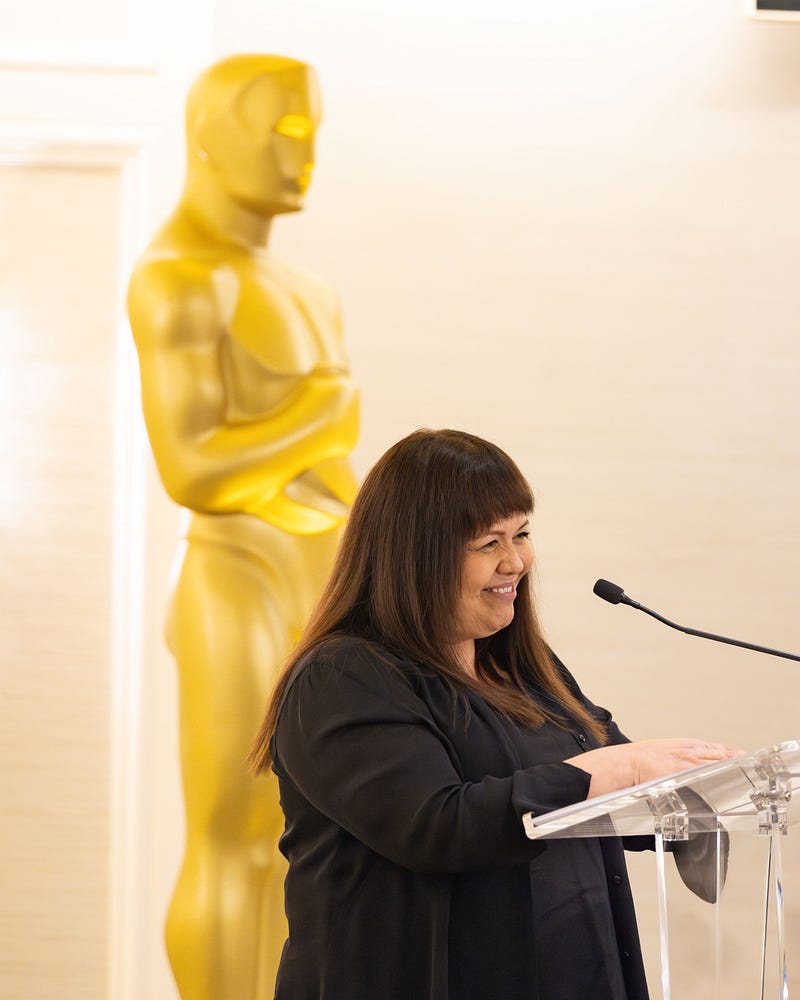
My interview with the 2024 Nicholl Fellowships in Screenwriting winner.
Charmaine Colina wrote the original screenplay “Gunslinger Bride” which won a 2024 Nicholl Fellowship in Screenwriting. Recently, I had the opportunity to chat with Charmaine about her creative background, her award-winning script, the craft of screenwriting, and what winning the Nicholl has meant to her.
Today in Part 4 of a 6-part series to run each day through Saturday, Charmaine discusses some of the key characters in “Gunslinger Bride” and how they emerged into being.
Scott: How that happens is she dresses like a guy, primarily because I said she’s grown up with it. But then fate intervenes as stories will do. She ends up in this little town called Salvation. That was the name of your TV version of it, right?
Charmaine: Yes. Welcome to Salvation.
Scott: Of course, which seems pretty intentional, that choice of a name.
Charmaine: Yeah.
Scott: She’s in a hotel room and she finds a valise with the women’s clothing in it. And because there’s this pressure, and she’s seen this guy Thorne around, she dresses up as a woman. And that leads to a mistaken identity, a big twist in the story. Could you talk about that shift there.
Charmaine: Yeah, the yellow bonnet. She’s thinking she’s going to wear this outfit so no one will recognize her as Kiwa-ku, the wanted bandit. On her way to the farrier to get her horse, she bumps into none other than Thorne. And then here comes a farmer, “Oh, there you are in your yellow bonnet.”
It was one of those things where Lou just did what she had to do in the moment. She pretends to be Kate Reilly and then gets embroiled in this mail-order bride situation. Yeah, there is a lot of fate, or maybe a lot of chance there, but the older I get, the more I realize those things really do happen in life.
Scott: Absolutely. I have a question I always ask the very first time I work with students when they’re prepping a story, we work on the Protagonist. And the last question in this little treatment I have them work on is: Why does this story have to happen to this character at this time?
That gives you a little bit more understanding of how fate can intervene, because it’s like this is what’s got to happen, and so the story takes a big shift. You’ve been,” OK, I’m thinking, it’s John Wick or Unforgiven, a revenge story, but now all of a sudden, it also becomes Mistaken Identity.
She’s a mail‑order bride taken out to this guy who’s got his own homestead and he’s got, I think, three kids if I remember correctly. Is that right?
Charmaine: Yes.
Scott: Was that always in mind that you were going to have this rather domestic type of situation for a majority of Act Two?
Charmaine: I would say that I wanted her to be embroiled in the mail‑order bride situation. In history, we learn about the women who came out West for opportunities, men put ads in the newspaper. There’s a great story called “Sarah, Plain and Tall,” by Patricia Maclachlan, that most kids growing up in California read in fourth grade Social Studies about a mail‑order bride.
I wanted Lou to be put in a situation where as a woman, she would be expected to know how to do certain things, but because she was raised as a boy and lived on the trail, she has no clue.
At first there weren’t any kids, it was just her and Seth. But then I thought for her emotional journey, she needed to see herself in these children because her development was arrested pretty much at nine years old. That’s when she stops being a child.
Her family is killed, she’s taught how to shoot guns, she has to hide who she is, she’s always hiding who she is. Now Lou is in this situation where there’s this Pinkerton guy poking around town and she needs to get away quickly so she goes along with the mail-order ruse for what she thinks will be a few minutes. But that’s when she has the encounter with a man with scars on the back of his head.
She’s thinking she could go guns blazing, but then what would happen? Thorne would probably shoot her, it would end horribly. So she’s got to do this in a clever way, plus there’s the promise that she made to Jeb that she would never take the life of an innocent man. She’s got to scope out her leads and find out all she can before she takes someone’s life.
I think that’s where it differs in other Westerns where it’s like, oh, I think that’s the guy who shot my dog and then just kill that person. Lou has to be absolutely certain. So pretending to be Kate Reilly is a cover. It’s like, “I’ll lay low. I’ll just take care of these kids for a couple days, figure this thing out and move on,” but then it doesn’t happen that way. She gets stuck there and her heart starts to change.
Scott: That’s an interesting twist. I was comparing it to True Grit particularly. I love the book and then also the Coen brothers version of it.
Charmaine: I love that one.
Scott: Because it is a road picture. I mean, they’re on the road, but there is this domestic type of thing going on between she and Rooster Cogburn where he becomes a Mentor father figure. Lou’s got all that stuff going on here because the character who she thinks is a bad guy, Brooks Haney, actually turns out to be the mayor of the town.
Charmaine: Yes, and he’s a grandfather to Seth’s kids. Let’s just throw some more guilt on there. Is she really going to kill Grandpa?
Scott: Exactly. Father of this guy Seth, the groom to be. He had no knowledge of this. It’s something orchestrated by a character named Arnie.
Charmaine: His best friend, Arnie, sets the whole thing up. The whole town kind of knows, and he’s writing the letters to the mail-order bride, pretending he’s Seth. That’s when Arnie brings Lou to the farm. He tells Seth, “ Remember that girl I told you about?” And Seth says, “Yeah, one of your drunken ideas.” She’s here now.
You could just imagine a pair of best friend guys, one thinking this is what my best friend really needs and the other one’s like, no, I don’t need this. But then the best friend goes and does it behind his back. That’s how I see their relationship. Arnie has a heart of gold, but he does overstep his boundaries.
Scott: Yeah, and he suffered a loss himself.
Charmaine: Seth lost his wife, we find out later.
Scott: He’s got a drinking issue, that’s one of the ways that he’s been dealing with that too. So you’ve got this really interesting…they talk about post‑modern filmmaking. Tarantino does a lot of these mixing of genres.
You’ve got the Western, you got a classic sort of revenge type Western, but then you’ve also got this thing that if you just described it, a mail‑order bride and this was set up by somebody else, it’s almost like a romantic comedy.
Charmaine: Yes, it almost feels like a rom‑com in some ways. While I thought that this was a detriment to the script, like, oh, these are kind of like all these genres I’m mixing, the reaction that I’ve gotten is that’s what people like about it. We think it’s one thing, but then it’s also this, but it’s also something else.
It sort of kept the storytelling a little fresh because you think it’s going one way and then it doesn’t go that way. The story was influenced by so many things. There’s almost a little bit of an “Overboard” situation, the Goldie Hawn and Kurt Russell movie.
Now Lou’s got to deal with this guy who’s grumpy and who he treats women horribly, and yet he has a daughter himself, and a young son, and a toddler. And Lou sees her siblings — the ones she lost — and herself in Seth’s kids. I didn’t even realize this until after I had finished the first draft. It’s funny the things that you don’t see as you’re writing it.
It was like oh, oh my gosh, those three children, they are a parallel to her, her brother, and then the baby that was never born because her mother was pregnant when she was killed.
Scott: That’s one of those cases where probably your subconscious took you into an area of the story that only later you realized …
Charmaine: Yes, it was. I didn’t even see it until much later.
Tomorrow in Part 5, Charmaine talks about her experience as a Nicholl-winning screenwriter..
For Part 1, go here.
Part 2, here.
Part 3, here.
For my interviews with every Nicholl Fellowships in Screenwriting winner since 2012, go here.