Interview (Part 4): Charlie Wachtel and David Rabinowitz
My conversation with the co-writers of the movie BlacKkKlansman.
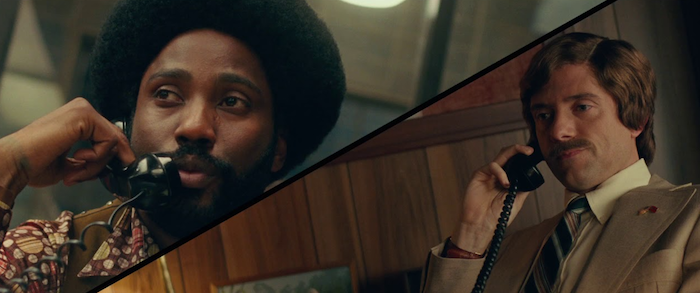
My conversation with the co-writers of the movie BlacKkKlansman.
The provocative movie BlacKkKlansman opens in North America this weekend. Directed by Spike Lee and starring John David Washington and Adam Driver, it was originated and co-written by screenwriters Charlie Wachtel and David Rabinowitz.
Today in Part 4 of my five-part series interview, Charlie and David talk about the surreal experience of stumbling upon the real-life story which led them to write BlacKkKlansman, attending the movie’s premiere, then watching as the movie has been receiving glowing reviews from film critics.
Scott: You mentioned Spike Lee. Of course, he did direct it. What was that collaboration like?
David: In September of 2016, we had a meeting with QC and Jordan. Jordan gave us notes. This was before Spike Lee was involved. Based on the notes that Jordan gave us, we did a rewrite. Then, five months later, Get Out came out.
Everything changed. Jordan’s on top of the world. QC’s on top of the world. Blumhouse ended up getting involved. Suddenly, they went out to a list of directors. Spike was among them. He said yes. Then when Spike came aboard, he and Kevin Willmott did their pass on the script.
Charlie: We handed them the baton, and they took it from there.
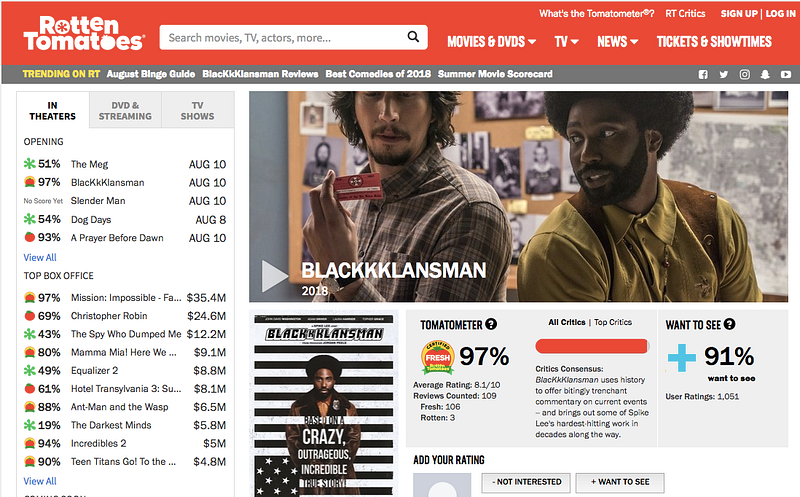
Scott: There’s so many things that can go wrong in making a movie. With BlacKkKlansman, it seems like most things went right, as critics love it. Here are comments from two of my favorite critics. David Ehrlich at IndieWire says, “If the Birth of a Nation was history written with lightning, BlacKkKlansman is a roll of thunder we’ve been waiting for ever since.”
Bilge Ebiri at Village Voice says, “I don’t know that I’ve ever seen a movie exploit its total mismatches so voraciously and purposely.” What’s it like for you to hear reviews like that about a movie you originated and cowrote?
Charlie: It’s a little bit surreal. Every morning, I think we’re still pinching ourselves. When we were at the Cannes Film Festival, we started seeing the reviews roll in, in Rotten Tomatoes at the afterparty. One by one, they were just overwhelmingly positive. It’s a good feeling. [laughs]
David: Yeah, it’s pretty crazy. I’m trying not to read the reviews, but I am. I’m reading every single one. I probably shouldn’t, but I can’t help myself.
Scott: Well, when they’re almost universally positive…
David: It is helpful, yeah.
Scott: Let’s settle in that a little bit more just for purposes of the readers who are enjoying this. You have that moment at Cannes. You’re sitting there at the audience for the premiere, right?
David: Yes.
Scott: OK, so there’s that. Now, I want you to transport yourself back in time to that first conversation. Charlie, were you the one that discovered it on Facebook?
Charlie: Yes.
Scott: The first conversation you had with David, “Hey, I think this could be a movie,” the distance between those two moments, what does that make you think or feel?
Charlie: Whew. Combination of lucky and, I don’t know, speechless, I guess.
David: It’s just really insane. One thing I would like to say is that I don’t know if you always see this in reading interviews with writers who have had something good happen to them — I want to emphasize how crazy this is for us. We didn’t expect this to happen.
It hasn’t really sunk in yet. By the way, one of the first conversations we had about writing this, we joked that Spike Lee was going to direct it.
Scott: I think most people are saying it’s his most successful venture since Inside Job.
David: Yeah. We’ll see how it does when it comes out and what people’s reactions are, but that’s great.
Scott: Well, what’s next for you?
Charlie: Next for us? It’s funny. Since Cannes, and before Cannes even, but since Cannes especially, we’ve been taking so many meetings. Especially after Cannes because we were pitching something new. The new thing we were pitching is an adaptation of this book, “Animal” by Casey Sherman, who did “The Finest Hours.”
We pitched to 35 different companies. Then we just concluded our final rounds pitching to studios a couple weeks ago. We’re done. We’re finally done. Now, we’re ready to embark on the writing process again. We’re working on two things at once, one which is that adaptation.
Just to, I guess, give you some more context, it’s about a Boston mobster in 1960’s New England who decides to testify against the mob. He becomes the first person in American history to be put in witness protection, into a program.
David: In the modern Witness Protection Program. Our take on it is that it’s less of a biopic and more of an action-thriller take on a true story.
Charlie: The other thing we’re working on right now is a TV pilot through some independent producers and financiers which is about Operation Mongoose. In case you don’t know, it’s a CIA secret operation in 1959, once Fidel Castro seized power, which was to attempt to assassinate him. It lasted eight presidential administrations and 638 failed assassination attempts. We think there’s a show there.
Scott: Maybe 638 episodes?
Charlie: Yeah, right. That was the first thought.
[laughter]
Scott: I follow spec script deals and, generally, the acquisition and development scene in Hollywood. I’ve been at this since 1987 and been following it pretty much ever since. Dramas were never anywhere near the top of the charts for spec script deals, but the last three years, it’s been the number one genre. Also we see it on the annual Black List. Some of the top scripts there the last several years are historically based dramas. What do you think is going on there?
Charlie: I think IP has a lot to do with it. Everyone wants to get their hands on something that is either a true story or a known property. This allows executives in Hollywood to hedge risk and what better way to do that than through a piece of history?
David: It’s also a marketing angle, based on a true story. For some reason, with audiences, it feels like that carries more weight these days.
Scott: Yeah, I think you’re right. Those are both absolutely part of the thing. That pre-branded entertainment that minimizes the risk level and maximizes the marketing component. I’m wondering, too, whether it’s a generational thing. We now have the first generation that’s grown up around so-called reality TV and they’re used to seeing real people on screen. Perhaps that has some sort of bleed-over effect.
David: That’s a good point. I haven’t really thought about that, but you might have something there.
Charlie: At the same time, I think also the expansion of the best picture nomination category to somewhere around between 8 and 10, I think it is, every year now, a lot of those films that are chosen are the so-called prestige films and films that are often rooted in history, especially the dramas. That’s always going to be a big target for the Academy.
Scott: If you mix the historical drama with this insane appetite for nostalgia that we see now, it’s not surprising to see scripts like “Bubbles,” the script about Michael Jackson told from the perspective of his monkey or the one about Madonna, “Blonde Ambition,” the more recent characters that Millennials may relate to…
Charlie: Pixels or Wreck it Ralph.
Scott: Exactly. That’s my theory. There’s a new four quadrant theory working in Hollywood. I call it FINS Franchise, International, Nostalgia, and Spectacle. Okay, enough Hollywood navel-gazing. How about some screenwriting craft questions for you.
Charlie: Sure.
Scott: Apart from spending time on Facebook clicking away, how do you come up with story ideas?
Charlie: How do we come up with story ideas, Dave?
[laughter]
David: It’s funny. The position we’re in right now is we haven’t had to necessarily recently come up with story ideas because there’s been so much stuff sent our way. It’s more about figuring out how we would tackle things.
Charlie: At the same time, something we’ve also learned over the past year is our probability of either making a sale or convincing someone to develop a concept. The idea is going to usually have to be originating from ourselves. That’s our best bet.
A lot of these other things that are being thrown our way, they’re having trouble finding writers for a very specific reason. It’s usually because the story isn’t so fresh or it’s difficult to take a unique angle on the story. Any number of those things.
David: I would say that the stuff that we’ve done that’s originated from ourselves, it’s not like we sat around kicking around ideas one day. I think these things, you’re open to them. If something occurs to you, you just log it. For every one thing that we want to pursue, there’s 200 things that we had an idea about and one or both of us were like, “This is not worth pursuing.”
Scott: I always tell writers that they should be looking for, conscious of, at least have one track of the brain every day about story possibilities. It’s just like Linus Pauling, the only guy to win two Nobel prizes for science. He said, “The best way to come up with a good idea is to have a lot of ideas.”
David: Exactly.
Tomorrow in Part 5, Charlie and David answer some of my questions about the craft of screenwriting.
For Part 1 of the interview, go here.
Part 2, here.
Part 3, here.
Twitter: @therealcwach, @BlacKkKlansman.
For 100s more Go Into The Story interviews with screenwriters, TV writers, producers, filmmakers, and industry insiders, go here.