Interview (Part 4): Byron Hamel
My interview with the 2021 Nicholl Fellowships in Screenwriting winner.
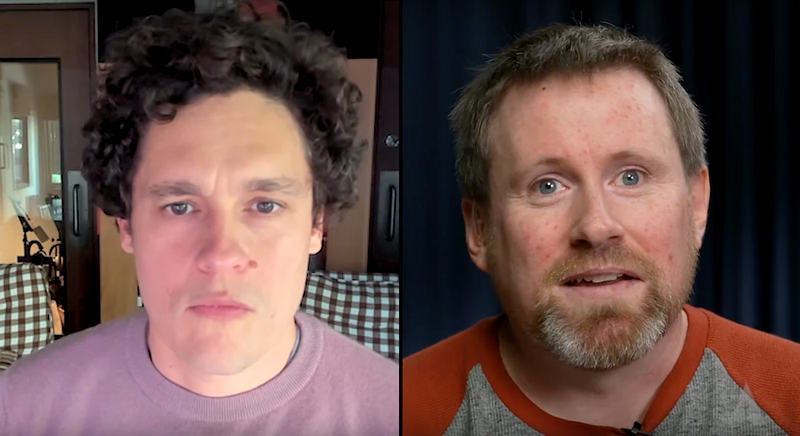
My interview with the 2021 Nicholl Fellowships in Screenwriting winner.
Byron Hamel wrote the original screenplay “Shade of the Grapefruit Tree” which won a 2021 Nicholl Fellowship in Screenwriting. Recently, I had the opportunity to chat with Byron about his creative background, his award-winning script, the craft of screenwriting, and what winning the Nicholl Award has meant to him.
Today in Part 4 of a 6 part series to run each day through Saturday, Byron discusses the role of robots as a central narrative element in his Nicholl-winning script.
Scott: I’d like to talk about this Felicia character. I found her quite engaging. I was so happy that Jamie found her because I felt like here’s a mentor, at least someone that could see this kid, not only taking care of them in the grapefruit way of sustenance, but also in the shade way providing some protection.
At first, more intellectual to engage him to think beyond himself, and this whole thing about science fiction, but she’s such an engaging character because she’s got her own backstory, too. I thought this was intriguing, this robots thing. She says:
“For starters, you got the three laws of robotics, and the first one, don’t hurt people.”
And I thought, “Wow.” If you look at that in terms of Jamie’s life experience, that is a wholly different meaning than what you would write. Maybe we could start there and talk about the robotics in having multiple layers of meaning in regard to Jamie’s life.
Byron: Jamie is me. And the laws of robotics have been important to me in regard to my life because I want to beat the violence. I don’t want to be a violent person, but I recognize that I am programmed to be one. I was raised by a child murderer. A brutal one. But I always considered people who are violent in practice to be inferior beings. Unless their goal is protection.
I’m a martial artist. I love martial arts, and I love fighting in an appropriate place. Because I am naturally violent and violent by conditioning. That can be a beautiful quality when used wisely. My kids and girlfriend feel very safe around me, for example, because anybody who wants to hurt them will have to go through me, and they know that I’ll die for them, but that I’m skilled enough to avoid dying. Protecting them is not even a choice for me. They come first. In that way, my violence is beautiful to me. I have rewritten this horrific thing that happened to me into a code that is beautiful for others using the laws of robotics.
When you’re in a dojo training, or when you are with a master ‑‑ sensei, Shifu, whoever you’re with ‑‑ who is wise in martial arts, they will tell you that the whole purpose is internal. It is to find your confidence and your mastery of self. It is to discover your inherent qualities and to understand their practical use, often in service to others. It is essential to avoid conflict whenever possible. A confident person will not seek conflict unless there is a wise and important war to wage.
And that’s in part the first law of robotics. I can’t harm those I love, nor allow those I love to come to harm through my inaction. It becomes unacceptable then for me to not be a practitioner of martial arts, so that I may better serve them. I should also become certified in first aid. It becomes important for me to care for my body, so that I can continue to be there for them, and so forth. I consider myself their robot.
Another law is that I have to serve them. So it becomes imperative, given my skill and talent in writing, that I do things like win the Nicholl and win at life in general for them.
There are also benefits for me, apart from their love. Personal satisfaction, affirmation for my existence, quality of life… Remember, I entirely based the character Jamie on myself as a child, but also gave him a circumstance where he was more formally introduced to the laws of robotics and their implication in that time, so that in the story you can watch him grow into a hero.
The character Felicia is like his sensei. She is the master of “the way of the robot,” if you will. Let’s call it “Robo-Do” She has to have her own life. It has to be a full life. She has to have her own wants and desires outside of the protagonist. They have to disagree on some things. She has to lose and win and be a complete person. And I’d be remiss not to mention how horrible of me it would be to write a Black woman who exists only in servitude to a White boy with problems.
And a baffling wisdom of this Robo-Do is imperative for her. She is a moral leader. When I first learned about the laws of robotics, I looked at them as almost a religion. Asimov was basing his laws on human ethics too, with the premise that humans would have used them to create the laws. Ethics which in large part are taken from many global religions. Serve others. That’s the golden rule. Treat your neighbor as you would yourself, or better. Don’t harm yourself. Stand up for what is right. Protect the innocent. Cultivate a better world through service. These are ideals humans believe in but do not uphold. Robots uphold them. For both humans and robots, corruption is inevitable as their existences become more complex.
Part of this is leadership. Who is leading you? Who has programmed you? This makes Felicia’s leadership even more important to Jamie, because the option she gives him lets him re-write the core of his programming. Love mode: On. Choosing the right path and avoiding corruption are core to the story of Jamie, and what the laws of robotics mean to his character. But he can’t make the choice without knowing the choice exists. Felicia hacks the Matrix, so to speak. And knowing one can choose rational thought is the core of the divide between the educated and the undereducated as well. Obviously, there is a lot to unpack here.
But I didn’t want the writing to be too intellectual either. The movie is not for smart people. It’s pretty black and white in concept. On or off? What’s it gonna be? I wanted it to be gripping and visceral. Felt. Loved. Angering. So this intellectual stuff to me is stuff I needed to make into subtext using character qualities. If I left it openly detectable, people would reflexively react against a large part of it and miss the point. So I ask the question simply: “Love mode. On or off, motherfucker? What’s it gonna be?”
Scott: You mentioned earlier about the story where the robot wants to become human, and this is the reverse of that in some respects. There’s a real structural flow. The story itself is that documentary style, slice‑of‑life type of a feel, but there’s a real structure to the thing.
I wanted to ask you how intentional that was, or whether it was a natural emergence of the story‑crafting process. For example, Act One midpoint, that’s where Felicia begins to watch over Jamie. By the end, he’s truly beginning the robot journey with, “I don’t want to be a person anymore.” Basically, “I want to be robotic.”
Then, by the midpoint, there’s that horrible experience from Augustine, and he’s beginning to transform. He starts to see body parts, imagining like he’s got these robotic limbs, and then by the end, after that major assault, he even has stuff on his arms which make him feel like it.
Was that structural aspect about that flow, because there’s a whole other thing about choice at the very end? Was that flow, was that a natural thing, or were you literally thinking like, “Act One, Act Two, and Act Three?”
Byron: Sure, the structure is entirely intentional, and the shape of the story is intentional.
I borrowed a lot of that tone-switching that I do, where I go from exceptionally violent, horrific cold things to peaceful, beautiful things. I do that a lot in Shade, and I’m borrowing there from Terrence Malick who I love. The Thin Red Line is one of my favorite movies. If you read that script, there is a lot of The Thin Red Line influence in there.
There’s influence from The Terminator, Predator. There’s influence from…Gosh, let me think. [laughs] How many movies went into this? So many nods. The Karate Kid is in there.
Scott: Oh, I had that written down in the script margins.
Byron: She’s my Miyagi, Felicia. A lot of that is what I’ve technically learned about writing and how to build in a story until people just can’t escape, and really reel them in and really give it to them once you got them. Combine that with 100 percent pouring my heart out on the page. The first draft was just puking on the page. It was everything that was a memory.
This took me five months to write. Which is longer than any other script I’ve ever written. That’s because I had to take frequent breaks to ensure the quality of my mental health. I mentioned the PTSD. It makes me very tired to feel strong emotions. And this needed to be recalled and felt fully. The emotion switch was set to “on.” To write this without grounding and taking breaks would have been self-destructive and unfair to my loved ones. I was very careful about being kind to myself. But after that initial push, the shape and structure became entirely intentional.
Scott: As long as we are talking shop, there were some interesting decisions you made as a writer. For example, using voiceover narration. You’ve got Old Jamie reflecting back. Can you talk about the choice of using voiceover narration?
Byron: Hope. I wanted to, right away on page one, say, “This kid survives.” I hate the dread of watching a kid go through that, any kid, and not knowing if he lives. To me, this would be distracting. I know that some people may prefer the thrill of not knowing. And I promise those people that my thriller is coming. But for this story, one of the first and most important aspects was hope for the future. That a good person can find a way if he gets a little help here and there. You can’t keep a good guy down.
As long as people edge toward that and decide that they’re going to be good with their lives, and not let the bad guys train you into being an asshole, then you fucking win.
I’m going to borrow from Melvin van Peebles here, and just say the theme of this fucking story is that I win. It really is. Kids who are abused, we can win. Call me late to the game, and not to be a dick, but look at me now. I won the Nicholl.
[laughter]
Scott: Literally, you won the Nicholl. Let’s talk about another choice you made. These fantasy elements. Apart from the thing where Jamie starts to see himself as a robotic element, but there are these things where he drifts away into this alternate reality.
One of the most violent sequences in the story is followed by this coma journey that he has. Isle of Skye, flying through the air, then brought back. Talk a bit about the fantasy elements. What was the thinking behind that?
Byron: I had this experience one time in my life where I just woke up one morning. And this was during my sober and clean journey to quit drugs, alcohol, and stuff, which I’ve been off of now for almost 28 years. So listen, you could blame acid for this.
But I just had this moment one morning in my late teens, where I saw this color outside my window. It was like overcast‑gray sky. I don’t know how to describe it, but it was every color in the whole fucking world, and then, it was all these colors I’d never seen before. But all at once. Everything and nothing too. Pure zen. Peace and purity. And I lived in that for what felt like an entire lifetime. But maybe minutes later I came back to consciousness. And there has never been any moment in my life where I have felt a greater feeling of truth and comfort.
And I wanted Jamie, after the worst of it to that point of the story, to feel something as kind and soft and full of love as I felt. To know that ultimately, this life is a gift. To know that you could leave but choose to stay. And this spot I put Jamie in, this unknowable truth which you already know to be true, this perfect quality called “goodness,” exists for him. And nothing will keep him from it, even the gift of life as an abused and terrified child in a world full of hatred and humans who behave like deadly viruses.
I have so many unspeakable things to say about why I put that scene in the script. As a writer choice, I was thinking, “How do you communicate that feeling to a production designer other than through poetry?” Tone is so important for this story. And I didn’t want the tone of pure goodness, in a story which essentially takes place in Hell, to be lost. For one, I’ve already seen that. This is new. His entire world is a threat, but he’ll be somehow inexplicably okay.
Here is Byron’s conversation with screenwriter, director, and producer Phil Lord whose screenwriting credits include Cloudy with a Chance of Meatballs, The Lego Movie, and Spider-Man: Into the Spider-Verse.
Tomorrow in Part 5, Byron shares his thoughts on winning the 2021 Nicholl fellowship.
For Part 1, go here.
For Part 2, go here.
For Part 3, go here.
For my interviews with every Nicholl Fellowships in Screenwriting winner since 2012, go here.
For my interviews with Black List writers, go here.