Interview (Part 4): Alysha Chan and David Zarif
My interview with the 2024 Nicholl Fellowships in Screenwriting winners.
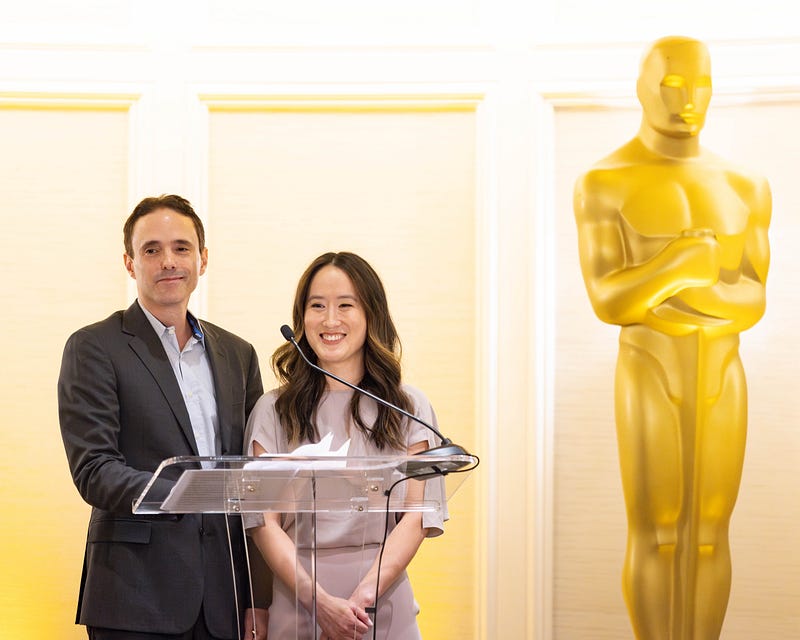
My interview with the 2024 Nicholl Fellowships in Screenwriting winners.
Alysha Chan and David Zarif wrote the original screenplay “Miss Chinatown” which won a 2024 Nicholl Fellowship in Screenwriting. Recently, I had the opportunity to chat with the couple about their creative background, their award-winning script, the craft of screenwriting, and what winning the Nicholl has meant to them.
Today in Part 4 of a 6-part series to run each day through Saturday, Alysha and David discuss how the time-frame of the actual Miss Chinatown competition provided a natural flow for Act Two’s structure.
Scott: Okay, moving into Act Two, Jackie’s got this determination that she’s going to win the Miss Chinatown competition. But she’s just not at all, I guess, you’d call it “girly girl.” She’s an underdog due to her lifestyle of years rebelling against her mother and the pageant mindset.
There’s some other characters that Jackie meets along the way. How about the Ivan character?
Alysha: He’s her best friend, her only friend we see outside of the Miss Chinatown competition. He’s also a skater.
David: He understands her.
Scott: He films her skateboarding
David: He’s her gateway to skater culture, representing everything Jackie’s mother opposes.
Scott: Later on in the script, she ignores his texts while she’s going through the Miss Chinatown process, but then there’s an important part where she finally does reach out and they reconnect — it’s a wonderful little arc between them.
You have this clever construction determining who goes forward in the Miss Chinatown contest: 20 people, cut down to 10, and so on, that helps with the structure of Act Two. Then there are other pageant contestants she meets: Coco, Kim, Fiona, and Mei.
Alysha: One thing I really wanted to emphasize was that beauty shouldn’t be the sole focus of this pageant. When I ran for Miss Chinatown, we were all regular people, and winning wasn’t about being the prettiest — which of course I was. [laughter] I’m kidding. It was about how we performed in various segments, which we tried to portray in the script.
We wanted a hodgepodge group of contestants to show that anyone can try out, so we made them quirky and unique. Kim is Jackie’s best friend in the competition. She’s pure, upbeat, and the glue of any friendship. Conversely, Mei is very shy and softspoken. Then we have Fiona, a bit of a goth girl.
David: We also have the de facto villain, Coco — a career pageant queen, who’s practically unbeatable. She’s Jackie’s nemesis.
Alysha: In addition, I wanted to show that Miss Chinatown is not just about a pageant but also about building camaraderie and learning about the culture.
Scott: It comes across quite well. These characters are all individuals. I love the thing at the end where they all confess the different reasons why they tried out for the Miss Chinatown pageant. Each of the characters is distinct, and the combination of them is quite funny.
I’ve got to talk about someone who isn’t a contestant and that’s Bobby Pan because he’s such a fun character. Was this a guy from your experience, Alysha?
[laughter]
Alysha: No, I wish! When we were writing him, I always envisioned Bowen Yang, who unfortunately isn’t part of my life… yet.
David: He was born out of a need for comic relief, and because this story is set in Los Angeles, we’d be remiss if we didn’t have someone trying to break into the entertainment industry.
Scott: He’s like, “I’ll be here unless I get this next gig,” that LA desperate actor thing, but he’s really quite funny. And again, another character with his own arc. There’s a moment where Jackie says, “I’m kind of glad you didn’t get those gigs because it turns out you’re a pretty good teacher.” Again, I was so impressed with the way you handle each of those individual storylines.
Now let’s talk story structure. I’m imagining if it were me, I’m saying, “Oh, Miss Chinatown, the advantages of this is that you’ve got a time-frame, you’ve got certain things they have to do, you’ve got cutoffs where people are getting eliminated.” That speaks directly to how you can structure Act Two and Act Three. That must have been helpful for you.
David: The competition certainly provides a nice framework with regards to our structure — there’s the training for Miss Chinatown, the desire to improve, and then, of course, the actual pageant at the end.
Scott: I was going to say, because at some point, Jackie’s like, “Oh my God, I can’t just show up. I’ve got to get my act together.” So who does she go to? Her sister Jade because Jade has a YouTube channel where she talks about makeup and fashion.
That’s a great way to bring those two characters together because at first, they’re at sixes and sevens, just significantly different personalities. Could you talk about that makeover sequence and how Jade helps out Jackie?
David: Jade is essential to Jackie’s success, but their relationship is strained by the differing ways they process their mother’s death. Jackie needs to mend their relationship, and in doing so, Jade becomes instrumental in getting Jackie pageant-ready.
Alysha: We wanted to show that Jackie initially struggled with the Miss Chinatown pageant segments, but through the help of her loved ones — Jade, Edwin, and Ivan — she improved and became a serious contender.
Scott: So there’s the makeover sequence with Jade, but then Jackie needs to learn a traditional Chinese dance for the pageant competition. And that leads her back to her father Edwin. He’s been hanging out in the story’s background, caught up in his private grieving about his wife’s death. Could you talk about the subplot of Jackie and Edwin?
Alysha: In earlier drafts, the focus was mostly on Jackie and Annie, but as Jade’s role grew, we realized the story needed to center on the entire family. We gave Edwin a bigger role, including the scene where he teaches Jackie the dance while reminiscing about meeting Annie. That scene always makes me feel both emotional and tickled, imagining him doing those dance moves. It’s what we strive for in our writing: a blend of humor and heart.
Tomorrow in Part 5, David and Alysha talk about their Nicholl experience.
For Part 1, go here.
Part 2, here.
Part 3, here.
For my interviews with every Nicholl Fellowships in Screenwriting winner since 2012, go here.