Interview (Part 4): Allison and Nicolas Buckmelter
My interview with the 2018 Nicholl Fellowships in Screenwriting winners.
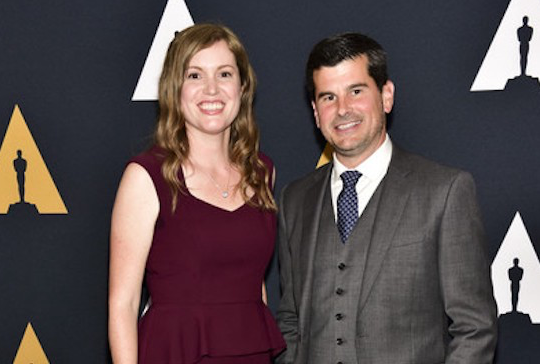
My interview with the 2018 Nicholl Fellowships in Screenwriting winners.
Allison and Nicholas Buckmelter wrote the original screenplay “American Refugee” which won a 2018 Nicholl Fellowship in Screenwriting. Recently, I had the opportunity to chat with the married couple about their backgrounds, their award-winning script, the craft of screenwriting, and what winning the Nicholl has meant to them.
Today in Part 4, Allison and Nicholas delve into the relationship which develops between these two radically divergent families and the impact that has on the individual family members.
Scott: We have this economic collapse that precipitates this deconstruction of the social order. That forces this Morgan family to reach out to these neighbors, who are headed up by this guy, Winter. I guess nowadays they’re called preppers, right?
Allison: Yeah.
Scott: Let’s talk about Winter and that family. You got these two families that live side by side. Winter, his wife, Amber. There’s some others there. Could you maybe describe that family circumstance?
Allison: Yeah. Winter, we imagine he’d be a veteran of the Afghanistan war who’s come back home. He has a unique perspective on government and trusting government. He’s been prepping all these years and he put together this bunker for himself and his girlfriend, who’s pregnant, and his son Matthew.
We did a lot of drafts of this script. In some of the earlier drafts, he’s gone through a whole evolution. He was pretty awful in some earlier drafts. The current draft now, we really like where he landed, where his character landed.
Nicolas: We really wanted to be fair to his perspective. We didn’t want him to be a right‑wing stereotype. We wanted the people who would identify with him to get behind him and be like, “This is our guy.”
Allison: Yeah. I even identify with him sometimes in this script.
Nicolas: I do, too.
Allison: This family, they are freeloaders off of all of the prepping he did.
Nicolas: Off of his hard work.
Allison: There’s a line in the script where he says to Helen, “While you guys were buying wine club memberships, we were clipping coupons for canned food, which you’re now eating.” I relate to that, because we’re not prepping.
[laughter]
Nicolas: We would be relying on somebody who did.
Allison: Yeah. We didn’t want to make him just a 100 percent evil, bad‑guy character. He is that somewhat, but we wanted audiences to empathize with him a little bit.
Scott: That’s that key word ‑‑ empathy.
Nicolas: Yeah.
Scott: You’ve got him for the best nemesis character. It’s just like that quote. I don’t know whoever said it, but, “Even bad guys have moms.”
Nicolas: Yeah.
Allison: Right.
Scott: You got to find some sort of relatability in there, and this is a guy that actually was smart enough in many ways to prepare this family for what he perceived to be, as it turns out, an accurate prediction of what was going to happen.
The thing that struck me about him, the first half of Act Two with Winter’s character, after you get over that initial brusqueness, you open up more his worldview and the utilitarian take that he has on life.
In fact, at one point he says, “Basically, Helen’s of value to me because my girlfriend’s pregnant and she’s an OBGYN, and I don’t see it in you other people.” There’s a certain logic to that.
Nicolas: Yes. On top of that, he does protect all the rest of the family members and Greg’s family at a very key moment, including Kai, who he had some ambivalence about.
Scott: In fact, there’s a conversation after some violent intruders show up. I think that’s what you’re talking about, is when Winter…They all bond together, which is a really interesting idea, and a very helpful one in terms of the story to really help cement them together.
There’s a conversation they have afterwards, because Helen had to resort to violence herself. She says, “I’m no stranger to blood, but out there…I felt like someone else,” talking about the incident that just happened. Winter says, “The first time you take a life, it haunts you. The second time, it thrills you. Eventually, it numbs you.”
Then he says, “Maybe it’s like delivering babies. You do it enough, it gets old.” It’s almost like they’re finding common ground or something that they can relate to. Is that a fair assessment of that?
Nicolas: Yeah, it is. It’s finding common ground philosophically, but also laying the groundwork for a plausible intimacy. With Helen, we were deliberately trying to walk that line between, is she really attracted or is she manipulating him? Where is that line? We wanted to keep the audience guessing on that.
Scott: As much as Greg’s got an arc to get in touch with his alpha male, she has her own arc, in that understanding the fact that they need her because of her being an OBGYN, she does manipulate that situation.
She creates this falsehood that Amber, the girlfriend, needs professional care, at least until the baby’s born. That’s going to buy them some time. Later on, she has an argument with Greg. She says, “Without me, we’d still be out there. I’m the one who’s needed here. It’s time you follow my lead for a change.”
How early in the process or along the way were you working with this idea that both of these characters are going to have their own transformation psychologically?
Nicolas: That’s a great question.
Allison: Pretty early on, because we wanted Greg…His character really changed in all the drafts. Throughout all the drafts, we wanted him to feel like he’s, for the first time, really coming out on top.
It’s ironic, because he’s a Peace and Conflict Studies professor, but he never apologizes to his wife. That’s something he just doesn’t do when they get into arguments, is that he’ll discuss things very reasonably, but he’ll never just own up to his mistakes and say he’s sorry.
At the end, when everything is said and done and it’s the end of Act Three, he finally tells Helen he’s sorry. He’s learned how to take a stand, become an alpha male, and protect his family. Especially in our earlier drafts, that’s what we really wanted, was here’s this guy who’s never had to do that.
Now he’s taken a stand and he’s protecting his loved ones, but he also knows how to admit his mistakes. That’s his arc.
Scott: What about hers?
Allison: With her, in the most recent draft where they’ve come into the bunker with baggage, he’s had an affair and she never really forgave him for that.
Being down in the bunker and getting close with Winter, even though it really was to protect her family, she was trying to do the same thing Greg was, but just in her own way, of having this affair with Winter so that, after his baby was born, her family wouldn’t be kicked out.
Still, Helen trying that on and seeing how it felt, even though she was doing it to protect her family, there was a part of her that was attracted to Winter, that liked that he was so masculine and was that alpha male that Greg wasn’t. There was a part of her that liked that.
Then her trying it on, having this affair that, even though the audience isn’t really sure if it’s genuine or not, she got to see how that felt and how terrible it felt, and then understood where Greg was probably coming from.
Nicolas: Yeah, and we knew early on that, from a story perspective, Helen was going to be the driving force in terms of keeping the family there in the bunker. She had this status, she had the one thing Winter needed. She was able to manipulate the situation to keep that family there.
We knew early on that she was going to probably have to take on that mantle, and so the decision to have Helen come to that conclusion in that line you read about how “It’s my turn to…”
Scott: “To lead.”
Nicolas: “…to lead, for a change.” We knew that point was going to have to be reached, so we were trying to set it up knowing that the switch was going to be flipped, so we were trying to lay the groundwork for that. That was pretty early.
Allison: Yeah. We wanted it where Greg was the one wanting them to go into the bunker, and Helen wasn’t. Then we knew, at some point while they were down there, it would switch, and Greg would want to get them out and Helen would want to stay.
Nicolas: Right.
Scott: It’s a fascinating job of what you did there, because there are a lot of switches, twists and turns, and ticking clocks ‑‑ the pregnancy, the impending birth, and then Winter’s threat, that once the baby’s…they have to leave the compound. In some respects, isn’t this story about connection, community, looking at the other, that sort of thing?
Nicolas: We ultimately saw this as a story of two families who have to depend on each other, or it’s over for everybody. We were just looking, as we spoke of earlier, at these families as a microcosm for the deep divide that we’re seeing in our country.
We just wanted to put these characters in that situation and see how it would play out. We knew, ultimately, that it wasn’t going to be one person’s ideology triumphing over the other. It was going to be this unusual melding of ideas, skills, learning experiences, and all the messy stuff that happens when there’s major disagreement on the process of enduring together.
We had that in mind, and that’s what we were shooting for.
Tomorrow in Part 5, Allison and Nicholas talk about the Nicholl experience and share some screenwriting craft tips.
For Part 1 of the interview, go here.
Part 2, here.
Part 3, here.
For my interviews with every Nicholl Fellowships in Screenwriting winners since 2012, go here.
For my interviews with 53 Black List writers, go here.