Interview (Part 4): Aaron Chung
My interview with the 2019 Nicholl Fellowships in Screenwriting winner.
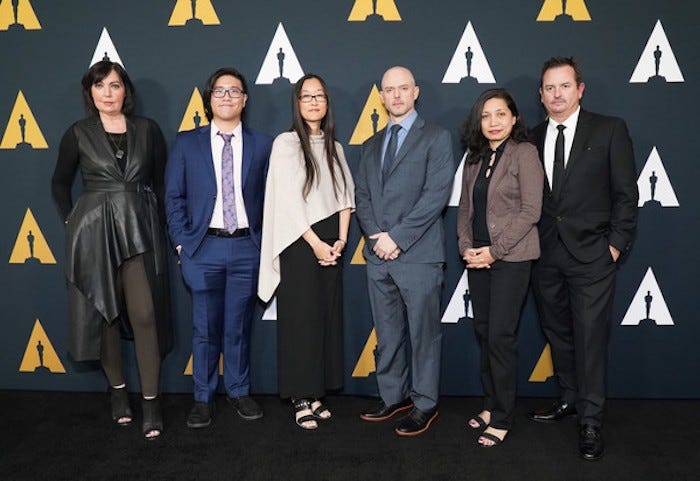
My interview with the 2019 Nicholl Fellowships in Screenwriting winner.
Aaron Chung wrote the original screenplay “Princess Vietnam” which won a 2019 Nicholl Fellowship in Screenwriting. Recently, I had the opportunity to chat with Aaron about his background as a screenwriter, his award-winning script, the craft of screenwriting, and what winning the Nicholl Award has meant to him.
Today in Part 4 of a 6 part series to run each day through Saturday, Aaron and I talk about the role of stories within the story of “Princess Vietnam” and its theme of empathy.
Scott: That brings me to something I saw was a central theme running through your script: the power of story. This script, it not only tells a story, but it’s a story about stories. It begins with Aisling in voice‑over asking someone, who turns out to be Fable, about a story that Fable had told Aisling.
Later on, we see Fable’s drawn to the book “The Lord of the Rings.” Aisling’s drawn to a comic book collection and superheroes, so that’s a story world. You’ve got the animation sequences. There were two locations that were featured in the script that are involving story universes.
There’s A Bookshelf, which is a bookstore, and The Ironside Theater, which features movies. That’s where Maude and Aisling work. They see a Charles Bronson movie that has an interesting impact on them. Indeed, the protagonist is named Fable which is, of course, a kind of story.
There’s also the stories the characters tell and have told about each other. Some of them, as you noted upfront, particularly with regard to Fable, she’s going to have to unpack the story in order to see someone differently, that stories can distort the perception.
The story about stories, I thought that there were these two counterpoint themes here. Stories have the power to inspire, and empower, and awaken one’s imaginations and new possibilities, but they also have the power to ensnare one’s beliefs, and faults, and narratives. Does any of that resonate with you?
Aaron: Yeah. Stories are one of those rare universal languages that anyone in any culture or any language can latch onto. Like I said earlier in the interview, I held onto stories. I was surrounded by stories.
I was surrounded by family memories, and television shows, and movies, and novels, and comics, and video games, and all sorts of different stories that I keep obsessing, and loving, and fantasizing about. It is also like you said, that this ensnaring oneself into a story can also be dangerous because you’re trying to live out something that has dire consequences.
That’s what happens when Aisling lashes out and burns Eric’s car. There was a severe consequence to that. It’s not like a fantasy world where there are villains who need to be defeated. Now it keeps going. It’s a cycle. That’s what real life is like. To me, the parallel story, when done correctly, ignites everyone more than ensnare or divide.
Scott: I won’t give away the ending, which is quite moving and is a story, itself, and involves a character telling another character a story which becomes not another animation sequence. It’s more realistic. It’s kind of a grounded fantasy. It’s very effective.
How did that ending emerge in your creative process? Did you always have that in mind, or was it something that grew as you were working with the characters?
Aaron: Without giving away too much, I would say that I always had the ending in mind when I first started. I always try to approach projects with a definite way to end it. With this one, I knew that I needed to have that ending where, yes, it did end on one last story. It was a very loving, affectionate, vulnerable story to show the growth of one of the characters but to also inspire hope.
Scott: You mentioned one of these things that happened with Fable toward the end that marked her transformation. I’d like to circle back to that comment again that you made at the Nicholl ceremony. “We have this amazing superpower to empathize, connect, and understand each other in ways no other living creatures can.”
Fable has series of these breakthroughs and what she sees other characters in a different light. The first is an interchange with Aisling’s father, Bill, who earlier had been…He was in Vietnam. He’s essentially a racist toward people from Vietnam. Of course, that was directed as a threat in a way to Fable.
You write in the script, when Fable intersects with him at some point late in the story, Fable lowers her guard. He isn’t some monster, just a pitiful man clawing for his last thread of human connection.
Then with Eric, who would earlier had tormented her and just generally bullied her, there’s a moment where in the scene description, you say, “Just like Bill, Fable really sees what Eric is, a rotten little boy who sorely misses his father.”
Then finally, the one you mentioned earlier, she asked her mom to go visit Roger’s grave. She had very complex feelings about this guy because he was a soldier fighting in the side of the United States. Of course, that meant he was killing Vietnamese people.
She’s very emphatically, as you noted, said, “I hate him. I hate him,” earlier. Then she has this wonderful monologue. I just want to excerpt part of this here. She’s talking to Roger in the grave.
“The truth is that I don’t want to see, but I know I have to, is that you brought us here. You brought a pregnant Vietnamese woman who could barely speak the language right here. And I wanna be thankful. I am. I really, really am. So even though I’ll never say the words ‘I love you,’ I promise I won’t say ‘I hate you’ either because it’s not always one or the other, is it?”
Those three, they do represent her gaining empathy. Isn’t that fair to say?
Aaron: Yeah, that’s very fair to say. The reality is that of these racist people, of the xenophobic, neo‑Nazis that we see even today is that when you boil down to who they are and you look at them, and I mean look at them and what they’re saying, as venomous and as evil as it may be, it’s also sad where they are. It’s very sad.
It always raises my curiosity about these people. How did you get here? What led you to this path? What circumstances made you think this way? That’s the same kind of thoughts and questions that Fable asks herself when she sees this man is, “What happened to you?” Once she starts to figure that out is, “Oh, you’re just sad. You’re broken. You’re miserable.”
Scott: I’m not sure if you’ve ever heard of this Jewish philosopher named Martin Buber. He was German. He wrote a book called “I and Thou.” He talked about the two natures of relationships.
One is an inauthentic relationship where you deal with the other person as an it. It’s an I‑it relationship as opposed to authentic relationship which is I‑you where you recognize the shared humanity of the person. In some respect, that is, in many ways, the arc of these two characters with regard to some of the other relationships they have.
Aaron: Yeah, it’s really interesting. Even Fable, herself, was kind of a hypocrite in that moment, has the I‑it mentality, but she later has to accept the I‑you. I’m not familiar with that book, but I definitely want to check it out.
Tomorrow in Part 5, Aaron recounts what it meant to him to be named a Nicholl Fellow.
Aaron is represented by MGMT.
For Part 1, go here.
For Part 2, here.
For Part 3, here.
For my interviews with every Nicholl Fellowships in Screenwriting winner since 2012, go here.
For my interviews with 53 Black List writers, go here.