Interview (Part 3): Walker McNight
My interview with the 2019 Nicholl Fellowships in Screenwriting winner.
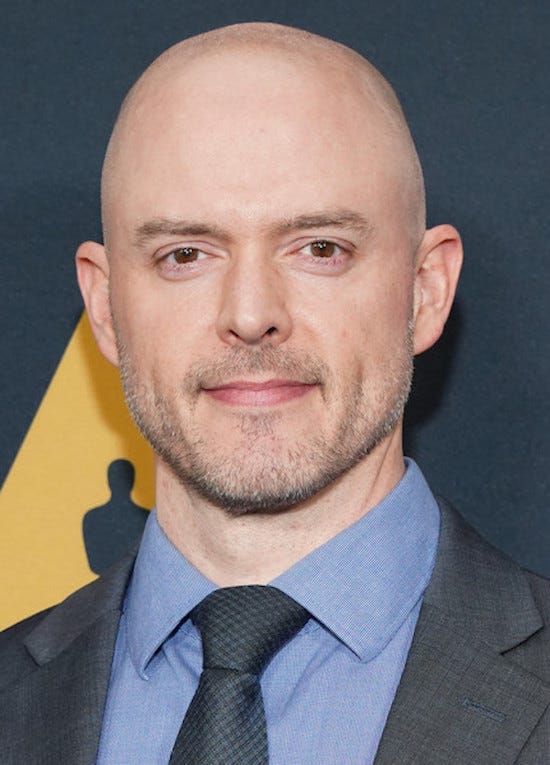
Interview (Part 3): Walker McKnight
My interview with the 2019 Nicholl Fellowships in Screenwriting winner.
Walker McKnight wrote the original screenplay “Street Rat Allie Punches Her Ticket” which won a 2019 Nicholl Fellowship in Screenwriting. Recently, I had the opportunity to chat with Walker about his background, his award-winning script, the craft of screenwriting, and what winning the Nicholl has meant to him.
Today in Part 3 of a 6 part series to run each day through Saturday, Walker discusses the dynamics of the surrogate family of four girls which lies at the heart of the story.
Scott: I know you love science fiction and fantasy. Of course, a big part writing in that space is the world‑building process. That’s what you were just describing in effect.
The idea of things getting progressively worse, I’m curious, was that arising from that learned screenwriter instinct to make things more challenging for the protagonist and the characters there or was that more deriving from your work with the characters, your direct engagement with the primary source material, the characters in the story?
Walker: Both. Once I decided she was part of a gang and she had these other girls, I started imagining that want versus need thing. Or sometimes it’s described as false goal versus true goal. I’ve heard it talked about different ways.
It meant putting Allie in the position of wanting something for herself, which is not wrong for her to do, and yet feeling this crushing pressure to be responsible for these girls and be their protector, even a kind of mother.
If just having enough to eat on a daily basis is a big issue in this place, then Allie having to provide for multiple people is so much more emotionally challenging than just her surviving.
So yes, it was a combination. Make it harder on her but also give her this crushing role and a legitimate reason for wanting to get away, to move on to what she can imagine is a better life.
Scott: They live in this bubble that’s largely inhabited by creatures that are not human. Let’s drill down into some of the humans, this gang of girls. There’s Allie who’s the leader.
What about Moonpie? How would you describe her?
Walker: Moonpie is the second in command of the Rats, but also she’s the one who’s been with Allie longest and who looks up to her the most. She is to Allie what Allie was to Jammer, who’s very briefly in that first scene, the previous leader who left.
In terms of Allie’s evolution, her biggest challenge is to recognize that the same cycle is playing out over again and that she’s got to break that cycle. Jammer, essentially, made the selfish decision to get out once she had the opportunity. She left Allie brokenhearted. Allie survived, rose to the challenge and became the leader that was needed, but only after a lot of pain.
Now, she’s about to do that to Moonpie. They have the closest bond. It’s going to destroy Moonpie the most if Allie leaves.
At midpoint, Allie realizes she can’t abandon them. She’s got to get them all out. But she’s still focused on something that’s ultimately selfish — putting them all in danger to fulfil her dream of getting out.
Whatever happens, it’s going to affect Moonpie the most. Allie’s emotional journey is tied to all of the Rats but it’s closest with Moonpie.
Scott: That’s interesting, your note that, in a way, she’s stuck with this handling of the mantel thing and trying to maybe break that chain.
Two other characters, PushPop, how would you describe her?
Walker: She’s kind of a middle child. She’s almost Guppy’s partner in a way. Guppy’s the only one who is still truly a child. Even though everybody takes care of Guppy, PushPop is Guppy’s right hand.
PushPop is also a visual representation of how tough the world is. She has the eyepatch from the beginning, and I was going for a thing where you wonder, “Maybe it’s just an affectation, a cool gang thing.” And when it’s removed, it’s like, “Oh, she’s literally missing an eye. It’s happened recently, and she and the others have had to deal with it.”
Scott: There’s this group of four, they are scrambling every day to find food. They’re street performers, right, to earn money?
Walker: Street performers and thieves, depending on the situation or the day.
Scott: They live at a place referred to as The Nest, which is this subterranean…this hiding place. You designated it in the scene heading as, “Home Street Home.”
Walker: Yeah.
Scott: I thought that, “Well, that has some thematic meaning,” because the story is about an ad‑hoc family, and trying to, I guess you could say, find a home.
Walker: Totally. I worried about putting Home Street Home only in a slug line and not explaining it. But Beta readers seemed to get it and like it.
Everything about them is constructed or ‘found.’ They’re a found family, it’s a found home, it’s a found little safe‑ish street. Home Street Home, that’s the closest they’ve ever gotten to an actual home.
I loved reading about the mudlark gangs in 19th century London that would troll the shore of the Thames at low tide for anything washed up they could sell. That was their income. They were orphans, living under the bridges and wherever they could. I can’t imagine what they had to do to create a space for themselves. Would they pick a spot and lie in a heap on top of each other at night, or were their territories and living spaces more constructed? Thinking about this kind of thing was part of the inspiration for Home Street Home and the Nest in the sewer.
And on top of just having a home, you’ve got almost literal monsters trolling the streets at night looking for a meal. That was part of the sewer aspect, having a space where they could lock themselves up behind a grate and a chain.
Scott: Let’s talk about some of these colorful characters who are threats. That initial daydream you had with Allie in this room, and being interviewed by some disgusting creature, I’m imagining that’s Big Green…that evolved into Big Green?
Walker: Yep, that survived pretty much intact to a final draft.
Scott: Big Green is the, I guess you’d say, the main nemesis in the story?
Walker: Yeah.
Scott: Describe Big Green for us.
Walker: He’s a gangster. He’s also probably the most biologically extreme of the creatures in the Bubble. Him being a blob who can absorb things is a dab at allegory for how he’s a leech on the city. Of all the criminal bosses, he’s the most powerful, the smartest. He’s stockpiling the food that everybody needs, cornering the market on supply, hoarding the cash.
I guess the name Big Green sounds like a really on-the-nose anti‑capitalist metaphor, but I promise that wasn’t the inspiration for him. But the fact that he’s a big, disgusting blob, he’s shifting, no solid form, hard to pin down, difficult to look at…he’s the worst of all these things you imagine in terms of criminal exploitation of others.
I don’t think of the denizens of the Bubble as aliens. My idea was, and there’s one line in the script about it, is that this is a version of Earth very far on from what we have now, a place in which a wild west of genetic experimentation has produced this massive diversity of crazy creatures. He’s one of the products of that.
Scott: Let’s talk about Cry Baby. What’s Cry Baby’s deal?
Walker: The robots in this script for the most part have very human‑ish personalities and dysfunctions. In terms of film legacy, they are closet to the robots of Wall‑E or the droids in Star Wars. They aren’t the most realistic robots you’re gonna see in film, though I imagine if we keep doing our best to make what we build as human as possible, we might get close.
I’ve always loved the idea of robots with big, wild personalities. Cry Baby is a renegade robot that’s gone a little bit wrong in the head.
Scott: Wants to be a human.
Walker: Wants to be a human, can’t control her emotions. Imagines that she’s never going to be satisfied being a robot, and she’s made her gang out of all the other broken, reject robots. They are not the ones that run the city. They’re the old models, the ones falling apart.
She resents pretty much everyone. Both loves and hates humans because she can’t be like them. In terms of the antagonists, she’s the wild‑card. Big Green is calculating but somewhat predictable. Bottom Dog is human, and he’s fairly predictable also. But CryBaby, you don’t know what she’s going to do from second to second. That’s part of what makes her scary.
Here is a video featuring the 2019 Nicholl winning writers receiving word of their awards including Walker:
Tomorrow in Part 4 of my interview with Walker, we talk about three sets of antagonist figures in the story, the theme of separation, a comparison to The Wizard of Oz, and how Walker calls the script an example of “fun dystopia.”
For Part 1 of the interview, go here.
Part 2, here.
For my interviews with every Nicholl Fellowships in Screenwriting winner since 2012, go here.
For my interviews with 53 Black List writers, go here.