Interview (Part 3): Travis Braun
My interview with the 2024 Black List writer for his script One Night Only.

My interview with the 2024 Black List writer for his script One Night Only.

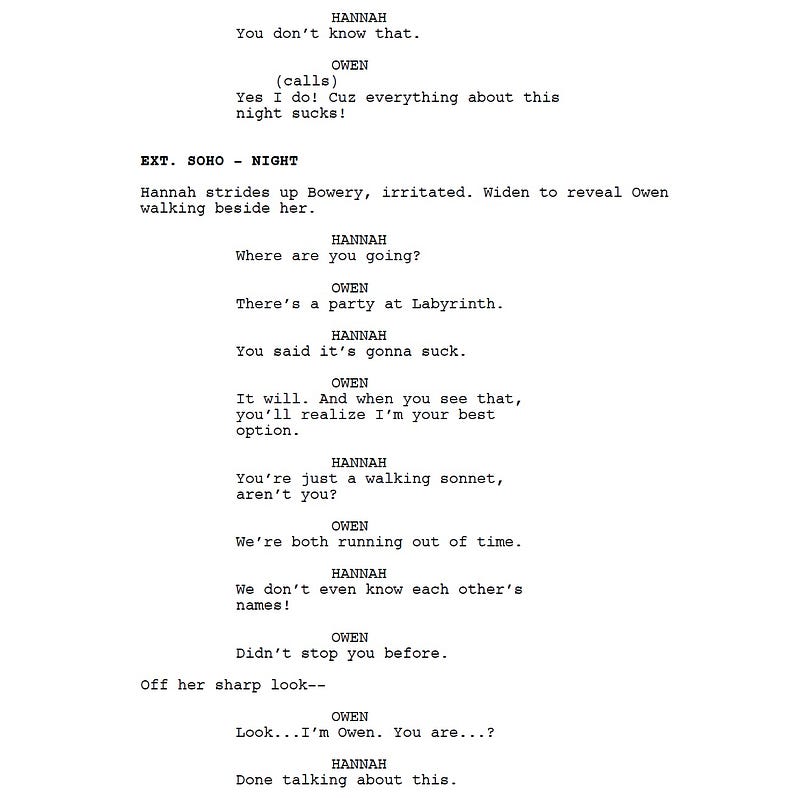
In the 20 years of the annual Black List, no writer has had the #1 script in consecutive years … until 2024. That writer is Travis Braun whose script One Night Only topped the 2024 Black List, his script Bad Boy did the same thing in 2023.
Given all that, I knew I had to interview Travis. We had a great conversation and I’m happy to share it with readers.
Today in Part 2 of a three-part series, Travis offers some thoughts about the screenwriting craft.
Scott: There’s one of my favorite quotes on writing from Javier Grillo‑Marxuach, one of the writer-producers on the TV show “Lost.” He said, “A great script creates an irresistible narrative flow that propels a reader to an inevitable dramatic conclusion.”
The ending of your script hits that perfect point where it’s both surprising and inevitable. It’s like you walk away going, “OK. I didn’t quite expect that, but you know what? That’s exactly how it had to end.” Do you resonate with that take on “inevitable dramatic conclusions?”
Travis: I couldn’t resonate more. I think that’s the job that we sign up for. We spend our time trying to figure out what that is. I’ve never written anything that I’ve felt good about until I’ve figured that ending out.
Scott: How long did it take you to get to the ending?
Travis: Took me a 60‑page draft that I threw away and then five or six different versions rebreaking the story until I figured out that ending. Then when I had the ending, I could start again from page one and rewrote the whole thing.
Scott: Well, I hope the development execs at Universal and your director say,” That’s it. That’s how we’re ending it.” In other words, don’t fuck with the ending.
Travis: [laughs] I hope not either. I would love there to be a more methodical approach to getting to a satisfying ending but I haven’t found it yet.
At some point, I had a theory that, “Oh, I’ll just start there.” Until I have that ending, I won’t start writing. I tried that with a few scripts, and I just never started writing them because I didn’t ever figure out what that ending was.
Every script I’ve done, it’s taken me writing basically a first draft to figure out what the heck that ending is. Then, having figured out the ending, starting again and rewriting the whole thing. It’s not an efficient process.
Scott: But isn’t that mostly about you finding the characters, digging down deeper like what do they need, why are they on this particular journey?
Travis: Exactly. It’s the butt‑in‑seat time.
Scott: I got two more questions about the script, which in Hollywood, they say it’s a good read. I mean, it’s just 99 pages, 98 pages. It just rolls along.
Travis: I’m a big fan of short scripts, and I’m a big fan of short movies as well.
Scott: Here’s the other thing. Another member of the Black List team is Kate Hagen. She’s like one of the most knowledgeable people I know about movies. We had a conversation several years ago about, where’s sex in movies nowadays? It’s, like, disappeared.
She ended up writing an article for “Playboy” magazine about this very subject. Then recently, I saw where a survey of Gen Z audience saying they wanted less sex in screen. So now here’s your script coming along. Yes. It’s a love story, but there’s sex as a central story point.
Were you at all aware of this trend? Was this just a case where, this is the concept, I love it, and I don’t give a damn about what the cultural trends are.
Travis: I feel like as writers, it’s so dangerous to follow a trend in any direction either away from something or towards something. I feel like as soon as you start, the trend is reversed. I wasn’t aware of it. I will say from my standpoint, my personal taste is less is more.
From the beginning, I knew I didn’t want this movie to be a raunchy R‑rated sex comedy. I thought the fun and the uniqueness of the concept was that that movie’s going on in the background. You’re getting glimpses of it, but it’s never takes center stage. It’s always told through the eyes of our main characters.
Scott: You’ve made the Black List three times. Maybe talk about what that’s been for you. Has it been significant in terms of your career as a film writer?
Travis: It’s been extremely significant. For my career, but also for each project. It’s like another attachment to the script. There’s an endorsement to it that carries some weight.
Scott: I’ve got a few craft questions for you.
Travis: Yeah. Hit me with them.
Scott: Here’s the most obvious one for me. How do you come up with story concepts?
Travis: I wish I had a better answer. I keep a running list in my Notes app — just fragments. A line of dialogue. A scenario. Most of them are terrible. But every once in a while, something sticks. And it’s the ones that hang around that I get excited about.
Because sometimes you fall in love with an idea, and three days later you’re like, “What was I thinking?” I’ve learned my lesson to make sure that it stands the test of time. If it does, if it’s still exciting after a few months or even years, I know that it’s something worth exploring.
Scott: Is this an intentional thing? Like, are you sitting out every day, setting out every day to say, I’m going to come up with story ideas, or is this, like, one track of your brain is just tracking what’s going on around you culturally, and you’re aware of things and going to put it down? I mean, how do you do that?
Travis: It’s more passive. I’m not sitting down with a whiteboard trying to crack new ideas. I’m just living life, paying attention. Sometimes something weird I overhear will trigger a “what if?” and I’ll jot it down.
Right now, I’m lucky to have a backlog. I’ve got three or four projects that I’ve been thinking about for over a year, and I’m just itching to get to them. That’s my favorite place to be — knowing what you want to write next, and just counting down until you can start.
Scott: Wow. That’s all those riches just waiting to happen here. What about your breaking story process? Maybe I’m thinking that because you’ve already worked in TV and, of course, most TV, I think, or if not all, you don’t go to episode, you don’t go to page until you’ve broken the story. I mean, is that how you approach features, or how do you do that?
Travis: Yeah, I usually do a super rough beat sheet. Nothing polished. Just for me. It’s usually three or four pages, broken out by act, with bullet points for the big movements — setup, midpoint, climax. It’s messy. And I might do three of those. Or I might do twenty.
And at some point I either get excited enough or frustrated enough to start writing. But I always give myself the freedom to throw it away if it’s not working. I’ve done that a lot.
Scott: Is it fair to say that there’s an aspect of freedom that you may have in writing features on spec versus the process of working on TV?
Travis: Totally. There’s no pressure, no notes, no deadlines. It’s just… play.
Scott: You’re actually writing on spec while you’re doing the TV series. It’s not like you go on hiatus and then write, or both maybe.
Travis: Yeah, it’s a lot of early mornings and weekends. That’s my break. My brain needs that to decompress and focus on something other than what the show is.
Scott: So clearly characters are, like, of primary importance to you. You mentioned that you do some writing and the discovering them through that process.
Before you get into the actual page writing, are there any particular kinds of exercises or things that you do to get to know characters? Like, some people will do interviews and biographies and that sort of thing. Do you have any sort of process to that at all?
Travis: Not really. To be honest, I hardly do any writing outside of the script itself. I just feel like no one’s ever going to see that work, and so I’m going to explore the characters through the scenes. And a lot of times those scenes don’t make it into the final draft, but they at least have the chance to. It’s character development and plot work that could potentially also be in the final product.
Scott: What about theme? You start with theme or themes, or discover them in the writing process?
Travis: It’s so elusive. I will say it’s something I never think about until deep into the process. I will think about what the story is about. A logline can be really helpful. I try to, early on, try to have a logline in my head as a North Star and have some sort of sentence of what is the emotion behind it.
Scott: One last question for you: What’s the one piece of advice you could give a person trying to learn the craft?
Travis: I think the biggest shift for me — and the thing that started to change the trajectory of my writing — was when I stopped trying to write something that felt like another movie or another show… and started chasing things that didn’t.
And I think that’s natural — when you’re learning, you mimic. You reach for familiar shapes. But at a certain point, I realized: those movies already exist. I go to the movies to seek novelty. I want to see something new. And I want to write something new.
I think that’s our job. How do we find a way to tell something fresh? Or take a familiar story and twist it. Or tell it from a different POV. Audiences seem to be sniffing out when we dust off the same old playbook. It’s not working anymore. We need to find something that feels fresh and challenge ourselves to take those risks. I want that because those are the movies I love.
Scott: Your lips to God’s ears, Hollywood.
[laughter]
For Part 1 of the interview, go here.
Part 2, here.
Travis is repped by UTA and Echo Lake Entertainment.
For my interviews with dozens of other Black List writers, go here.