Interview (Part 3): Scott Beck and Bryan Woods
The co-writers of A Quiet Place go deep into their background, creative process, and the evolution of their hit horror movie.
The co-writers of A Quiet Place go deep into their background, creative process, and the evolution of their hit horror movie.
As of today, the Paramount movie A Quiet Place has grossed $236M in worldwide box office revenues. Given the movie’s reported $17M production budget, that represents a ginormous ROI, but the movie is not only a success financially because critics have given the film an enthusiastic thumbs-up: Rotten Tomatoes (95%), Metacritic (82%), IMDb (8.1). Thus, it’s no surprise Paramount has announced a sequel is in the works.
Where did this movie come from? Who came up with the central conceit of the story? Who wrote the original screenplay which sold as a spec script?
The answer is longtime friends and filmmakers: Scott Beck and Bryan Woods. As it turns out, the two have been Go Into The Story followers for several years and with thanks to Joshua Caldwell, I ended up grabbing an hour of the writing duo’s time for an in-depth interview. It turned out to be not only a fascinating conversation, but also an inspiration for anyone who aspires to cinematic storytelling who resides far outside of Hollywood’s pearly gates.
Today in Part 3 of a six-part series to run each day through Saturday, Bryan and Scott share insights into how the mother’s pregnancy, the deaf daughter, and dropping into the story in media res emerged in their creative process for their original A Quiet Place script .
Scott Myers: I’d like to take a look at the evolution of the story. In your original script, the mother and father were Mia and John. The children were Will who’s ten, and April, eight. In the movie, the names were changed ‑‑ Evelyn, Lee, Regan, and Marcus. I’m guessing that the name of Regan, that was a nod to the girl in The Exorcist. That’s her name.
Scott Beck: You might be right.
Scott Myers: In your iteration, how did that family of characters emerge into being, those four particular characters?
Bryan: Man, that’s such a good question. I’m getting into a time machine right now and going back to it. I think it was just pretty organic. We knew we wanted to have a family. We knew we wanted them all to have their various issues. We knew the younger boy was the one who was afraid.
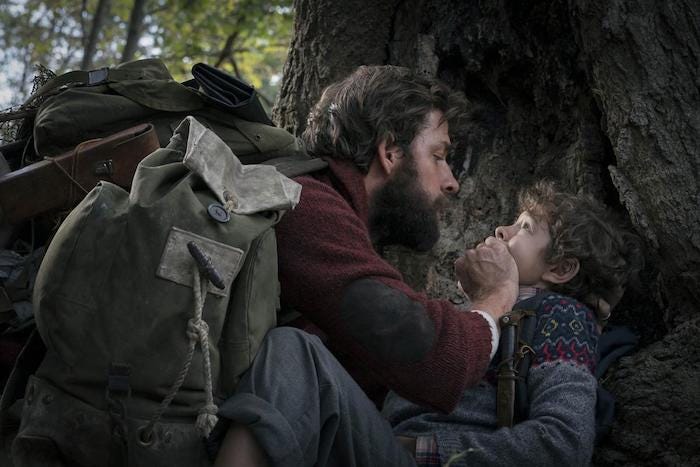
We knew that the young daughter, who is deaf, was facing challenges in trying to step up and be a bigger part of the family. The father couldn’t see that because he’s this classic patriarch of the family who’s trying to keep them safe. We knew we wanted to upend some of those conventions or stereotypes by the end of the story.
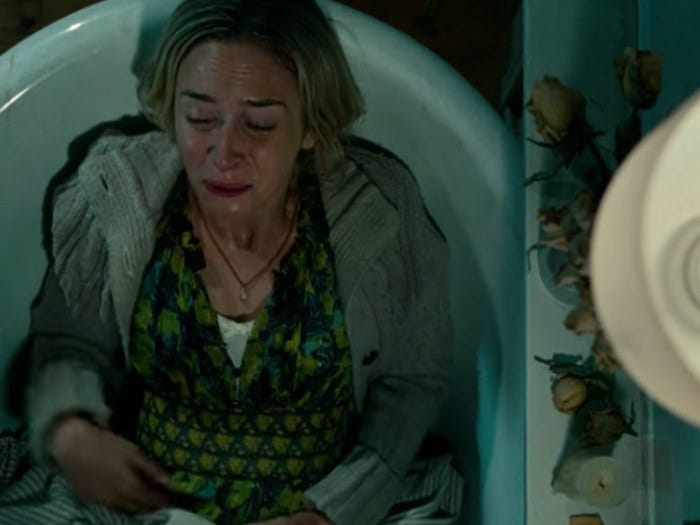
Scott Beck: Yeah, and I think with the mother, too. She was always a character that we felt could be the beacon of hope that’s keeping this family together. Obviously, she’s pregnant in the film. You can read that one of two ways. You can read that as, “Oh, that’s a terrible decision to make in this post‑apocalyptic world,” or it is an eye towards the future.
That was super‑important to us from a storytelling perspective, especially when you’re doing a story that sat in the post‑apocalyptic genre. Too often, in films like that, they have this hopelessness that permeates every single step of the way, including the ending.
For us, we wanted to make sure that there was always that beacon of promise that the family could move past their issues if they were able to finally communicate.
Scott Myers: I’d like to talk about that pregnancy thing because you can completely see the narrative value of that idea. It’s like a ticking bomb. We know at some point, she’s going to have to deliver the baby and do it quietly, which seems like an almost impossible task. How early in the gestation of the story did you hit on that idea? Was that something that came pretty early on?
Bryan: Yeah, it was something that came in the proof‑of‑concept stage. We were sitting around, talking about, “What is the worst thing that could possibly happen in a world where you can’t make a noise?” and very quickly came to the notion of, “There’s nothing you can do to stop a baby from crying.” That is going to be absolutely terrifying.
It was also an opportunity to comment on a theme and what the story was about. Ultimately, for us, the story was about this family that suffered a tragedy. They lost one of their own. They lost a family member and, as a result of that, that tragedy has fractured their ability to communicate with each other.
In particular, it’s damaged the ability of the daughter, the youngest, Regan, and the father to communicate. We wanted the whole movie to drive towards this resolution where he finally says what he needs to say to her. It’s character, but it’s also theme.
It’s theme, and we wanted them to live in a world where we are literally not able to talk to each other as a family, but we’re also metaphorically [laughs] not able to talk to each other. We felt like even if this post‑apocalyptic event wasn’t happening, they still wouldn’t be talking properly.
Scott Myers: Of course, it’s ironic because they can’t talk. It looks like a metaphor for their problem with communicating, right?
Scott Beck: Exactly.
Scott Myers: This idea that the girl is deaf and wears a hearing aid, was that also early on in the process that you came up with that?
Scott Beck: Yeah. It actually was something we poached from one of our other screenplays that we were working at the time and never finished. It was an adaptation of the Pied Piper story. We had written a character in that story that was deaf.
In that incarnation, the tale of the Pied Piper, he lures children away based on a sound. We felt that if somebody is impervious to that sound, then what if it’s a deaf character? We used that same idea, used that and reappropriated it in A Quiet Place.
It felt like an interesting opportunity to us from the standpoint that, at first in the story, you’re perceiving a hearing impairment as a potential weakness. By the end, you’re able to learn what the weaknesses of the creatures are and use your own abilities as a strength.
Scott Myers: One thing about your script ‑‑ and the movie does, too ‑‑ it drops us in to the situation in media res. No crawl upfront that explains the post-apocalyptic scenario, you’re just… boom! Right into it. It creates questions and curiosity, so we participate in the story process as it unfolds. Did you always envision that? Start us right in the middle of the story?
Bryan: Absolutely. We wanted to keep the mystery alive. Part of the fun of the movie is just figuring out what’s going on. In the very, very early draft ‑‑ I think you have the spec draft that sold ‑‑ then, obviously, we did some revisions after that.
Very early on, the idea that attracted us was opening with a completely idyllic farmscape and what appears to be the perfect family living out the perfect life. Little by little, as this family starts to move about their farmhouse, we start to realize that there are weird things going on.
They’re putting padding on the walls. They’re wearing shoe covers on their feet. They don’t seem to be speaking very much. Everything is really quiet. It all builds up to that Monopoly scene where there’s a noise and we realize, “Oh, there’s creatures out there. If they make a noise, then they’re in danger.”
That’s how it started. Then it started to evolve more into this Jaws opening, where we set the stakes up immediately. We would pay full credit to John for going this dark this early, but we love it. The finished form of the movie is more just like… We’re going to see the monster actually kill their family member in the opening moments.
To your question, more on point, we talked a lot about how we love the movie Prometheus, but seeing Prometheus did not enhance our viewing of the movie Alien. Having all that back story, we love how mysterious, simple, clean, weird, and unusual Alien is, and we love taking that journey and not really knowing exactly what’s going on.
We wanted to capture some of that magic for A Quiet Place and let the audience try to figure it out as they go along, and not answer too many of their questions throughout the process.
Scott Myers: I have a Facebook group called Zero Draft Thirty. I said I was interviewing you and everybody went crazy. I got a couple of questions. One of them from Adam Skelter: “How much of the mythology or origin was developed behind the story in terms of the aliens and that kind of thing?”
I know in the script, you referred to them as aliens. Did you have that all figured out or did you just go with it’s mysterious in your mind, too?
Scott Beck: There’s two answers to that. One, we definitely did our homework. Even if it’s not going to be on the final form on the page, you need to still understand the rules that you’re setting for yourself or the rules that you build for yourself.
We certainly had the idea of where the origin is, how they operate, what’s happened to the rest of the world, but, again, that all lives behind the scenes. For us, what we felt most important is to feel the immediate fear and feel like you’re in the characters’ shoes.
Obviously, the characters have been living in this world for quite some time. It was like, “If you’re going to catch the audience up to speed, do it elegantly and don’t shove it down their throats.”
Bryan: I guess the only thing I would add to that is we talked a lot about the monster in terms of the logistics and the origin. How did they get here? What is it doing? We talked about all that stuff.
Just as much as talking about that stuff, we talked about it as a metaphor of sorts for the tragedy they suffered, coming in and infringing on their ability to communicate with each other.
Scott Beck: I would say the mythology even evolved into us when we were doing rewrites for Paramount, too. There were just interesting conversations that provoked new angles. Again, it doesn’t really exist in a hard‑hitting way in the film or even in our script, but it was very much a conversation piece.
Tomorrow in Part 4, Bryan and Scott discuss why they decided to break so many of the so-called screenwriting ‘rules’ when it came to screenplay format and style.
For Part 1, go here.
Part 2, here.
Scott and Bryan are repped by ICM Partners and Madhouse Entertainment.
Twitter: @beckandwoods.
For nearly 200 Go Into The Story interviews with screenwriters, filmmakers, and Hollywood insiders, go here.