Interview (Part 3): Samantha Buck and Marie Schlingmann
An in-depth conversation with the co-writers and co-directors of the movie Sister Aimee which premiered at the 2019 Sundance Film Festival.
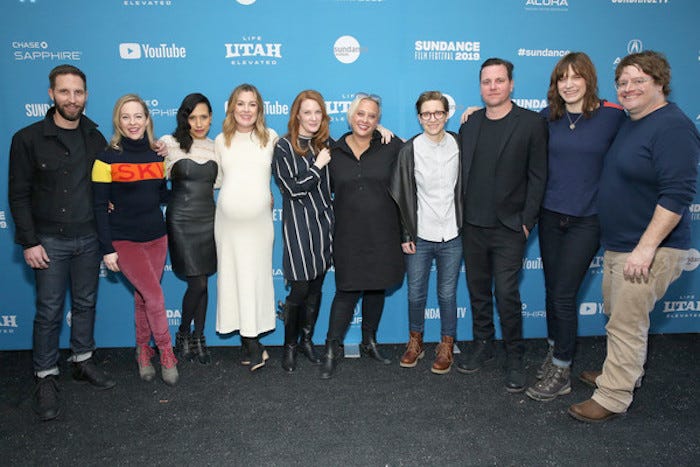
An in-depth conversation with the co-writers and co-directors of the movie Sister Aimee which premiered at the 2019 Sundance Film Festival.
The very first movie I saw at this year’s Sundance Film Festival was Sister Aimee. It was a 9:30AM screening on a Monday morning. I am not a morning person, so the fact I was so taken by this film should tell you something about how entertaining it is.
In watching the post-screening Q&A with the film’s co-writers and co-directors Samantha Buck and Marie Schlingmann, I was so struck by the story behind the story of how this project came to be, I decided I needed to interview the pair. I got in touch with their manager Lee Stobby which led to a 45-minute conversation which I am happy to share over the course of this week.
Today in Part 3, Sam and Marie delve into the three main characters in Sister Aimee and how they influence each other in their journey to Mexico.
Scott: Let’s talk about your story’s protagonist Sister Aimee. You start the story in media res, she’s in the middle of a faith healing ceremony at the height of her fame. There’s this woman in a wheelchair she’s supposed to heal, but Aimee just walks away. It’s almost like you’re introducing us to her in the midst of a midlife crisis.
Samantha: That’s exactly right. One thing about Aimee that…We did a lot of research about her. There’s people that are like, “She was a charlatan. Did she heal or didn’t she heal?”
There’s all of these narratives around her, but something that was always pretty consistent or is consistent is how people talk about what a great entertainer she was. Charlie Chaplin would go see her shows at the Angelus Temple.
Betty Davis is quoted, “She’s the best play performer she ever saw.” We wanted to approach her in her midlife crisis from that perspective of what happens when you can no longer perform. In Aimee’s case, and in her art form, part of her performance in stage performance is healing people.
We thought, “Well, if you’re unable to perform any more, a writer who cannot write has writer’s block.” That lends itself to a midlife identity crisis and that kind of pressure would make you want to run away.
Marie: It opens up a space in your life where something else can come in. In this case, it’s this lovely, radio engineer Kenny, who has the kind of passion for something that she is lacking at that moment.
She sees, in him and in the story that he tells her, something that she feels is missing from her life in that moment.
Samantha: Aimee is the type of woman who loves a good storyteller, because she is a good storyteller.
Scott: Interesting. I know that chopping away to the end of the movie, at one point she has to claim. She says, “I’m an entertainer.” She is trying to do that in order to save her skin, and so when you introduce her, you’ve got a great line of scene description in the script. You say, “She is Carole Lombard with a dose of Christian righteousness.”
I thought that was interesting, because he didn’t say, “She is Christian righteousness with a dose of Carole Lombard.”
[laughter]
Scott: You had that sense that the proportions there, more Carole Lombard than Christian righteousness. From the beginning, you had that understanding of her character.
Marie: Yes, I think that was for us. This wasn’t as much a predominantly religious story for us. She was a very religious, very devout person, but for us, the aspect in her that we could really tap into was the performance, the entertainment aspect, so we wanted to push that very early on.
Samantha: Anna Margaret also, when we act we work with her in that story, so much of our Aimee, so much of it is Anna Margaret, too. When we worked with her and a sort of the main capture after experience, we both thought, “She is Doris Day. She is Carole Lombard.” She should have been doing…
Marie: …comedies in the 1930s. [laughs]
Scott: I was struck by your comment just previously, about how she is in this crisis point like a writer’s block or psychologically just not connected to what she is doing. It reminded me of the “Hero’s Journey,” how Joseph Campbell talks about the heroine at the beginning of the story, that they’re just making it through, they need to change. That seems like a fair appraisal of her situation at the beginning. Yes?
Samantha: Yeah.
Marie: Yes, for sure.
Scott: Then they call to adventure Kenny…
[laughter]
Scott: …who has faith in the narrative imperative. She runs into this guy Kenny. How would you describe this character who is so important, in the story, that falls for Aimee and the journey she goes on?
Marie: To a certain degree, it’s not as much as him, but the story that he tells her that is really the thing that pulls her away, that gives her this call to adventure and this idea of, “Oh, there’s something so exciting somewhere else and you know what? I can be a nobody.”
Because this guy really wants to make it in Mexico as a writer and I can be his muse. He sweeps her off her feet, in that moment, genuinely, but what she pretty quickly learns is that Kenny is not as talented as she thought. He is a radio engineer. He is not a storyteller on the radio.
Scott: Yeah, he’s got a pretty inflated sense of himself as a writer, and fashions himself after that, like someone like Jack Reed…
Samantha: Yeah.
Scott: You talk about this story that he shares with Aimee, while they are in that interesting position of straddling, in a way that really catches our imagination, “The Hero With No Name.” Is that an actual folktale or is that something you all made up?
Samantha: It is.
Marie: It is totally made up.
Samantha: We certainly looked into especially female fighters during the Mexican Revolution and afterwards, but this is not as any specific tale that we’ve taken.
Scott: It takes on quite a bit of significance in the movie. There is a mystery element to it and as I said, it inspires Aimee to take off to Mexico with Kenny.
As I’m watching the film, it also plays to a central theme I find running in your movie. That’s this, the stories we tell ourselves about ourselves. Like Aimee has told herself a story about being a faith healer and spiritual leader. Kenny has told himself a story about being a great writer of the common people. There’s a story, A Hero with No Name, which at other points other characters claim to be the unnamed hero.
There’s all these stories you drop in throughout the movie where people are telling stories about Aimee’s life over the years to these LA detectives. There was a story that Aimee insist Kenny tell when she sends him back to LA to clear up the gossip which has sprung up.
Then there’s that story she ends up telling the musical version of it to the Mexican police. I’d like to get your thoughts on that, because this is a possible theme in the movie, “the stories we tell ourselves about ourselves.” How the stories can help to define who we are, but also trap us due to the confines of the narratives or free us by telling new stories. Did any of that resonate with you?
Marie: Yeah. Yeah, absolutely. Really, for us, this was very early on it. “Oh, we’re making it.” This is a story about storytelling and about the power of storytelling, the privilege of storytelling. There’s also the idea that Aimee, in the beginning of the movie, is a person who actually has the power to tell her story, to tell it in the way that she wants it told, and she gives that power up.
The moment that she runs away from it, which opens up this space for other people to tap in and say, “No, no, no, no. Let me tell the story of this woman,” her gradual awareness of her lack of that power and then her reclaiming it is part of the narrative.
Samantha: Then the same things about the character Greg was this guy that they end up hiring to help them cross the border, because Aimee is in all the papers.
You have this other woman who ‑‑ again when we were doing research about Mexico and what’s happening in Mexico at the time and all these artists going to Mexico City, and it’s like hang out with Diego Rivera ‑‑ we researched these women who were fighters in the Mexican Revolution.
Some of these women, what happened to them afterwards and how their image was transformed and morphed into these sexual paintings. Just completely false [laughs] for a lot of them.
We thought it would be interesting if you have this other character who is a lot like Aimee in terms of wanting immortality and ambition, and really good at what she does, but she has never had the ability to control her narrative. Her story has been taken by everybody, and no one will ever believe that she is who she says she is, her story is what she claims it is.
Another video clip of Aimee Semple McPherson in which she calls the Broadway theater scene in New York “the mecca of sin”:
Tomorrow in Part 4, Sam and Marie go into detail about Rey, the third primary character in the story and one of the most interesting.
For Part 1 of my interview with Marie and Samantha, go here.
Part 2, here.
For more exclusive Go Into The Story interviews with screenwriters and filmmakers, go here.