Interview (Part 3): Michael Ballin and Thomas Aguilar
My interview with 2021 Black List writer for their script The College Dropout.
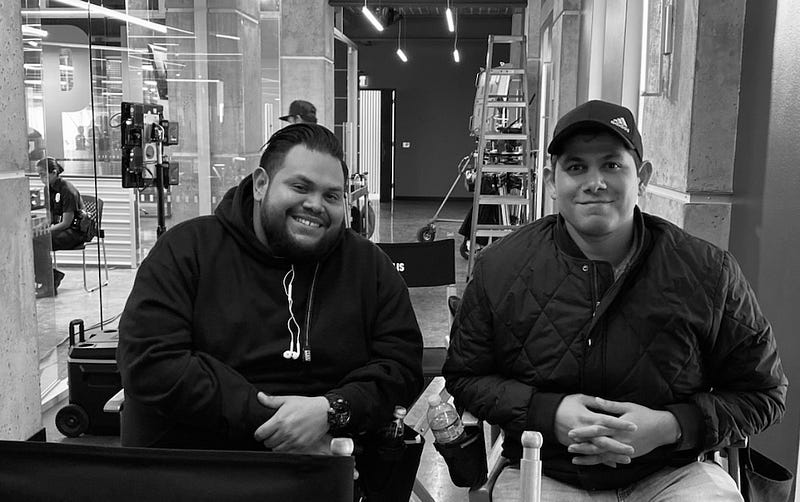
My interview with 2021 Black List writer for their script The College Dropout.
Michael Ballin and Thomas Aguilar wrote the original screenplay “The College Dropout” which landed on the 2021 Black List. Recently, I had the opportunity to chat with with Mike and Tom about their creative background, their script based on a period of time in the life of Kanye West, the craft of screenwriting, and what making the annual Black List has meant to them.
Today Part 3 of a 6-part series to run each day through Saturday, Tom and Mike talk about some of the unique challenges of writing a biopic, specifically about such a famous individual like Kanye West.
Scott: You were fans of the music. It started off whimsically, “Let’s do an album project,” and then, of course, that album, The College Dropout, having been important to you.
I’m curious about where the balance was in that original instinct to do this. How much of it was writerly-oriented, and how much of that is putting on your producer’s cap.
If you’re coming at it primarily from a writing standpoint, it gives you a chance to explore the dramatic conflict, creative talent. He’s rebelling against familial, societal, and his own heightened expectations. But you put on your producer’s hat, it’s like, “Kanye West, one of the most well-known musical artists.” You’re looking for an audience, you got a big audience.
I’m curious whether you even thought about it from the producing side of things, or was it just like, “No, we just want to write this because it’s cool. We really dig that album?”
Thomas: It’s funny. Between me and Mike, that’s always the push and pull we’re always dealing with. We want to write a good script where you care about the character’s personal journey, but at the same time, we want to write it for a large audience.
We want to make it for us, for our families, and for a packed theater. I think that came into play, like, “This could potentially be an interesting thing for everyone, not just fans of Kanye.”
Michael: A calling card for us in terms of making big studio movies. You had the IP that is Kanye, people could access that, but we could show a different side you didn’t know much about and do some cool things. We saw the genre was being advanced, and we were like, “What do we have to add to it?” Because you don’t want to repeat what’s out there.
Scott: Was this after Blonde Ambition? Do you remember that script about Madonna that came out in the Black List? I think it was five or six years ago (editorial note: The script topped the 2016 Black List), which was a similar thing, just focusing on a young Madonna Louise Ciccone as she was trying to break into the business. Had you read that, or were you familiar with that at all?
Michael: Definitely. We had an idea back in 2015, but then we read that on the Black List and it gave us the confidence to keep going forward seeing somebody write such an entertaining and concise music story.
Scott: You mentioned that you said you didn’t want to do a cradle-to-grave biopic which doesn’t seem to be as popular nowadays. More popular nowadays what some call a “snapshot bio,” where you the focus is on a specific period of time, say from the musical standpoint like Bohemian Rhapsody Rocketman, Straight Outta Compton.
How early on in your process did you make that decision for a narrative framework?
Thomas: The idea for us was centering it around a great album, and Kanye’s story lent itself to that. Not only was it a great album, but the journey to making it was too.
Michael: If you contained it, it gave a challenge. We feel like the future of music narratives will be “the album movie”, because you want to see how somebody made the music you fell in love with. It’s additive to the music experience.
Scott: In the script, you focus on the years 1997 through 2004 when the album came out, using that pivotal time in Kanye’s musical career to provide the audience a lens through which to look at this character.
So you’re fans of Kanye, you’re fans of the album, how much research did you do, and what research did you do in order to come up with this complex articulation of the character in your script?
Michael: We ascribe to this Ken Burns mantra which is, “40 gallons of sap to make one gallon of maple syrup” In doing this, we were reading all the books, articles, we were watching YouTubes, listening to songs, dissecting them, and trying to find the objective truth in there, but more importantly: the character truth. It was definitely a lot of research.
Thomas: We just immersed ourselves in everything. Whether it was Kanye’s mom Donda’s book or surgically listening to every word of every interview. Kanye’s a fascinating figure where there are many interviews and footage of him really walking through his process and through his time when he was doing this stuff.
Scott: That’s a great quote from Ken Burns, I’ve never heard that. “40 gallons of sap to make one gallon of maple syrup” With my students, I talk about the iceberg approach to research and story development. Ninety percent of the iceberg is under the water, right?
Thomas: Definitely.
Scott: That’s what you need to do. You need to have all that research, that ninety percent. It may not show up directly in the script, it’s “below the surface,” but it’s going to show up somehow as an echo or emotional subtext.
You do all that research, then the challenge becomes how do you organize it? You’re probably starting with the endpoint being the release of the album, I’m imagining that’s what you were thinking when you began the process.
Thomas: We definitely thought it would be a good end point.
Michael: And in seeing the songs, one of the things we did talk about was not just in the order of the tracklist, but in the order of the drama, how each song could help us tell the story. We were inspired by (500) Days of Summer and how they structured the drama and applied similar principles to our story with the songs.
What’s cool is that the first single was one of the last songs he recorded, and it’s the song that represents his story, “Through the Wire.” We were like, “There was a cool, fun way to organize it in that way, but definitely, it was some jigsaw puzzling of making sure things fit in certain places.”
The other thing we’ll say on it, too, is that once we did all the research, it did free us up. We remember that thing Sorkin said about Steve Jobs, “Art isn’t about what happened,” and we didn’t want to make a documentary about Kanye. We wanted to capture the essence of Kanye in a movie.
Thomas: Yeah, like we all know what his first true performance on stage was, it’s documented, but we wanted to show the audience five minutes before that, what’s going through his mind? What’s on his heart at that moment? Bring the audience into that.
Scott: Sorkin’s famous for that, right? He did the Steve Jobs movie where he had the moments before those three rollouts of the Apple products.
I found a quote of Kanye. He said about the overall theme of his first album, The College Dropout, was, “Make your own decisions. Don’t let society tell you this is what you have to do.” That seems to be a consistent theme playing out in your script.
Thomas: I think so. I think it was very clear who he was. Kanye’s whole mentality was, “You have to do what’s calling you, what your heart tells you, be where your passion is.”
Michael: In our little pre-writing document, we had a quote by Donda West which was similar to what you’re saying, Scott. “Have the guts to embrace who you are rather than following the path society has carved out for you.” That quote was our guiding theme.
We related to it through Tom, because he dropped out of grad school. Tom is one of those people, I think, that it’s rare for people to just leave something, but Tom was working at Sony. These were things that we talked about while writing it. He was offered a paid job there, and he’s like, “Screw it. I’m going to leave and I’m going to go work as an unpaid intern at Imagine.”
It was like, “Dude, what are you doing? You’re leaving money on the table. You’ve been working for free. Take the money.” And he said no. It’s an idea that’s so hard for so many people to embrace. To do it your way and owning it. Kanye did that in his life in so many ways that it became clear what the movie was about.
Scott: In your script, there are a number of times where it’s almost like he’s self-sabotaging, but it’s more about him sticking to his personal truth. It really is the Hero’s Journey. Joseph Campbell, he says, “If the path is laid out in front of you, that’s probably not your path.” That’s the Parent Path, the path of Should, what’s expected of you.
The path you need to be on is your own path, the path you need to discover. When Tom left that paid gig, and went off and worked for Imagine, that’s an example of what Campbell calls “follow your bliss.” Find the thing you’re passionate about and do that. You’re more likely to live an authentic life. It plays through your script about Kanye because he was going to college in Chicago. His mother was on staff there. She was a faculty member?
Michael: Yes, she was the Head of the English Department.
Scott: There, you got that parent path because she and that Professor Milner, both of them are saying the same thing, “Kanye, the only way you’re going to make a success of yourself is by graduating from college.” He had that path laid out for him, but that was not his path ultimately. Could you maybe talk a bit about that tension in terms of him being in college?
Michael: Seeing Kanye, reading about it and stuff, you were like, “How do we get this to a bigger audience that maybe doesn’t feel compelled to go to college, but has a dream?” In looking at the movie too, early on we wondered, “What’s the movie without music?”
It’s a guy in college and feeling like he’s not connecting with it, but he’s got something else to offer. You’re in a space where no one’s going to see that. They’re saying, “Can you relate to this book?” He just doesn’t think that way. It was capturing the artist in that way, in that environment that isn’t Baseline Studios, it’s Chicago State University.
Thomas: When you’re young, you have a lot of insecurities, a lot of, “Am I making the right choice? Is this the wrong path?” But the truth is, you don’t know if you’re on the right path. You just have to go where your heart’s being called. If you have the opportunity to do it and it’s in front of you, grab it, take it. Give it a shot.
Scott: That’s such a good writerly instinct that you hit on this. What’s the movie without the music? That’s terrific. Again, you go back to Joseph Campbell. He talks about the outer journey and the inner journey. The outer journey’s all the stuff that happens, the plot basically. This is an actual quote, he says that’s “incidental” to what’s going on inside the character.
By saying, “Let’s take the music out of here and let’s look at this strictly from the dramatic standpoint of what Kanye, the protagonist, and his journey is,” then you’re drilled down into a guy who is convinced about his musical talent. He could’ve been a producer and created beats, could’ve been very successful just doing that, but that was not his thing.
He was insistent that he could be a performer. That’s metaphorical, him finding his voice, expressing himself, right?
Thomas: Yeah, for sure.
Michael: The goal was how do we access him finding his voice in a way that other people could relate to? Sometimes, you see movies that are only aspirational. Not everyone is going to have that aspiration, but how do they make the choices in their life that feel impactful every day? That’s what we wanted to capture for audiences.
Tomorrow in Part 4, Mike and Tom discuss how they handled a pivotal turning point in Kanye West’s career: a car crash and his recording of Through the Wire.
For Part 1 of the interview, go here.
Part 2, go here.
Mike and Tom are repped by:
Mike Goldberg, Kyle Loftus, Adam Perry (APA)
Matt Ochacher, Michael Pelmont (New Wave Entertainment)
Twitter: @MichaelBallin, @Thomasraguilar
For my interviews with dozens of other Black List writers, go here.