Interview (Part 4): Karin delaPeña Collison
My interview with the 2021 Nicholl Fellowships in Screenwriting winner.
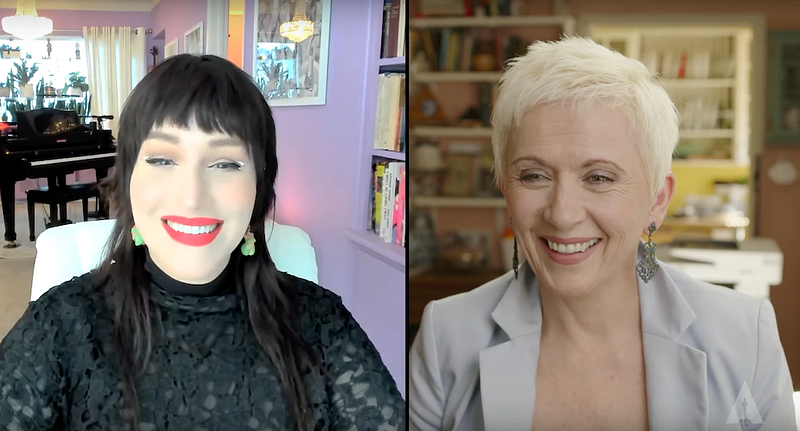
My interview with the 2021 Nicholl Fellowships in Screenwriting winner.
Karin delaPeña Collison wrote the original screenplay “Coming of Age” which won a 2021 Nicholl Fellowship in Screenwriting. Recently, I had the opportunity to chat with Karin about her creative background, her award-winning script, the craft of screenwriting, and what winning the Nicholl Award has meant to her.
Today in Part 4 of a 6 part series to run each day through Saturday, Karin talks about her own real-life story served as an inspiration for her Nicholl-winning screenplay “Coming of Age.”
Scott: Let’s talk about your script, “Coming of Age.” This is the script that you were just talking about that won the Nicholl. Here’s a summary of the plot:
“In 1965 Britain, a sheltered, studious schoolgirl, lands on a British Farce tour her mother stage manages, where tutoring by company members successfully replaces her formal schooling, she’s cajoled into replacing an actress in the show with surprising success, and she experiences a scandalous sexual awakening in the morally wobbly era of Free Love, which leads both her and her mother to ‘come of age.’.”
How much of this was inspired by your own experience as a young person and an actor, and how much of this is fabrication?
Karin: I was very interested in exploring the influence of lack of structure on the sexual development of a young girl. How lack of oversight can set a girl adrift. Especially in that era. The 1960s. In that era, it was all free love. Somebody who has had a sheltered life could be exposed to shocking revelations about herself, for which she’s ill prepared. Yes, although the scene I’ve written in the screenplay isn’t what happened to me, there’s a lot of truth in it about the emotions I felt back then. How lost I felt.
Discovering that she can attract men … especially one on whom she has a crush … would be wildly intoxicating and can also steer her…can knock her off base. Now, in the feature, it doesn’t really knock her off base. It is traumatic for her, definitely. But it ties itself up at the end, for her.
The series version of the material explores her dilemma with more ambiguity.
I think I just said to Pilar, “Look, my mother was a stage manager. My father was out of the picture altogether.” I told her enough about it that she caught on to the theater side of it. She went, “Oh, yes … that’s interesting. That’s an interesting environment.”
The first part of the screenplay that leads up to the inciting incident, and maybe a little bit past that, when the family is at home as a family unit — elements of that section feel very close to my life. That felt very close to home. Although my father never lived with us, I was able to just imagine that. The actual events that happened, though — I made most of those up. Although, I did walk around a lamppost and leave imprints in the wet cement.
Scott: Let’s jump to that. One thing, as a screenwriter, I thought you did very well ‑‑ because you’ve got a lot of characters in that theater group ‑‑ is there’s a specificity to them, which once you get to know them, you get it. When you introduce characters, that’s really important.
The script reader, they’re not privy to it like you are. You know the whole world. They’re being introduced. They’re just trying to figure out the roster. You do these little descriptors of the characters. In this case, Charlotte. Let me just read this to you, because I thought it was quite clever.
“Charlotte, 14, her eyes never leaving a biology textbook, halts at a driveway for a car to exit, sidesteps some dog poop, and dodges wet cement around a streetlight. She frees a grasshopper from the cement, glances down the empty street, and then, with great intent, heel toes around the light, leaving footprints in the wet cement. The middle shirt button of her school uniform has popped open. She rebuttons it as she walks on, reading again.”
That’s very specific. If you look at that, you’re setting into motion a complex figure. Biology text. You knows she’s studious.
We learned, she’s got a clear goal. She wants to be a doctor. Frees a grasshopper. There you go. She’s got some empathy. There’s that going on. She leaves these footprints in the wet cement, which suggests she’s got a bit of a rebellious streak.
Then this middle shirt popping open, which is not a metaphor. It’s like she’s growing into herself. Her body is evolving.
Karin: Growing out of herself. [laughs]
Scott: Out of herself. Exactly. Let’s talk about this choice of 1965. I’m old enough to remember this. [laughs] This is literally my youth. Free love. Did you choose that era because of the lack of structure?
Karin: I think what I was also interested in exploring was how we as a culture, writ large, create behavior. I’m interested in how people like Harvey Weinstein, Jeffrey Epstein, Charlie Rose, Bill Cosby were a product of that time. It was a very “nudge, nudge, wink, wink — say no more” time for men. An “anything goes” time, for men. Free love was very much in service to men. Not so much to women. Women simply had an ability to make it easier for the men to have sex more freely and with more impunity, because of the pill.
I wasn’t interested in indicting the culture of the time, but in just looking at how the bad behavior these men exhibited throughout their lives didn’t come out of nowhere. Yes, there are myriad men who came out of that time period who didn’t exploit women, obviously. But the culture supported whatever predatory predisposition these particular men had. Their bullying tendencies.
I started writing this at the end of 2019. It was top of mind, the whole “Me Too — Time’s Up” issue. Top of my mind, anyway.
Scott: Even the father character, Micky.
Karin: Very much. Micky; and Edward.
Scott: They’re cut from the same cloth. Even to the point where they smoke the same cigarettes. From a symbolic standpoint, a metaphorical standpoint, Edward, the actor, is a substitute version in a way. He’s like a surrogate father figure in a way.
Micky has this comment. The inciting incident, if you will. Trisha, the mom, comes home and finds Micky in bed, in their bed, with the 18‑year‑old au pair.
Micky attitude is, “I just don’t see the problem. You want to traipse around with a bunch of actors, fine. If little Fleur [the au pair] can handle some of your wifely duties, why not a few more? At least for now. It seems only fair.” That’s that kind of entitlement. The male entitlement.
Karin: That’s not necessarily only typical of the ’60s. That sense of entitlement has existed in many men through the millennia. I just think that there was a lot of, “Yes, old boy.” Nudge, nudge, wink, wink encouragement. That the ’60s made it easier for people to condone that.
Scott: I think there was less structure, and there was less oversight. In this case, the mom, Trisha, who’s a theater stage manager, she’s drawn toward the arts. Once she discovers her husband’s infidelity, she takes Charlotte who keeps saying, “I just want to be a doctor.” But her mom takes her off to this strange environment.
Karin: It’s not just that she takes her TO the environment. She takes her away FROM her father fooling around.
Here is Karin’s conversation with television writer-producer Our Lady J whose credits include Transparent and Pose.
Tomorrow in Part 5, Karin delves more deeply into the key characters in her Nicholl-winning script.
For Part 1 of the interview, go here.
For Part 2, go here.
For Part 3, go here.
For my interviews with every Nicholl Fellowships in Screenwriting winner since 2012, go here.
For my interviews with Black List writers, go here.