Interview (Part 3): Karen McDermott
My interview with the 2019 Nicholl Fellowships in Screenwriting winner.
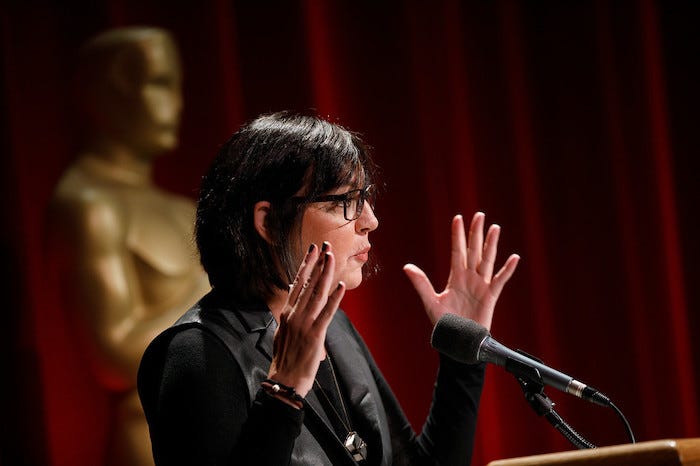
My interview with the 2019 Nicholl Fellowships in Screenwriting winner.
Karen McDermott wrote the original screenplay “Lullabies of La Jaula” which won a 2019 Nicholl Fellowship in Screenwriting. Recently, I had the opportunity to chat with Karen about her background as a screenwriter, her award-winning script, the craft of screenwriting, and what winning the Nicholl has meant to her.
Today in Part 3, Karen discusses how she was careful to avoid writing a ‘preachy’ movie and the role of poetry in the story.
Scott: I definitely want to talk to you about that because there’s so many different layers to the experience of these characters when they’re in these cages that it impacts them. That one is basically the evisceration of memory, which is, when you think about it, unbelievable.
When I heard those quotes, I was immediately reminded, if you hang around Hollywood long enough, you hear all these anecdotes. There’s one that’s pretty famous, Samuel Goldwyn, who commented to screenwriters back in the ’30s. Of course, many of them were Communists, or very left‑leaning, who kept trying to put their message into these movies.
He said, famously, “If you wanna send a message, use Western Union.”
Karen: You should just entertain, yeah.
Scott: Were you at all worried about the fact that you knew going in this was going to be a message‑heavy script, that somehow might strangle the story?
Karen: Yes. I knew the risk. It could become didactic. And I hate preachy movies, myself. So I looked to literature and asked myself: how does message-heavy literature remain readable, entertaining? One way, I noticed, is through the use of a child protagonist. Children aren’t aware of the politics of their situation. They’re dealing with the results, the fallout. So the story can implicate the politics without referring to them overtly.
I remembered what I loved about The Diary of Anne Frank: Anne’s relationship with the boy in hiding with her — her crush on Peter. So I gave my protagonist a crush. I thought: if she has something that lifts her, figuratively, out of the cage, then the reader/viewer will be lifted, too. And that will make it more watchable, less didactic and message laden.
Scott: When you organize, I don’t want to drill down so much into the technicalities of it, but… Index cards? How did you organize things?
Karen: Index cards, yeah. But not at first. The first thing I do is write long‑hand, in cursive, in notebooks. I just write in flow, not worrying about the delineation between dialogue and action and description. I write what I see, in whatever form it comes.
Then I put those pages in piles like, “Okay, “Maybe these pages go together.” I get to the note card stage once I get a sense of, “How does this break down into scenes?” Then I put the scenes onto note cards.
Scott: It’s like you have to immerse yourself in the characters in that story world first.
Karen: Right. And then I can organize it. Sometimes, I’ll write many iterations of a paragraph of description or a line of dialogue. When I finally get to my computer, I try to choose the best version.
Scott: By the time you get to the actual ‑‑ you’re using Fade In, Final Draft, or whatever…
Karen: Final Draft, yeah.
Scott: You’ve got that content. Do you actually reference that or are you going from memory at this point?
Karen: Sometimes memory, sometimes I reference my note cards and notebook pages when I’m in Final Draft. But I’m always wary of touching my computer too soon. I mean, it’s called Final Draft.
[laughter]
Scott: It sounds like you would resonate with Ray Bradbury where he says, “When you sit down to write, don’t think… feel.”
Karen: Yes, exactly.
Scott: Let’s talk about the characters in your script, Lullabies. Hector was your first character. When did Dahlia come along. The protagonist in this story, the 14‑year‑old Mexican girl. When did she emerge?
Karen: I knew I wanted to see this atrocity through a child’s eyes so as not to get bogged down in politics…
Scott: Sure, that’s what we were just talking about. The message could swallow up the story.
Karen: Right. So through the eyes of a child, and, because of Anne Frank, one old enough to have a first crush.
Scott: Hector was the first character to come based off this video you say, but it seems like you had an instinct that you knew it was going to be a female lead.
Karen: Maybe because, as my sister said, I was (unconsciously) writing about myself. Another factor was that I wanted to use the poetry of a Spanish revolutionary, Miguel Hernandez, in voice over. I didn’t know who was going to recite these poems, but I thought it was more likely that a girl would be reading poetry in the cage than a boy. That helped me choose the protagonist’s gender.
Scott: One of my best friends was a poet. He turned me on to it about 15 years ago, and I read a poem every morning. I was very struck by this because you weren’t just playing around. These poems, excerpts that you have, there are numerous ones. It’s fascinating how thematically they’re tied in to the scenes. Obviously, as a writer, you wouldn’t do it if that didn’t work. I’m curious, did the poem…
Karen: Which came first?
Scott: Yeah, which came first, the plot or the poems?
Karen: The poetry dictated a lot of the plot, actually. Miguel Hernandez had a son who died, and there were some gorgeous, gut-wrenching poems about missing him, so I thought, “Okay, I need a little boy. And he either dies or leaves.” Some of the poems were about violence, described as a kind of horrific dance, so: “Okay, I need a fight to break out in the cage.” It was fun to try to fit a plot around the poems.
Scott: The fact that they’re the “prison poems,” I’m assuming he spent a lot of time in prison. That’s a perfect parallel because, in effect, that’s what your protagonist ends up…
Karen: All of those poems were written while he was in prison. He died in prison.
Tomorrow in Part 4, Karen burrows down into the key characters in her original screenplay.
For Part 1, go here.
Part 2, here.
Karen is repped by APA.
For my interviews with every Nicholl Fellowships in Screenwriting winner since 2012, go here.
For my interviews with 53 Black List writers, go here.