Interview (Part 3): Jonathan Stokes
My interview with the 5-time Black List screenwriter.
My interview with the 5-time Black List screenwriter.
Jonathan Stokes has written five screenplays which have made the annual Black List. They are:
- Blood Mountain (2011)
- Murders & Acquisitions (2011)
- Border Country (2012)
- Tchaikovsky’s Requiem (2013)
- Murder in the White House (2020)
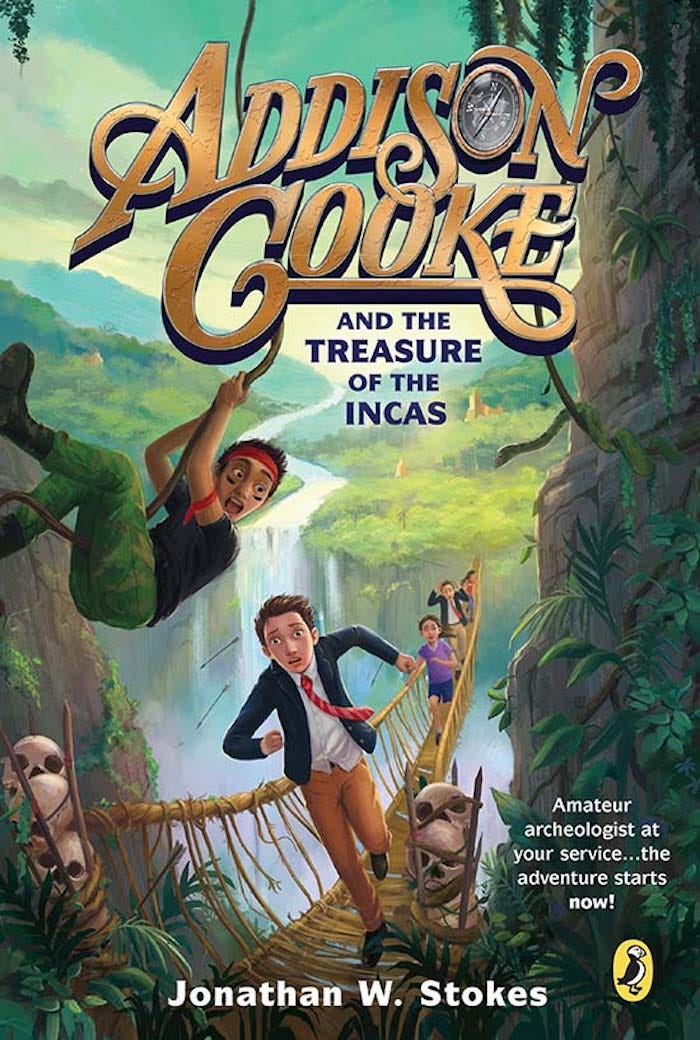
For that reason alone, I thought it would be a great idea to interview Jonathan, but there’s much more going on with this prolific writer. For example, he is the author of four books including Addison Cooke and the Treasure of the Incas.
I reached out to Jonathan to see if he’d be up for a Go Into The Story interview and he kindly agreed. We had a terrific conversation which could have gone on for hours.
Today in Part 3 of a 6-part series to run each day through Sunday, Jonathan and I discuss whether and how to think in terms of a story’s marketability when deciding to take it on as a spec project or not.
Scott: That’s terrific. We should just quote that, put that there because it’s so valuable. You’re right. When the spec script boom hit in the ’80s ‑‑ and that’s when I broke in ‑‑ there was this whole cottage industry. You may remember, Jonathan, these websites and people. “Learn the secrets of the million‑dollar spec script.”
There was this sense that, “Well, it’s easier than a novel. It’s only 100 pages.” People have unrealistic expectations. You’re right. It’s incredibly competitive. That’s such an inspirational story. I love the whole thing about the photographers. That’s so great.
Were you writing screenplays at this point? Have you just decided you’ve done sketch writing, poetry, short stories, novellas, you’re focusing on screenplays and feature films, that sort of thing, right? Is that is that where your focus was?
Jonathan: Yes, like you, Scott, I have too many hobbies. At age 27, I decided, “You are allowed only five pursuits: writing, reading, music, dance, and the stock market. Those are the five things I allowed myself.
No matter how much I wanted to become good at archery, or juggling, I just had to put that off. I competed in ballroom for a good 12 years there, which split my focus a little. But otherwise, I went all-in on screenwriting.
I pictured Hollywood as having this castle wall around it, that I needed to break through. Now, I have friends who have made the mistake of chipping away at one corner of the wall for six months and then thinking, “Well, that’s not working. I’ll go chip away at this other corner on the other side of the wall.” Then six months later, “Well, that’s not working. Let me find another brick to chip away at.” It dawned on me around age 27 that I needed to just pick one wall, and then never stop chipping.
Scott: Let me ask you because you mentioned this earlier, and having come from a background of finance this might have had some influence about the viability or marketability. It’s let’s just get an idea, and go write a screenplay.
Did you start thinking because if you look at the projects you’ve sold, the movies you’ve made, The Black List scripts, most of them have what you could, at least an identifiable concept, if not a high concept? How much of that was coming into play during this period of time where you were writing stuff, or you’re thinking, “OK, I’ve got to be cognizant of the marketplace?”
Jonathan: It still took me a few years, and it’s still something I’m working hard on because I will get a bug up my butt to go write some crazy Charlie Kaufman‑esque experimental story that has limited chances in the marketplace. But those are often the movies that get us the most excited.
When someone makes a movie like “Everything Everywhere All at Once”, that’s completely left‑field, it’s so inspiring. A “Pulp Fiction” or a “(500) Days of Summer” that breaks all the rules in just the right way. But you have to be very lucky to break-in with a script that is so left-field.
Scott: I was just thinking that.
Jonathan: I have had to try and discipline myself to write things that are a little bit more down the middle because I didn’t want to piano teach forever. I love piano teaching, don’t get me wrong, but it was a struggle to make ends meet.
I would take odd jobs on construction sites, digging ditches and hanging drywall. I had to take bartending gigs, all kinds of horrendous jobs that I’m not qualified for. Being poor is an incredibly stressful existence.
I think that there’s been a lot of talk about diversity in screenwriting in the past few years. Of course, we should have those conversations, but from my perspective, the biggest issue, and one that I have no solutions for, is income diversity. I feel like 90 or 95 percent of the screenwriters that I am friends with had a big financial safety net. Their parents subsidized them so that they could survive that silent decade before breaking in.
That was what was so challenging for me about breaking in. It’s exhausting to work a day job, and then feverishly write all night. Poverty itself is incredibly exhausting. When you get that parking ticket or your car is towed, it sets you back for months when you’re living hand to mouth. [laughs]
Scott: Did that influence your thinking? There’s always that debate. You mentioned the Charlie Kaufman‑esque story or (500) Days of Summer. I know those guys (Scott Neustadter and Michael H. Weber). They said, “We’re going to break every rule. We don’t care. We’re going to write what we want to write and how we want to write it.”
It seems like if you literally are struggling with paying parking tickets, the car gets towed, you’ve got to be thinking marketplace. You’ve got to be thinking of buyers. Where is that balance? How did you do that? If you look at The Black List scripts, as I say, each one of them’s interesting in itself.
“Tchaikovsky’s Requiem” is not something that you would necessarily equate with a mainstream commercial movie, and yet you can look at it, and you look at the plot description, you can say, “Yeah, I can see that as a movie.” How did you balance that out in terms of the marketability versus wanting to write stuff that is emotionally satisfying to you?
Jonathan: That’s a great question, Scott, and one that I will spend the rest of my life trying to figure out. I don’t have a smart answer.
When I write something like “Tchaikovsky’s Requiem,” which is wildly unmarketable because it’s the real‑life murder mystery of a Russian composer who died 150 years ago — it doesn’t sound very marketable to me. But at least it’s a movie idea that you can explain in one sentence.
I do believe that when you’re going to the multiplex with your buddies on a Friday night, debating what movie you want to see, the person who wins that debate does it in one or two sentences.
“It’s Tom Cruise, and it’s fighter planes, and there’s incredible action sequences.” [laughs] “Yeah, that sounds like a fun Friday night.” So if you’re writing something left of center, but can still explain it with an exciting one-sentence hook, then maybe it has a shot at market viability.
Tomorrow in Part 4, Jonathan talks about how as soon as he fired his reps who weren’t advocating for him, the phone began ringing, but he still continued to teach piano for a year and a half before he was confident enough to focus solely on screenwriting.
For Part 1 of the interview, go here.
Part 2, here.
Twitter: @jonathanwstokes
Website: https://www.jonathanwstokes.com/
Jonathan is repped by UTA and Management SGC.
For my interviews with dozens of other Black List writers, go here.