Interview (Part 3): Greg Roque
My interview with 2022 Black List writer for his script Jerry!
My interview with 2022 Black List writer for his script Jerry!
Greg Roque wrote the original screenplay Jerry! which landed on the 2022 Black List. I had the opportunity to chat with Greg about his creative background, writing a Black List script, and the craft of screenwriting.
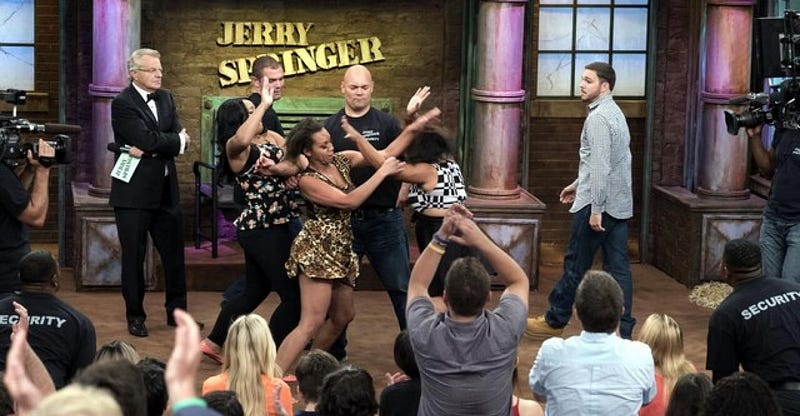
Today in Part 3 of a 6-part series to run each day through Sunday, Greg discusses how he came up with Show Host Jerry, a kind of alter-ego characters who appears from time to time to the real Jerry Springer.
Scott: The thing that interested me the most about your script it is that Jerry Springer is a progressive, he’s a liberal. There are many times that you note in the script where he’s altruistic towards someone. He’s empathetic toward people.
That puts a spotlight on the story. How could someone who we would typically associate a liberal, as being a kind‑hearted, good‑natured person become the post of the most offensive TV show of all time? Does that play around with that idea of the inversion of the American dream, as well?
Greg: I love history and I think history is often way more interesting that any fantasy or sci‑fi book. I remember reading, I must have been an undergrad in college or I don’t know when I read it, but that people who were involved in the hippie movement were the ones who re‑discovered and reappraised Ayn Rand.
From there, that was the beginning of the modern Libertarian movement. I thought it was funny that the flower children became the antithesis of what they wanted. It was something similar with Jerry. Not trying to take away his credentials, but someone who went from SDS to the excess of the 1980s.
Not that he supported the entire system, but the conspicuous consumption and this idea of putting everything on the largest billboard you can — is that being a libertine, or does that fall under exploitation?
Where do you draw the line? I think that was the crux of my script. I wanted how good intentions and altruism can be warped and the cognitive dissonance of trying to rationalize contradictions by claiming you’re doing it for the greater good or hallowed values like democracy via television.
Scott: Let’s dig into your script. It begins with Jerry in the sound stage, the studio. He’s getting ready to do a show. He’s number one in the ratings and yet he seems distracted at the beginning and he’s even tired. First of all, what is psychological state was at the beginning and why you decided to start the movie there?
Greg: I started there because that is the theme of the movie. Forgive me for being so glib and trite, but you can have all the riches in the world, but if you don’t have your family or that anchor, do you really call it success? That’s why I wanted to start Jerry at the peak of his success.
That was a misdirection, because he learns that his hunger for power or success has all been a detour. He wants to be a good father. He’s a workhorse. In the script, there’s the ongoing joke of a horse and his romantic partner.
I was inspired by Sunset Boulevard when William Holden goes into the mansion for first time and there’s a dead helper monkey. That’s the metaphor there. It was very much, “Let’s get Jerry right smack dab in the middle of him being a workhorse, tiring himself out and trying to find that oasis of family, love, and blah, blah, blah,” all the wholesome stuff.
Scott: Sets the dynamic up. There’s a really interesting choice you made. He falls asleep and suddenly host Jerry shows up. Only he’s identical to Jerry, but he’s wearing an Armani suit. Was that early on in the process that you came up with this idea? Because it lends itself to a really interesting narrative structure where you’re bouncing back and forth between Host Jerry grilling Jerry like he’s on his own show and then Jerry’s past events. How early was that idea of the host Jerry in the process of developing a story?
Greg: Admittedly, that was in the second or third draft. At first, I was writing a biopic. I wanted to get the chapters and figure out, what am I trying to say. Luckily, my manager is blunt and frank and he said, “This reads like this happened, then this happened. Where is the, this happens therefore this must happen,” that kind of narrative structure.
Admittedly, when I suffer a defeat like that, I retreat. I started looking at more stuff for inspiration. I was lying in bed and I was like, “OK. Jerry Springer, his life is like a crazy talk show.” I said, “Fuck it. Let’s go all in with that metaphor,” and then dusted off Dostoevsky’s “The Double” and Mark Twain’s “Prince and the Pauper.
I was like, “Let’s get this mirror image. Let’s play with this subversion and everything.” That came around maybe the second or third draft.
Scott: That’s such a great idea too, Greg, because not only does it reverse the dynamic because Jerry is now being interrogated and away from time to time by Host Jerry, but it allows you to bounce back and forth between the present and the past. You can cut through a lot of the interstitial stuff.
Greg: I wanted to mention this: Philip Roth was also a big influence. I reread “Portnoy’s Complaint” becuase I wanted the story to have an emotional logic instead of a straight line.
You can’t have the story without the Jewish American experience in diaspora. I reread Portnoy’s Complaint and I was like, “Let’s turn this into a free association session that pieces everything together.”
Scott: Let’s talk about some of the other characters in the story. One is Mickey. I want to read from the script. Here’s how she’s introduced.
“A White woman with short blonde hair emerges from backstage. She sprints over to Jerry and attacks him.”
The first words out of her mouth are “You fucking pig!”. Could you describe the nature of the relationship between these two? Because they do start off very much in love, but then they go through a lot of stuff.
Greg: That was very much me trying to make it work within the show’s format. I re‑watched God knows how many episodes while writing this, and I noticed the guest always starts off sympathetic, like, “Oh, I love my partner, she’s the greatest, but I have the secret. I’m fucking her cousin,” or whatever they’ll say.
And Jerry will ask, “Does she know? Well she knows now” followed by a fight. Jerry Springer goes from 0 to 60 quick. Then I noticed after the violence subsides, when the characters take this little repose, they’re calm like, “Oh, I remember when I first met him, he was a loser.”
That was me trying to stay authentic to the show.
Tomorrow in Part 4, Greg talks about some of Jerry’s key relationships in the script and how Citizen Kane was a reference in his writing process.
For Part 1, go here.
Part 2, here.
Greg is repped by Bellevue Productions.
Twitter and Instagram: @gregroqueislame.
Website: gregroqu.com.
For my interviews with dozens of other Black List writers, go here.