Interview (Part 3): Grace Sherman
My interview with the 2018 Nicholl Fellowships in Screenwriting winner.
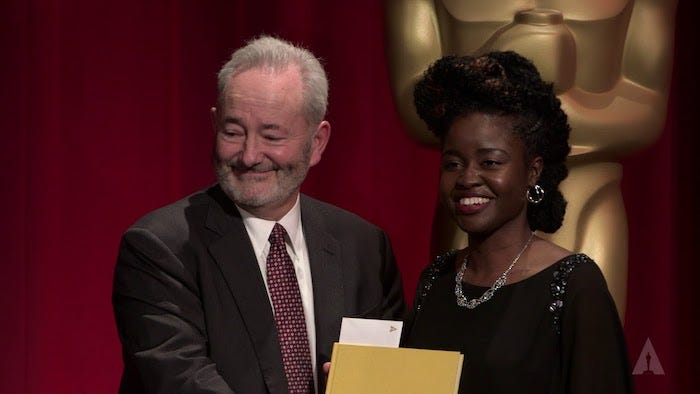
My interview with the 2018 Nicholl Fellowships in Screenwriting winner.
Grace Sherman wrote the original screenplay “Numbers and Words” which won a 2018 Nicholl Fellowship in Screenwriting. Recently, I had the opportunity to chat with Grace about her background, her award-winning script, the craft of screenwriting, and what winning the Nicholl has meant to her.
Today in Part 3, Grace delves more deeply into her original screenplay “Numbers and Words” and the thematic role Joseph Campbell plays in the story.
Scott: Let’s talk about this. Is it the Pythenian Hypothesis? Is that it? Right?
Grace: It’s not real, [laughs] so you can say it however you want. Yes.
Scott: I looked it up, and I was like, “Wait a minute. I’m not finding anything on this.” I thought I either had bad Google references or…You made this up, right?
Grace: I did, I did. I’ve heard other people say they went and looked it up. Yeah, it’s not real.
Scott: I did find Pythia, which is a priestess in the court of Pytho, the sanctuary dedicated to the Greek god Apollo. Pythia was highly regarded, believed that she channeled prophecies from Apollo himself. Is there any reference there, or did you come up with Pythia as a cool sounding name?
Grace: No, but thank you for telling me that. I didn’t know that. It’s a cool-sounding name.
Scott: The legacy of your story, it’s been around for four centuries or so, and it’s confounded people. DeMarcus feels like he’s obsessed with solving this thing? What does that mean to him?
Grace: He just knows he has to do it. The outcome or what it would look like, I think is freedom to him for some reason. He started thinking about it when he experienced the loss of his father. It became fulfillment. Then it became obsession. He knows he has to solve it.
What it’ll bring, he doesn’t exactly know, but he knows he has to do it. It’ll just, in some way, save him and give him freedom. He just knows he has to do it.
Scott: That’s interesting, because I was thinking that the text, him trying to solve this mathematical equation.
Then, if you look at it sub-textually, say, from a psychological standpoint, he may not even understand it from a conscious level, but subconsciously, it feels like what he’s really trying to figure out is another mystery, which is why he is the way he is and, ultimately, discover who he is. Does that seem fair?
Grace: Yes, in a way of, “I look at this environment around me. It’s poverty. There’s sadness. There’s depression. I want to do better than this. How do I get from beyond this? What is it that I need?” For some reason, that problem is the piece of that puzzle, so you’re right. He doesn’t know overtly what it means to him.
Like you said, psychologically or emotionally, it’s just something tells him that this is going to be the key.
Scott: In fact, Beth even asks him, “What are you going to get out of this? What does it mean to you?” Let’s talk about Beth. There are two figures that enter into DeMarcus’s life over a period of two plus decades, nearly three decades, that we follow him in this story, one of whom is Beth, who’s younger than him. When we meet her, she’s 12 years old, but she’s sharp as a tack.
As we used to say in the South, she’s a ‘pistol.’ She’s smart and sassy. She’s also black, like DeMarcus. They are both going to this predominantly white after-school-type program. DeMarcus is only interested in the math and nominally that in the context of that school where she’s voraciously taking on everything. How did that character emerge?
I know you said math, in “Numbers and Words.” She’s the words person. Do you remember how that character evolved in your story-crafting process?
Grace: Actually, she evolved first with meeting him while he’s in prison. I had set it where she would meet him in the second half of the story, and they would start the dialog there. He’s incarcerated. I wanted his relationship with her to offer him hope and inspiration while he is incarcerated.
She would come and visit him. Then they would have that dialog and that conflict. Then, as I was writing it and developing it, I don’t know [laughs] how it came about. Just one day. A spark. Woo. What if he knows her beforehand? What if he meets her in childhood?
Then I toyed with it. Then I was like, “Yes, yes.” In the way I wrote her character, she pushes him. She’s the challenge. She’s the conflict. I needed somebody that, intellectually, was at his level in some way.
Math is his strong point, English is hers, but they can challenge and push each other. You have him, who’s [laughs] not a people person. “Let me just focus on my math,” a loner. Then here comes Beth, who is jovial, loves education, wants to be immersed in everything, likes going to school, and she pushes him.
That’s basically how she came about. She started in the middle of the script. Then I decided that they should meet earlier.
Scott: Well, I’m glad you made that decision because their exchanges as kids is quite precious. I mean that in the best way possible. She serves as something of a mentor figure early on, eventually, you could say. As adults, they develop feelings of each other of a more romantic nature.
Early on, I was so [laughs] happy to…I’m a big Joseph Campbell fan. Somehow she discovered this. Maybe she watched “The Power of Myth,” that six-part series with Bill Moyers or something. She’s quoting Joseph Campbell in “The Hero’s Journey.”
Even as a child, she says, early on, “In every journey the ultimate boon is the great reward of the quest, what the hero went on the journey for in the first place.” I think that’s actually in the context of her asking, “Why are you so into this Pythenian Hypothesis thing?”
Then, much later on, she says to him, “The road of trials, the hero will encounter many dragons to slay over and over again, but he must never give up. It’s how he gets stronger.” Let me ask you, personally, when did you discover Joseph Campbell? How did the idea of literally articulating The Hero’s Journey as part of the story, how did that all emerge?
Grace: That is what centers the story. I was at a conference years ago. One of the speakers was talking about that journey.
That was the first time I had thought about it and just how applicable it is to any situation. It just stayed with me. I was like, “Ah, there’s something there. There’s something about that.” I didn’t know where to put it, but it stayed with me. Then, as I was working on this story, and thinking about it and the dialog that was emerging, I was like “OK. That’s where we’ll go with this.”
As I was developing the beginning of the script when they are younger, I was also thinking about the end that they’re going to come back to this and that he’s going on this hero’s journey and that there are going to be challenges in different aspects of the journey that he goes through.
That’s basically what I had in mind. When she asks that question in the beginning and the different seeds that she’s planted, they’re going to revisit that in the end. When I’m thinking about the scene, I can see DeMarcus rolling his eyes at this, this kid spouting, like you said, Joseph Campbell at 12 years old. Like, “Come on, gimme a break,” but it stayed with him.
That’s what I wanted to convey. It’s very important, this relationship, because I like that in movies in general. The importance of relationships and how we influence each other and ultimately change the trajectory of one another’s lives. Their relationship is so important, so significant to each of them.
I wanted something throughout the script, something that held that relationship together. That’s what I wanted to revisit in each of the acts, was coming back to that hero’s journey because he was on that journey. He didn’t see it, but Beth did. From her personal and literary perspective, she saw him as a hero on that journey.
Here is a video featuring the 2018 Nicholl winning writers receiving word of their awards including Grace:
Tomorrow in Part 4, Grace talks about two other key characters in her screenplay, both of whom influence the story’s Protagonist.
For Part 1 of the interview, go here.
Part 2, here.
For my interviews with every Nicholl Fellowships in Screenwriting winners since 2012, go here.
For my interviews with 53 Black List writers, go here.