Interview (Part 3): Chris Parizo
My interview with 2023 Black List writer for his script Kazan.
My interview with 2023 Black List writer for his script Kazan.
Chris Parizo has made the annual Black List two times: In 2020 for his script Viceland, then in 2023 with Kazan. Recently, I had the opportunity to chat with Chris about his creative background, the craft of screenwriting, and the challenges associated with writing a biopic like Kazan.
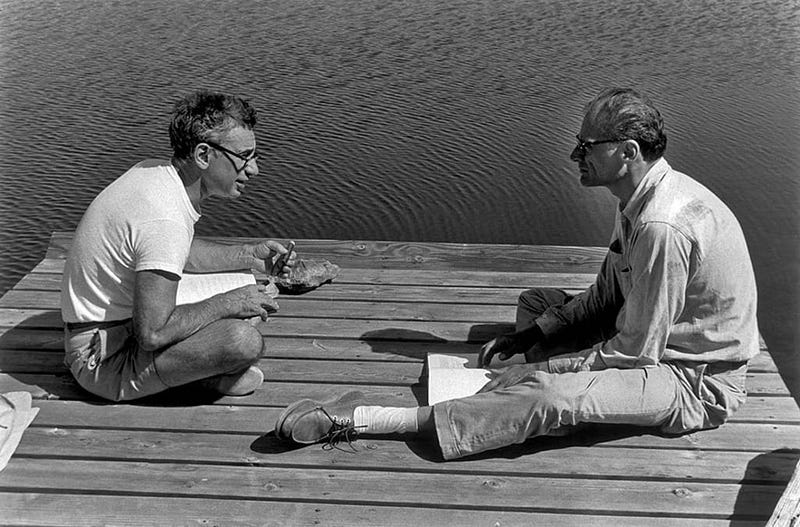
Today in Part 3 of a 6-part series to run each day this week, Chris reveals how he approached writing the story’s two characters: Kazan and Arthur Miller.
Scott: The description that you had of your own existence going from the band and then to college and teaching high school shows that you were trying to better yourself. I could see why you would resonate with this idea.
Chris: Yeah, 100 percent. Even my script I wrote about the skateboarder Rodney Mullen, which is what got me connected to Bellevue. Rodney Mullen was the skateboarder who invented the Flatland Ollie — the jump without a launch ramp. Revolutionized skateboarding. He was on the Bones Brigade alongside Tony Hawk back in the 80s.
He’s watching these guys go 50-feet ramps and going 30 feet up and above that and doing tricks and he was like, “I can’t do that.” He was pulled out of obscurity in Florida and brought to LA and told, “No. You’re going to do great things. You’re going to be huge!” And it doesn’t happen for him. Not for a long time. That was autobiographical for me.
Every character that I’m drawn to has that sense in them that there is something that has yet to open up, or they have more to give to the world, and the struggle is figuring out how to get it out.
That’s what drew me to Kazan, Miller and to the guys from Viceland, from “Vice Magazine.”
Every script I wrote that had wheels on it, that was the invisible thread through all of them. People yearning to do immortal things. If I have a motif in my scripts, that’s it.
And daddy issues. [laughs]
Scott: Let’s talk about these two central characters. I’d like for you to draw comparisons and contrast between them. Here’s how Kazan’s introduced in the script:
“33, a ragged face of Middle Europe roots, carries the scars of a poverty-stricken immigrant upbringing and a rage in his eyes. Didn’t even have a smile.”
Then, in contrast, Miller:
“33, prim and proper mannerisms manicured-like hedges around his father’s estate. Unlike Kazan, his face is solid, built on a foundation of a full belly of wealth.”
There’s obviously a socioeconomic difference between the two. What else would you say draws them together, but also distinguishes them?
Chris: The two biggest differences that I pulled from the research between Miller and Kazan was that Miller was artistically satisfied. He knew he was good. He knew that he was great. And didn’t really need to prove it. He knew the world would come to him because, being a child of upper class roots, it always did. He never had that feeling that he had to be hungry. To sacrifice. To do the next thing and the next thing had to be bigger than the previous thing.
The man hit it big on Broadway with Death of a Salesman, he didn’t even attempt to write another play. He tried to direct another person’s play. Then after The Crucible, which gave him immortality, it took him another 10 years before he wrote the next one.
He was this guy who was cut out of wealth; where it was OK to fail and it was OK to take some time off, versus Kazan.
Kazan, he has in his biography this amazing photo of two year old him and his family when they first arrived in America from Greece. In his notes he says something along the lines of, “If you look at this, we’re all touching each other.” Everyone has a hand on somebody and he was like, “That’s something that we don’t do anymore. Americans don’t do that. We lost that.”
I was like, “This is a dude who has put everything into becoming American to the point where now he’s old and looking back and regretful. He’s looking back and feeling the loss of who he was, and his instinct is… oh well.”
To him, that was a sacrifice to become American. He needed more, and was willing to sacrifice it all to get it. He had to be sleeping with Marilyn Monroe behind his wife’s back. He had to sleep with all of his leading ladies. He had to be on a constant conquest and he had to conquer.
That was what I pulled from it. You don’t get to the top without making some people angry. You don’t get that thing without burning bridges. You don’t bed Marilyn Monroe if you don’t plan on hurting other people. For him, anybody who stood in the way of him becoming an icon, becoming immortal and a legend, the best there ever was, anybody standing between him and that was going to get trampled, including his own family. But not Miller.
Miller knew he was going to come up with something great and was patient. And it was that calmness that eventually got him married to Monroe (and eventually bore her to divorce). Kazan wasn’t. He wanted to burn the world if they didn’t love him. That was what he wanted to do.
Scott: You get a sense that he needed that external validation and that’s what the Oscar for Best Director represented for him, right?
Chris: Yeah, his shield. To prove that he was an American. His father charged him, “Make this country yours, make the Kazans be American.”
He thought the only way that could happen would be to achieve something that equaled America’s greatness — that top tier, one-percent thing. In his mind the Oscar was that thing. He watched Miller win awards effortlessly. He was fuming about that.
We took some liberties with Kazan’s story because, if you’re a big Golden Age of Hollywood nerd like John and I, Kazan did win a Best Director Oscar BEFORE On the Waterfront. It was actually for his first film ever, A Gentlemen’s Agreement, the moment he got out there.
John and I were like, “No, we’re not going to talk about that. Don’t tell anyone that.”
[laughter]
Scott: I do want to get into that, because writing a historical adaptation is a tricky business. I want to get to that just a sec because there’s a whole backdrop to this.
Of course, being a screenwriter and a lover of history, the Hollywood Blacklist was just such an incredibly vicious period of time.
There’s always a question in Hollywood whenever you do something that’s a period piece: “Why now?” You just mentioned it earlier. We are in this strange type of an environment nowadays that echoes the political and cultural situation back in the late 40s and 50s America.
Maybe you could talk a little bit about your understanding of that whole Red Scare, HUAC committee, the Hollywood Blacklist. What was your general sense of how you’re going to use that as the backdrop of the story?
Chris: I think I was raised as a creative-minded person. But blue collar. My mom worked on a factory machine when I was a kid. So did my father. Section 9 housing. Workers Unions. Rage against the machine. The landlord sucks. The boss sucks. Damn the Man. Power in numbers. .
My grandfather Joe Smyrski took me to see the movie Guilty by Suspicion in 1991. He was the guy who sort of planted the seed of the love of film and the meaning of film for me. We’d go to movies and he’d explain all the inner workings to me so I understood what I was watching. And took me to movies that were over my 12 year old head, but he had a magic to him that made it all make sense to me. That’s where I learned about McCarthy… and him showing me Silkwood, the Union-movie with Meryl Streep.
The more I read about Kazan, the more you realize that it was a no-win situation for everybody involved. Pressure from McCarthy, from the Unions, from the communists, from the studios. Once you were named, you were named, and that was that. You had to choose a side.
Tying it into the Salem witch trials, as Miller did, made perfect sense. I say this as a fan, but The Crucible is a very easy interpretation of the situation. Be good. Stand by your principles. Deny. Deny. Deny. Versus Kazan, where here’s this guy who’s like, “Look, I won’t deny it. I was a communist. I told you I was a communist before. It’s the truth!”
He testified twice. The first time he named himself, didn’t name anybody else. Even when provoked, he was like, “No, I’m sorry, I’m here for me. If you want to know about them, you can ask other people, but I’m not going to tell you.”
Then the second time he’s realizing that these people he’s protecting, these members of Group Theatre back in the day, who had kicked him out of Group Theatre because he stood up to the Communist Party, threw him under the bus.
Why protect those people? Brando’s Terry Malloy was a thug. Did horrible things because horrible people told him to. Then they turn on him and try to get his brother to kill him.
That was what was happening to Kazan in Hollywood. They were driving wedges between him and Hollywood. “Why am I going to lose Hollywood over these people who weren’t protecting me back then?” He did it and had to face that backlash.
I think that’s important today because you read about these celebrities who say something or they post something, or whatever, that either is viciously cruel and heartless or is misconstrued that way. The Internet and the social networking today is like having your name named. If you post the wrong thing, and enough people say you’re out… you’re out.
Be honest about who you are and what you think. But accept the consequences.
That’s what Kazan was facing. He was like, “Well, I can fess up and be honest and continue on and be hated, or I could lie and keep some sort of false sense of pride about who I was and lose everything. What should I do?” He chose to protect himself.
Now, as a 47-year-old writer who feels like they’re on the brink of something happening in Hollywood, if I was in that situation, I can’t tell you I’d go the Miller route or the Kazan route.
If it was suddenly anti-American to be in a band and could lose the last seven years of work in Hollywood because of it. And someone said, were you in a band? I’d be like, “You know I was in a band! You know who I was in a band with! It’s documented! Why do you need me to say it!?!”
Damned if you say the truth. What everyone already knows. That’s where Elia Kazan was. I’d like to think I’d take the high road and do nothing, but I can’t honestly tell you what I would do.
I wanted to get that in the script. I wanted people to get into Kazan’s mindset and be like, “This isn’t an honorable thing from any point of view.” This is a rock and a hard place and there’s no easy decision to make.
That was the motivation for the story, do you tell the truth to save yourself, even if the truth hurts those you love? In the end, he told the truth. What everyone already knew.
But he never named Miller. Even when implored.
Tomorrow in Part 4, Chris discusses how it took him two and a half years to nail the story structure before starting to write the script.
For Part 1 of the interview series, go here.
Part 2, go here.
Chris is repped by Bellevue Productions.
chrisparizo.com
https://www.imdb.com/name/nm8446483/
www.slamdance.com
For my interviews with dozens of other Black List writers, go here.