Interview (Part 3): Charlie Wachtel and David Rabinowitz
My conversation with the co-writers of the movie BlacKkKlansman.
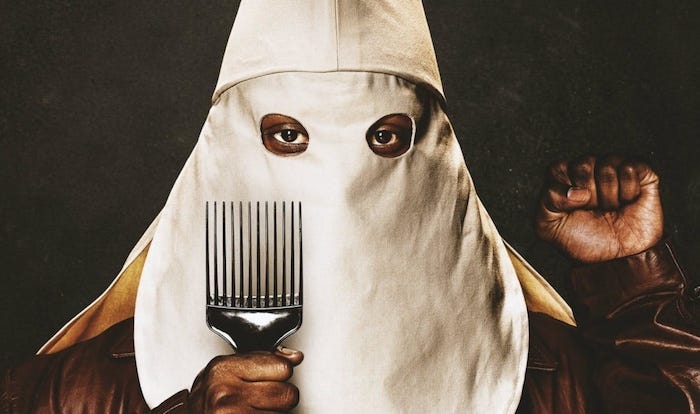
My conversation with the co-writers of the movie BlacKkKlansman.
The provocative movie BlacKkKlansman opens in North America this weekend. Directed by Spike Lee and starring John David Washington and Adam Driver, it was originated and co-written by screenwriters Charlie Wachtel and David Rabinowitz.
Today in Part 3 of my five-part series interview, Charlie and David discuss how the controversial nature of the story’s content is particularly relevant to our current cultural discourse about race.
Scott: It’s effectively an adaptation, based on a book which is based on a real life experience. In the adaptations I’ve written, I found it’s as important sometimes as what narrative elements you omit as to what you include. The sheer amount of storylines, did that pose a problem for you in deciding what to use and not to use?
David: It was all creative problems. There are huge portions of the book that we could not include and we had extensive conversations about, “Well, should we include this? Should we not include this?”
That was between us and Ron. Ultimately, it was like we knew there were certain things in the book that would be in the movie 100 percent. There were certain things that had to be in the movie to give it a cinematic structure. After that it was, “Does this work for us or does it not?”
Scott: I’ve seen the trailer, it’s great. It’s clear that this is an angry movie and it’s also got a lot of humor in it. Even the conceit. You mentioned high concept, the title. The conceit of a white guy impersonating a black guy who’s imitating a white guy feels like an ‘80’s high concept buddy comedy.
[laughter]
David: Sort of, yeah.
Scott: That had to be tough. You want to write it as a thriller. It’s got dramatic elements and yet it’s also funny. The subject matter, racism, is dead serious. How did you find that balance point?
Charlie: Early on it was important to us, and it was important to Ron as well, that this movie, while we preserve the comedic elements, it tips to the genre of a thriller more so because Ron especially wanted people to take this seriously.
He wanted people to be moved by this. He didn’t want it to be this throwaway piece of comedy, but more so a sophisticated satire that the audience would be really into and invested in.
David: There are absurdist elements to the story.
Charlie: It’s impossible to ignore them.
David: Our general thing was, as long as these characters are reacting to these absurdist elements in a grounded, believable way that’s not undercutting our character, then we’re good. If that leads to a funny moment, then great because it’s going to be grounded and real.
Scott: You’ve spent a lot of time breaking the script, breaking the story. You write the script. This is now early 2016, maybe January, February. How are you getting the script out there at this point? Are you represented or not?
Charlie: A few months after we discover it, I had a run-in with a producer named Shaun Redick, who I had met through my days as an assistant. He had just formed this company, QC Entertainment, with Sean McKittrick, Ray Mansfield, and Ed Hamm.
Scott: They were behind Get Out, too, right?
Charlie: Correct.
David: Yeah. That wasn’t really on anybody’s radar at that point. Shaun invited us in to pitch it to him and Ray Mansfield at QC. We were still in the middle of writing it. We pitched it. They had a very good reaction to it.
They said, “Hey, we’re in early pre-production on this thing called Get Out with Jordan Peele. This would be an easy conversation to have with Jordan. He might be interested.” Then, maybe two or three months later, we had a draft in to QC. Jordan had read it and he came on board as the producer.
Scott: At this point, do you have a manager or anything?
Charlie: We still don’t have a manager, actually. I reached into my Rolodex. Right when I got the offer, I was like, “Oh, crap. We need a lawyer. We need an agent.” I hired this lawyer who I had met on a golf course. Yeah, he gave me his business card once. I didn’t think I was ever going to need it.
Then I asked somebody over at the agency world, at UTA where I worked, if he wouldn’t mind making the deal. He said, “Sure, I’ll do your deal.” Now, we had at least the backing of serious people so that we wouldn’t get taken advantage of.
Scott: I’m thinking that this not the object lesson we want to give to aspiring screenwriters, that they should spend their time on Facebook and golf courses…
[laughter]
Charlie: Yeah, probably not.
Scott: …to augment their career.
Charlie: If they can get a gig at a talent agency, that’s a better place to start.
Scott: The script is acquired in 2016. You’re writing in 2015. 2016, of course, was a presidential election year in which race was emerging as a provocative issue.
Do you think that cultural context had any influence at all, apart from the fact that they wanted to do movies that were aimed at the black audience? Do you think that there was something about that particular thing bubbling up that may have influenced the decision to acquire the project?
Charlie: I think that definitely made them a little bit more confident in their decision, because all of the stuff that was going on. The conversation was evolving on a week by week basis.
We were lucky enough because, when we were ultimately hired to do the rewrite, that was towards the end of 2016 when, obviously, that conversation changed very much so and intensified. We had the opportunity to make things a little bit more political and tied a little bit closer to the conversation in our country at the time.
Scott: Yeah. You look at the trailer, and it’s like, “Oh, my God. This is like the perfect movie for right now,” where things are you might say cultural conversation, some might say scream fest about race relations and the rise of public racism. What are your thoughts on that with this movie coming out right now where we are culturally?
David: Well, it’s kind of crazy. We think that no matter what people’s reaction to the movie is, good or bad, we think there’s going to be a lot of just reactions in general, which is, overall, a good thing. People are going to be talking about it, hopefully.
Charlie: I think it’s going to be polarizing in a sense that it’s a Spike Lee movie. He has political leanings and a certain attitude about things which some people really like and some people, it rubs them the wrong way.
I personally think, in many ways this is not a controversial film at all because we’re not demanding so much of the audience when we say, “Hey, we’re gonna bring down the KKK. Can you side with us on this? If you can’t side with us on this, I don’t know what side you’re on.” That’s the way I see it.
Tomorrow in Part 4, Charlie and David talk about the surreal experience of stumbling upon the real-life story which led them to write BlacKkKlansman, attending the movie’s premiere, then watching as the movie has been receiving glowing reviews from film critics.
For Part 1 of the interview, go here.
Part 2, here.
Twitter: @therealcwach, @BlacKkKlansman.
For 100s more Go Into The Story interviews with screenwriters, TV writers, producers, filmmakers, and industry insiders, go here.