Interview (Part 3): Callie Bloem and Christopher Ewing
My interview with the 2022 Nicholl Fellowships in Screenwriting winners.
My interview with the 2022 Nicholl Fellowships in Screenwriting winners.
Callie Bloem and Christopher Ewing wrote the original screenplay “Tape 22” which won a 2022 Nicholl Fellowship in Screenwriting. Recently, I had the opportunity to chat with the couple about their creative backgrounds, their award-winning script, the craft of screenwriting, and what winning the Nicholl Award has meant to them.
Today in Part 3 of a 6-part series to run each day through Saturday, Callie and Chris reveal why the number 22 and discuss the physics behind the metaphysical conceit of bringing someone back from the dead for four minutes and twenty-three seconds.
Scott: The format. It’s a cassette tape. It is like this thing when he’s listening to them, it brings the past into the present. You’ve psychologically got a little bit of time travel thing going on there. Question: Why 22? Does that number mean anything?
Christopher: The initial idea was that it was enough that you could find a box filled with that many tapes and it wouldn’t spill into a briefcase or something bigger and unwieldy that you would have to find. Then we also thought about famous movies with numbers in their titles, and we couldn’t think of a lot of 22. There’s “21 Grams,” and then Tape 22 and then…
Scott: There you go.
Christopher: I can’t think of a 23. I’m sure there is.
Scott: You got one in the script. The song is 4:23 in terms of its length. He’s listening to these tapes and he comes to the last one, the last tape, 22. Sam’s recorded voice saying, “This is my favorite song.” I’m wondering whether it’s that last tape, whether that was intentional on your part or maybe that’s Sam saying, there’s a sense of finality here because it is the last tape.
Christopher: Yeah. Our idea was that basically Sam was making these tapes until she had confirmation that this was going to be their forever relationship. That they were going to exchange I love yous and this was going to be it for them.
By her sharing her absolute favorite song with him as the last song on the last tape that she would ever make during this courting process, it was like her baring her soul and saying, “This is all of me.” Now, you know through how many of her songs you could fit on 22 tapes, whether that’s 672 songs, this is the biography of Sam. This is everything that you ever need to know about me.
Also, throughout these tapes, she’s also been leaving him messages in between the songs. Recording these messages onto the tapes herself. She’s basically created this in‑real‑time blog of her feelings about Hutch as they’re developing.
The idea that this is the last song, and she’s finally sharing it with him, this is the song that made her want to become a producer, it’s like now, we’re able to exist as Sam and Hutch.
Before she gave him that song, she was still Sam and had her own personal trajectory. By the time she shared with him that song and that final piece of her, now, it was Sam and Hutch. They were going to go together as a duo.
Scott: It helps, too. You do have a metaphysical element in the story, which I want to talk about in a second. The fact that that song is so much of what she is about, and what the couple was about, does lend itself to this metaphysical element. Which is that when Hutch plays this song, Sam appears to him alive.
I thought when I hit that part, I was like this could have been a drama about a grieving husband listening to tapes and memories, processing his pain. Wandering around the streets of LA, but no. The dead wife returns as a kind of ghost. So yeah, we are now into definitely high‑concept territory.
[laughter]
Scott: That little note that Chris wrote, was that there about the mixtapes? That was part of the thing from the very get‑go.
Christopher: Absolutely.
Callie: Yeah.
Christopher: 100 percent.
Callie: We love those high concepts. I feel like that’s the easiest way for us to start any project is to have that quick, little high‑concept sentence.
Our first short film that we did is called “Written By.” It’s about a woman who discovers that she’s fictional, and was written by a man. We start with these quick, brief, little ideas, then we can fill everything else out, and then it all falls into place.
Christopher: Whenever we’re writing our outline, and working together on figuring out the big ideas in the script and the big visuals, one of our go‑to processes is we always ask what is the trailer moment?
What’s the thing that you see in the cinema, and makes you say, “I have to go see that movie,” or you see online on your phone on silent for five seconds on Instagram? What’s the thing that hooks you into, “I need to go see that movie”? That, for us, the idea of her actually appearing, was the thing where you would sit up and take notice of the movie.
Scott: I have a theory that basically, all successful movies, they evoke memories of previous films that did well. When I read your script, I was thinking of the movie, Ghost, a big hit in 1990. There’s a similar thing where Molly, her husband has died. His name was Sam, by the way. I wonder if there was an homage there, or if that was unintentional.
Christopher: Yeah. I haven’t…
Scott: That was unintentional?
Christopher: That’s actually so interesting.
Scott: That may be a little bit of Jungian synchronicity or something there.
Callie: I desperately wanted my name to be Sam when I was little.
[laughter]
Scott: Another movie that I was thinking of which I enjoyed quite a bit was Palm Springs.
Callie: Yes.
Scott: I made that connection for a lot of reasons. First of all, there’s that fantastical element. Nyles and Sarah are stuck in reliving, like Groundhog Day. You’ve got this fantastical element where every time Hutch plays this song in this specific place, he gets Sam back for four minutes and twenty-three seconds.
Then, there’s also the romance dynamic between the two characters.
Also, there’s physics involved in both movies. Finally, you look at the narrative elements — a grieving husband, mixtapes, that’s drama territory, but Tape 22 is funny.
Christopher: Thank you.
Callie: Thank you.
Scott: Palm Springs did the same thing. You got this dark, cynical tone, but it’s also very funny. Was that your intention all along that it was going to have this tone? If so, how did you manage to pull that off, because it’s tricky?
Callie: We always knew we wanted it to have that tone. We call that the Callie and Chris tone. It’s a space that we’re comfortable in and we enjoy. We love everything to have a lot of depth and emotion, but also still be funny. We like to say it’s our funny drama about ghosts, grief, and great music.
Christopher: For us, our default is trying to write funny dialogue and funny situations no matter what kind of script we’re writing.
We usually find ourselves dialing back on the jokes a little bit to make more room for drama. Usually, our first drafts are terribly written laugh riots. Then, we scale it way back so it’s just not a ton of non‑sequitur jokes that no one cares about.
It was important for us that we always think even when terrible things are happening in life, humor is such a huge part of our lives. We always try to see the comedy in any situation. That’s a life thing that comes through in our writing, but I’m very happy that it was funny to you.
Scott: Let’s talk about the physics of this. You’re reading along, then suddenly there’s all this dialogue about dielectric-slab waveguides and Faraday cages.
It doesn’t seem that either of you got a background in science, yet it all sounds authentic. Did you have to do a lot of research?
Christopher: Some, yes.
Scott: Some.
Callie: Some.
[laughter]
Christopher: I personally am obsessed with physics, but I never fully understand it. I’ve never fully understood any physics book that I’ve finished reading. I love a lot of those ideas, and we wanted to play with some of that.
We wanted to make sure that what was happening wasn’t purely supernatural. It wasn’t purely a religious experience. We both feel that ‑‑ especially, during the time of the pandemic ‑‑ science is incredibly important and holds a lot of answers.
We always wanted it to be a scientific explanation, but in the same way that the idea of science takes a while for us to get answers. We usually can say we have an idea of why somethings happening many, many, many years before we know the actual reason.
We love the idea of having this be an inexplainable phenomena that scientists can’t quite explain yet. And because Hutch is a layperson, he really has no idea what’s happening around him.
It would be like if someone figured out fusion, but they weren’t one of those fusion scientists, they were like a sad rocker dude in Los Angeles. What’s he going to do with it? Probably going to maybe destroy Los Angeles accidentally.
Callie: We wanted to have enough science in it so it felt reasonable, like, “Yeah, that explains it.” We didn’t feel like we had to go so deep into it that it needed to be accurate.
Christopher: Most of the science is more audiology and audio science that might not have transcendent physics repercussions.
We wanted it to feel tangible, so it wasn’t like a ghost story where it’s like, “Oh, anything could happen.” We wanted it to feel like it had some rules, even if Hutch had no possible way of comprehending what those rules were.
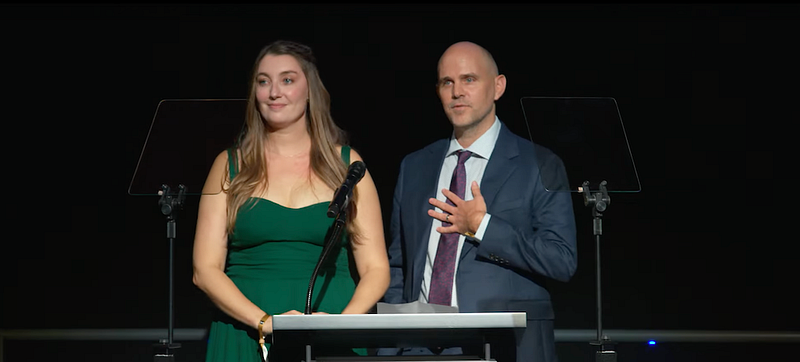
Here is a video of Callie and Chris’s Nicholl Award acceptance speech:
Tomorrow in Part 4, Callie and Chris provide insights into several of the memorable characters in their script Tape 22.
For Part 1 of the interview, go here.
For Part 2, go here.
Callie and Chris are repped by Grandview.
For my interviews with every Nicholl Fellowships in Screenwriting winner since 2012, go here.
For my interviews with Black List writers, go here.