Interview (Part 3): Allison and Nicolas Buckmelter
My interview with the 2018 Nicholl Fellowships in Screenwriting winners.
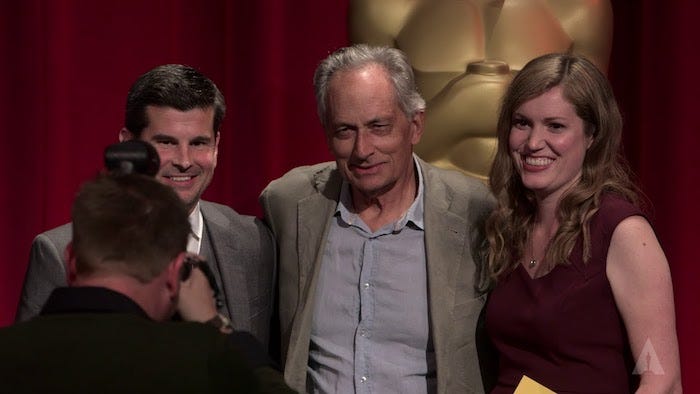
My interview with the 2018 Nicholl Fellowships in Screenwriting winners.
Allison and Nicholas Buckmelter wrote the original screenplay “American Refugee” which won a 2018 Nicholl Fellowship in Screenwriting. Recently, I had the opportunity to chat with the married couple about their backgrounds, their award-winning script, the craft of screenwriting, and what winning the Nicholl has meant to them.
Today in Part 3, Allison and Nicholas discuss the two families at the center of their story, and how they explored various levels of conflict between characters.
Scott: Let’s talk about these two families. We meet the Morgan family, Greg Morgan and his wife and children. They light the center of the story. They’re the ones who’ve moved out there. The year’s 2023, and things are tenuous in the world. Let’s talk about these family members. Maybe could you give us a description of who Greg Morgan is?
Allison: We had Greg being a college professor of Peace and Conflict Studies, which we just thought was relevant to the story.
Scott: That’s an actual program at Cal, isn’t it?
Nicolas: Yes, I think it’s called Global Studies now.
Allison: Yeah. Then we developed this backstory, which you don’t really see too much of in the script. It’s there a little bit. About a year earlier, Greg had an affair, which, along with what was happening in the country, sparked the family’s move just to start over and start afresh. He’s teaching online, guest lecturing. His wife is an OBGYN, but she’s recently retired from her practice. She has conflicting feelings about that. She both hates and misses her work.
Scott: Greg is black and she’s white.
Nicolas: Yes.
Scott: Maybe let’s unpack a little bit those writerly instincts that, as you’re developing this backstory, in terms of the interracial composition of the marriage and providing that tension that he’d had an affair with a graduate student, how did those emerge? Where did they come along in the process? Were they pretty early on or did that just…?
Allison: The whole backstory with the affair was a later draft addition. We had written a very early draft, which we did submit to the Nicholl a couple years before, in 2016. It was a semi‑finalist, I think.
In that earlier draft, Greg was a video editor. They were from L.A., and he had done editing in L.A. Then they moved somewhere rural. There was no affair. He was a bit of a man-child. That’s where their relationship tension came from. He hadn’t really done anything wrong.
When we got notes back from readers… As you can imagine, if you’re down in a bunker with people in a small space, tensions are heightened because of the close quarters. There are quite a few scenes where Greg and Helen are arguing. But it just felt like, “Where is this animosity coming from?” It felt forced.
Then we realized, if they came down into that bunker with baggage, it would make it a lot more interesting than just their personalities getting on each other’s nerves.
Scott: He was more of a, as you just said, man‑child and you…
Allison: That’s probably not the right term to use [laughs].
Scott: Yeah, but he evolved into something that provides a similar length of arc for his character. He became this academic, which is book learning, which is the opposite of what you need in a survivalist type of a mode.
Allison: Exactly.
Nicolas: Right. That was a specific choice, to enhance that aspect of it, because some people spend their whole lives preparing, learning skills that are useful in a broken society. Other people, like us, we spent most of our education acquiring skills that are really only useful in a functioning democracy.
A guy like Greg, with his academic background, lives in his own head a little bit. Winter in fact calls him out on that. That was a specific choice to emphasize the tension that would arise from somebody without the necessary skills.
Scott: They have two children, Zoe and Kai. We’ll talk about them in just a sec, but Kai, who’s 11, you use him, in voiceover narration, as a device throughout. He says in voiceover narration, “But my dad, I always wished he could be the alpha,” which, in a way, presages his arc, isn’t it? He’s got to get in touch with his alpha male over time in order to help the family.
Allison: Right.
Scott: Let’s talk about these two kids. Zoe, 15, sister. You describe her in the script as mature beyond her years. Kai, who’s really, in many respects, not only just narrator, but he has a unique perspective on the world there. He’s got some medical and psychological issues, I guess you’d say. Maybe you could describe both of the kids for us.
Allison: We imagined Kai was a child with autism.
Nicolas: Yes, and nonverbal. We wanted him to be the, as you say, the voiceover narrator, but, more importantly, the conscience of the story. This character who didn’t have a voice, a literal voice… We wanted to give him a voice.
Around the time we were writing early drafts, I remember hearing a radio interview with a man who had a nonverbal son with autism. If I recall, the man had good reason to believe that his son had this rich, incredibly thoughtful interior life that he just wasn’t able to articulate verbally.
Listening to this father talk about his child was very moving. We thought it was a beautiful idea to allow a character like this to be heard, and we wanted to incorporate it into a story about a contemporary American family. That was the thinking there.
Scott: It also contributes to the challenges that they face, not only in their daily lives, but once the proverbial shit hits the fan, they’ve got to deal with that aspect of living with Kai.
Allison: Right.
Nicolas: Right, and from Winter’s point of view, he almost looks at Kai as a liability. We were repulsed by that idea and thought that it was a very compelling thing for an antagonist to do. We wanted to give Kai some role to play in his family’s redemption or success in navigating this very perilous situation.
Scott: Was the voiceover narration that choice? There’s a conventional wisdom which, in my experience in Hollywood, is really more of a convention than wisdom. [laughs] The conventional wisdom is that voiceover narration represents “flabby writing,” the Robert McKee character says in “Adaptation.”
Did the choice to use voiceover narration arise mostly out of wanting to access Kai’s inner world as opposed to we feel like we need a narrative voiceover narration to stitch the story together, or something?
Nicolas: The former.
Allison: Yeah. Honestly, it was just a sudden choice. When we were sitting down, doing page one of the script, we’re like, “Let’s try this.” It just came out. It was something we were trying on page one. We liked it, and we kept going with it throughout the script.
Nicolas: Kai is commenting. He’s establishing a perspective.
We agree with that idea about voiceover generally, but we thought that in this case, it was an original enough and emotionally engaging enough reason to include it. Interestingly, at least one reader suggested to us that we should consider dropping it.
Allison and I took that into account. We talked about it a lot and ultimately decided, “No, this is really essential to the story of this family and of Greg’s journey as well.”
Scott: First of all, I think it’s plenty fine. It’s a terrific narrative device that’s been used successfully in movie after movie after movie. It’s just that when it’s used poorly, when it’s describing something that we already see on screen. What you all did was you provide an access point to this really unique perspective, this boy, and his interior life.
I think you do a quite lovely and a quite wonderful job of it in the script.
Nicolas: Thank you.
Tomorrow in Part 4, Allison and Nicholas delve into the relationship which develops between these two radically divergent families and the impact that has on the individual family members.
For Part 1 of the interview, go here.
Part 2, here.
For my interviews with every Nicholl Fellowships in Screenwriting winners since 2012, go here.
For my interviews with 53 Black List writers, go here.