Interview (Part 3): Adam Best
My interview with 2023 Black List writer for his script The Wolf in Chiefs Clothing.
My interview with 2023 Black List writer for his script The Wolf in Chiefs Clothing.
Recently, I had the opportunity to chat with Adam Best about his creative background, the craft of screenwriting, and his Black List script The Wolf in Chiefs Clothing.
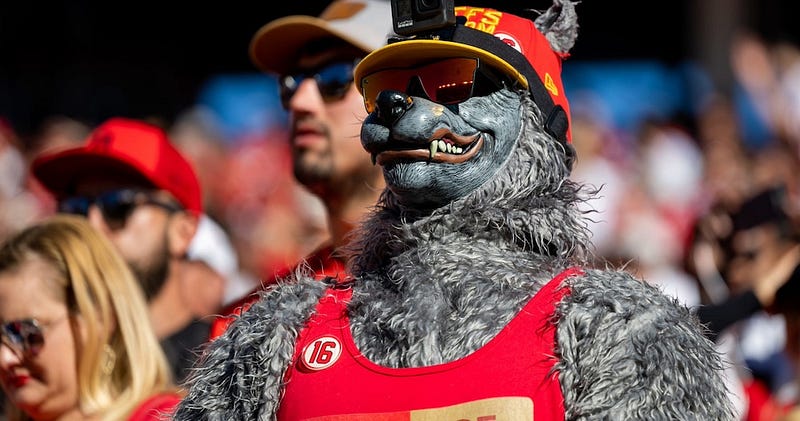
Today in Part 3 of a 6-part series to run each day this week, Adam reveals how and why he came up with the imaginary character Wolfie for his 2023 Black List script.
Scott: We haven’t talked about one of the more influential characters, and that’s the imaginary Wolfie. You’ve got the good angel over here in Emerald, and you got the devil dude over here, Wolfie. You had this idea, an imaginary friend or imaginary character. Let’s talk about this character. How did that character evolve in your writing process?
Adam: In a previous script, I created a character named Ocho, who was a telepathic octopus. Had a lot of fun doing it. Didn’t know if I quite nailed it, but I always want to challenge myself. I have this theory that screenwriters are indeterminate growers. Like snakes, goldfish, tomato plants or whatever. The environment we place ourselves in encourages or restricts growth.
When I start writing a script, I want to be slightly terrified. “I don’t know if I can do this.” I think that’s actually a good feeling to have. “Leap and the net will appear” is a famous quote for a reason. I was feeling that with the Wolfie character, but I had seen some other scripts try something like this. I knew it was possible.
I always felt like they didn’t push that imaginary character’s voice far enough. It’s an imaginary friend! You can do whatever the hell you want with this character. You can really push the envelope and make them a super original character.
I just leaned into it. Wolfie’s dialogue is the most fun I’ve ever had with dialogue. Because there’s no line he won’t cross in these imaginary conversations. It was a blast to write and it also took a little while. It took a little while for me to figure out how Wolfie sounded and the rules of when he would appear. Eventually I got that down, but it took trial and error.
There was this album by rapper DMX, “It’s Dark and Hell is Hot,” that was a huge inspiration. Kind of the “Dante’s Inferno” of hip-hop. The whole thing is about being immersed in poverty and the repercussions, how the situation can lead to crime. On that album there’s this song called “Damien.” DMX has a dark friend who gives him fame and fortune in exchange for committing crimes. That was an unexpected spark. Especially when I needed to take it to a darker place.
Scott: Do I remember correctly, but didn’t you mention the word “shadow” in relation to that character?
Adam: I’m pretty sure that’s in there. My mom’s a therapist, so I was thinking along those lines, and always have a pipeline to ask about mental health. I do like to take the mental health of my characters, especially the characters who have issues there, pretty seriously. But also, it’s a story and it needs to be fun.
Scott: Wolfie does strike me as being like a Trickster character. Ostensibly an ally, but he is leading Gage down this path, his inner desire for fame, that’s that shadow dynamic. You’re right, at some point it, you become emotionally involved with like, “God, don’t you see, there’s this woman, Emerald right over here. That’s a path you could go down.” You have a feeling, “No, that’s not going to pan out,” because of the shadow personified by Wolfie, the voice of that self-destructive aspect inside Gage’s psyche.
Adam: There’s a Faustian bargain there. He needs Wolfie to become the person he can’t on his own. There’s some dramatic irony too, because he wants Emerald. He wants to become the person he thinks Emerald wants to be with. However, he can’t do that without Wolfie, who is eventually the side of him that blocks this relationship.
It’s complex in a way, but also pretty simple. It’s Gage’s worst side manifesting itself until he becomes only that. There’s this tug of war. You see an innocent character at the start become corrupted throughout the script. I dig that kind of story. Like The Godfather. Some of our greatest films have this arc.
Scott: It’s like Wolfie is a second cousin of Darth Vader in The Empire Strikes Back. [Darth Vader voice] “Come to the dark side.”
[laughter]
Adam: An extremely sarcastic version of Darth Vader.
Scott: You introduce him on 33: “Wolfie is the Big Bad Wolf and your fucked-up uncle tossed in a blender. A seven-foot tall fuzzball with a sardonic streak.” [laughs] You even say, “Upon seeing this Faustian figment of his imagination, Gage freaks the eff out, attempts to open the passenger door.” By the way, you have a lot of fun with your scene description. In fact, the script overall is quite funny. Any stand-up comedy in your background?
Adam: When I was in LA, I explored writing jokes for comedians. I thought, that’s how Woody Allen, Albert Brooks, Judd Apatow and all these guys started out. Maybe it could be a path for me too. Maybe I’d even grow accustomed to going on stage. But I’m probably too introverted.
That didn’t pan out, but interestingly enough, a random little tangent here, I met Jon Lovitz and asked him for advice. He said, “Don’t have a backup plan,” and that has stuck with me. Doubt he remembers me, but I definitely remember that advice. So thank you, Jon.
During COVID, I thought of that advice because I had never gone all in on screenwriting. It was always my backup plan. I thought, “Man, I gotta listen to that dude.” That’s the way to do it. Just throw yourself at it and find out if you’re good enough or not.
Scott: You have to go all in.
Adam: Yep! As for comedy, it evolves organically. For a long time, I set out to make my scripts more serious than they ended up being. At this point, I’ve embraced comedy and acknowledged that I’m probably never going to write Christopher Nolan style scripts. Humor is very much a part of my process. Things can get a little goofy.
When writers are having fun on the page, the audience is having fun too. So I try to have a blast writing. Whether it’s dialogue, descriptions, formatting, onomatopoeias, whatever.
Scott: That first script you read, Long Kiss Goodnight by Shane Black, there is definitely some echoes there because Shane has a lot of fun with his scene description. His dialogue is obviously great and the action he writes, but his scene description is super entertaining and has a specific narrative voice. Yours does, too, in your script.
Adam: One of our main jobs — especially if you’re writing spec scripts or trying to break out as a writer — is to be a stack buster.
These readers, executives, managers, whoever, they dread reading a pile of scripts. So you want your script to be the one they can’t put down because it’s so fun, it’s so entertaining, it’s so unique, all those things.
A dash of flavor often beats the straightforward route. It’s like that Smiths song. Instead of saying he doesn’t have anything to wear, Morrissey sings, “I haven’t got a stitch to wear.” Using “stitch” brings everything to life. Much more evocative. So I try to spend extra time evaluating if the words chosen can pop more.
It’s weird. When I first started writing, I was probably too voicey, and most scripts weren’t as voicey as they are now. But the rules have loosened, and I’ve learned to pick my spots. For instance, if I’m in a really emotional beat, I have to be careful about stepping on that moment with too much voice, or even humor.
Scott: I also thought it was interesting, but your secondary characters, like Knox is a drug dealer, but he knits, and then one of these FBI agents, I think his name is McCrae, he does performance art, stand-up comedy.
This is one thing I think is a sign of a really good screenwriter, is they care about all their characters, evidenced by how the secondary characters also have some specificity and vibrancy to them. Were you intentional about that or was it just you got to know the characters and these things filtered up.
Adam: It’s intentional. I’m a big fan of the Coen brothers. Watching them over the years, they don’t have empty-calorie characters. Every single character is an opportunity to express something. Some part of the world, or some point of view. The other thing I try to do is you always hear familiar but different in terms of how we should design our plots.
I try to keep that in mind for every beat, every line of dialogue, every character. If I think somebody is a little too trope-ish, I’ll think about, “How can I take this 20 degrees to the left to give us something we’ve never seen before?” There’s a lot of intention to subvert cliches, use misdirection, and give us characters or lines we haven’t exactly seen before.
Scott: Yeah, you had a great phrase in there, “stack buster.” I never heard that one before, but I get it. I tell my students, I say, “You have to imagine that the person who’s reading your script, whether it’s a lowly assistant or a studio. It’s Sunday night, they’ve already read three or four scripts over the weekend. They’re ready to go out and have a drink, and then, ding. Email. ‘You’ve got to read one more script’. That’s your script, so they already hate you. You’ve got to do something that entertains them right from the get-go, page one.”
What you’ve been saying, I think there’s a lot of truth to it.
Adam: I’ve done different things to make my scripts more readable. I learn new tricks each time. Being a voracious reader of scripts can help you achieve that. Over the years, I’ve slimmed down my descriptions. In this particular script, my rule was no descriptions longer than two lines. I wanted a shit ton of white space. I wanted each description to feel like one shot. I wanted it to read super fast. To have the feel of a movie on TNT that you catch channel-surfing and get stuck watching. Breezy.
It’s challenging to condense things. It’s funny, where I learned to do that was stuff like social media, writing ad copy, doing pitches in business. Skills from my previous careers, where you must traffic in brevity to get your message across, have suited me well.
Part of the reason I condense so much is I’m a bit of a maximalist. You can probably still tell by reading my script, but I have some rules to protect me from myself.
Scott: Let’s talk about the ending of the script. On an emotional level, it’s a tragedy. You mentioned the Coen brothers. In Inside Llewyn Davis, where he’s driving back from Chicago and he sees the off ramp where the woman… Did you see Inside Llewyn Davis?
Adam: Yeah, I did.
Scott: Llewyn’s driving past the off ramp where the woman who has had his baby, he could go that way. But he doesn’t turn off, he just keeps going. It is a tragedy on an emotional level. just like Emerald represents in your story. “Gage, go have a normal life with a woman you can love and who loves you.” Did you always have that ending in mind?
Adam: I always had it in mind. I had an early chat with my old teacher, Jill Chamberlain, who’s fantastic. She came up with the Nutshell Method. I often consult with her early on in my story process. I have a writing group, too, that I lean on. Early on, those conversations made it apparent that this had to be a tragic arc.
It could be comedic in tone. You could like the protagonist, but we romanticize bank-robbing to a great degree. During my discussions with Joe, that bank robber, I discovered this is not a victimless crime. They shove guns in people’s faces. That creates PTSD. People have to quit their jobs. People are looking over their shoulders nonstop after that happens to them. A lot of them are women.
So I felt like, sure, he can go on this fun ride and almost make it. But it felt false, emotionally false and societally false, to take this in a happy-ending direction.
Tomorrow in Part 4, Adam responds to some screenwriting craft questions.
For Part 1 of the interview series, go here.
Part 2, go here.
Adam is repped by Writ Large.
https://www.youtube.com/channel/UC3CdquRsu60VZcbGMfr1WgQ\
https://arrowheadaddict.com/
https://twitter.com/adamcbest
For my interviews with dozens of other Black List writers, go here.