Interview (Part 2): Vanar Jaddou
My interview with the 2020 Nicholl Fellowships in Screenwriting winner.
My interview with the 2020 Nicholl Fellowships in Screenwriting winner.
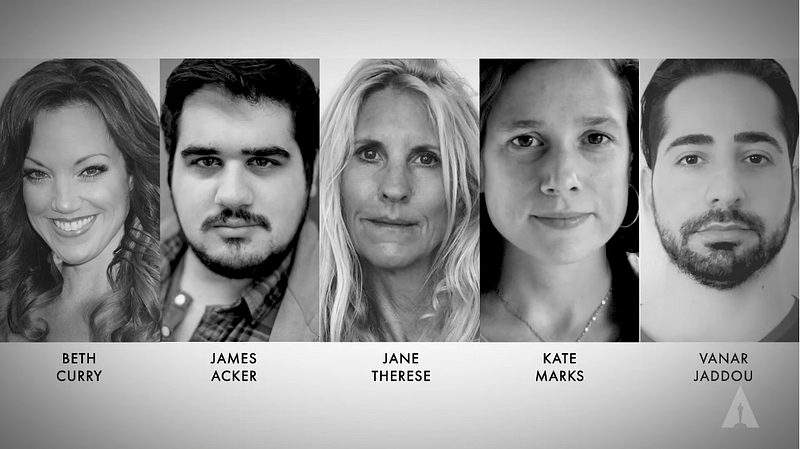
Vanar Jaddou wrote the original screenplay “Goodbye, Iraq” which won a 2020 Nicholl Fellowship in Screenwriting. Recently, I had the opportunity to chat with Vanar about his creative background, his award-winning script, the craft of screenwriting, and what winning the Nicholl Award has meant to him.
Today in Part 2 of a 6 part series to run each day through Saturday, Vanar discusses how real-life events inspired him to write his Nicholl-winning script “Goodbye, “Iraq.”
Scott: A lot of writers talk about the importance of that subconscious writing, coming from that more intuitive state. It sounds like what you’re trying to get at.
Vanar: Yeah, exactly. If you don’t have that embedded in your subconscious, then it’s going to take you a long time to write a script. The script is going to ultimately progress as the techniques supporting it start to evolve more and more. That’s what happened for me with “Goodbye, Iraq.” Going forward, I’m hoping that this just becomes more of second nature to me.
Scott: You mentioned in an interview, “I’m interested in good storytelling. It could be the type of adventure that’ll shake your world, frighten you, make you laugh, sad, create that knot in your stomach, cause you to question things, enliven all these different emotions that were dormant before you sat down to read this or watch that.”
I think that definitely applies to your Nicholl‑winning script, “Goodbye, Iraq.” I’d like to move into that part of the discussion. Described as an action‑adventure thriller about a paranoid ex‑soldier who tries to assassinate Saddam Hussein. When he fails, he and his daughter, 13, have to make a nightmarish trek from Iraq to the United States while being hunted by Saddam’s ruthless regime.
On a much deeper level, it’s a story about a father and a daughter, two people who see the world in completely different ways. In the script’s title page, it says inspired by true events. Could you unpack the genesis of the story and maybe what those true events were?
Vanar: Sure. My dad and my late grandfather shared with me so many different stories, untold stories of Iraq, of their villages, of their people there, what they went through under the regime of Saddam. There were so many differing opinions, actually.
That’s where some of the initial seeds were planted. Several other things are true, like the hanging of his parents, being robbed in red as communist would be. Parts of the refuge were real. Of course, the chemical attacks on the Kurds.
Things like my father’s cousin in Detroit who came here from Iraq and who started a column and started writing things about Saddam and thought he was safe on the other side of the world, but he was found murdered in his store a few days after he wrote a column.
A lot of things were true, but it was also finding that synergy between truth and fiction. As anybody who’s writing historical fiction knows — if you want to categorize this as such — we’ll find that there needs to be that collaboration between fact and art. That’s where the initial seeds were planted.
Then of course, there were dozens of interviews with Chaldeans, with Kurds. I spoke with the Director of the International Crisis Group for the Middle East to make sure things were historically accurate. Then all the individual research that I did, which took me well over a year. That’s where I got the blueprint. But a script is much more than a blueprint.
Like I said in that quote, to me, films have an obligation to entertain. Engaging, informing, empowering, and enchanting the audience are all important. Those aren’t just random words. They’re necessary, each of them. But to me, the number one duty of a writer or an entertainer is to do that. Entertain.
You see sometimes a film is very engaging and informative, but it’s boring. Nothing happens. You’ll see an action film is very entertaining, very cinematic, but it lacks any emotional depth. You’ll see a film that can empower, but it comes up short on a conceptual level.
To me, I always ask, “Does this script deserve to be shown on the big screen?” You say yourself I need to ascend to that in order to produce my best work. For me, I feel like satisfaction is the enemy of artistry. I’m very harsh to myself, very self‑critical. Harsher on myself than anyone else.
That’s the bare origins of “Goodbye, Iraq,” and then everything else is a product of imagination. Cormac McCarthy, he’s been very inspirational for me. The way that he crafts his prose, his themes. Everything he writes is pretty violent and dark. The stakes are always life and death. I leaned into that.
No Country for Old Men, for example. That’s one of my favorite movies. For my script, I wanted to find a way to subvert genre in a way and come up with something that I had never seen before. No one has ever seen a movie like “Goodbye, Iraq” before. It doesn’t exist.
Scott: You certainly start off the story with a bang, quite literally. The two central characters in the story, the father and the daughter. The father is Mahzen. He, as noted in the logline, attempts to assassinate Saddam Hussein. That’s the opening incident. Did you always have that in mind, that opening?
Vanar: Yeah, I did. I always wanted to start with that and see what that would catalyze. That’s something that did happen. There was someone I knew who tried to do that. There were many other people, of course, who tried to do that as well, unsuccessfully.
I wanted to build the whole story around that first scene, because that’s what set everything in motion. I wanted it to be fast‑paced. I wanted them to be on the run the whole time. To be looking over their shoulder the entire time. That was the way that I thought would serve that purpose best.
Scott: That does set everything into motion. It causes the whole narrative engine to get kick‑started. How would you describe Mahzen? His backstory that led him to this crucial point where he’s attempting to kill Saddam Hussein.
Vanar: The idea for Mahzen’s character came from not only people I interviewed, but from an imagined version of what my father could have become if he was enlisted or he joined the regime, which they were pressuring him to do so.
I wanted him to experience some of the paranoia and some of the guilt of what he’s done in his time there with the regime. He was a character, I thought, who had been plotting this for many, many years. He had joined the regime not because he wanted to help them, but because he wanted to be privy to their secrets and eventually one day, his time would come where he would have this opportunity.
He was a mole who was in the regime, but was working with the resistance and he never forgot about what the regime and Saddam did to his parents. He held on to that for his whole life. Everything he did in life was built around that. Built around waiting for this moment.
Now, with his daughter, he essentially took his final shot to not only try and avenge his parents, but also for his country. He saw some of the things that the regime was doing that he didn’t want to be a part of, but at the same time, he had to or else he’d be ousted.
He took his final shot. Then set off with his daughter hoping to build a better life for her than he had for himself. Along the way, little does he realize that she’s already experienced much of what he did when he was young. A lot of the violence, a lot of the horror, the very thing that he didn’t want to subject her to, she’s been subjected to on this journey.
Tomorrow in Part 3, Vanar delves more deeply into the emotional core of his script “Goodbye, Iraq” and its father-daughter relationship.
Vanar is repped by Bellevue and APA.
Instagram: @vanarjaddou
For my interviews with every Nicholl Fellowships in Screenwriting winner since 2012, go here.
For my interviews with Black List writers, go here.