Interview (Part 2): Travis Braun
My interview with the 2024 Black List writer for his script One Night Only.
My interview with the 2024 Black List writer for his script One Night Only.
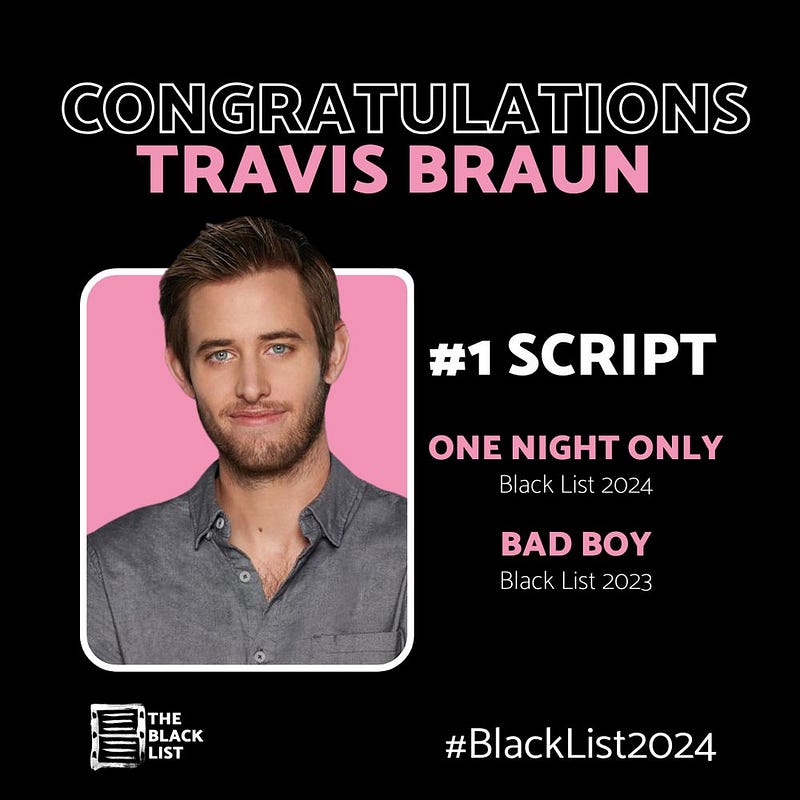
In the 20 years of the annual Black List, no writer has had the #1 script in consecutive years … until 2024. That writer is Travis Braun whose script One Night Only topped the 2024 Black List, his script Bad Boy did the same thing in 2023.
Given all that, I knew I had to interview Travis. We had a great conversation and I’m happy to share it with readers.
Today in Part 2 of a three-part series, Travis and I dive into his 2024 Black List script One Night Only and what that writing process was like.
Scott: Let’s get to the script which was named the #1 script on the 2024 Black List: “One Night Only.” It’s the first time someone had back-to-back number one scripts… Logline: “Two strangers scramble to find someone to sleep with on the one night of the year when premarital sex is legal.” I believe it was just announced yesterday where Will Gluck is attached now.
Travis: Will Gluck attached to direct, and we’ve set it up with Universal. We are casting and trying to figure out how to hopefully get it going.
Scott: Where did that story concept come from?
Travis: I got married recently, and I found myself thinking back to how chaotic and lonely dating was — especially in the app era. That’s where the idea came from: What if all that dating pressure was crammed into one night? Just twelve hours? How selfish would people be, and how lonely would that experience be, trying to navigate that night and find someone that you actually connect with?
The hook is high-concept and absurd, but I wanted to tell a real love story within it. A grounded, emotional romance inside a world that doesn’t seem built for that. The broad sex comedy version exists — but I wanted to flip that. I wanted to tell something tender and true.
Scott: And in a compressed time frame.
Travis: Yeah, I always look for a box to write inside. Something that narrows the decision-making. I don’t trust myself with endless options.
With Dying For You, everything happens on a spaceship. With Bad Boy, you’re trapped in a dog’s POV. With One Night Only, it’s twelve hours. I need that box before I start. It’s the only way I can work — I have to know the boundaries I’m playing inside of.
Scott: You establish the reality of it. People have these biosensors or whatever that you know, it’s red to green when they’re able to start the sex-for-a-night process. Then there’s just one little TV thing with, like, three sides of dialogue from some congressman, and that’s it. You just sort of write it like “Here we go.” I thought it was very efficient.
Travis: The tricky part was figuring out how much world-building to do. How much setup do you really need before we can just go? I didn’t want to get bogged down in explaining the rules. I wanted to get to the characters. But that’s also just me being bored by exposition. I wanted it to feel fast, propulsive. But also human. It’s a love story first. The high concept is just the wrapper.
Scott: Let’s talk about these two lead characters. It is a lovely story between these two. First, Owen who we meet when his significant other announces that basically she wants to go have sex that night with someone else essentially breaking his heart. Maybe if you could talk a little bit about this Owen character and what we need to know about him at the beginning of the story.
Travis: Yeah, I wanted to start with both characters having their plans completely implode. It’s a night everyone plans for all year. So to have it blow up on them right as the clock starts — that felt really fun and relatable.
Owen thinks he’s in love. Thinks he has it figured out. But his girlfriend tells him she wants to sleep with someone else tonight. He’s blindsided. It’s that universal feeling of thinking you’re secure — and then the rug gets pulled out. Now he’s scrambling, just trying to survive this night emotionally.
Scott: Then you’ve got Hannah, who’s got a terrible boss, reminds me of some stories I’ve heard about needy development executives in Hollywood. She’s a romantic. She has this plan with this guy Sebastian, a Latin lover and going to replicate this intense sexual event that they had a year ago, and then that doesn’t turn out very well. Could you maybe talk a bit about Hannah and what we need to know about her at the beginning?
Travis: Yeah. Hannah’s a romantic. She has this big, cinematic version of what love looks like — and this night is supposed to deliver that. She’s got the flowers, the hotel, the Latin lover. She wants the sweeping romance. And then it all falls apart.
She hates everything about this night. It’s transactional, it’s gross — it flies in the face of the fairytale she wants. She’s still looking for her prince charming, and Owen comes into her night, and he’s the furthest thing from her prince charming. So you have these two broken characters together for this night.
Scott: Each with a similar goal. They both want to get laid. In the script, Hannah says, “What’s happening is I’m changing into some hot girl shit, and I’m going to go find someone.” Then later on, Owen has determined, like you said, that he thinks if he can just go and have sex with some random person, that’ll help him get over what’s happened with his girlfriend.
They both have a similar goal making them both active protagonists, which is a plus per conventional screenwriting theory. And setting them up the way you do, these parallel storylines, the reader anticipates, they’re going to meet up. Then they do meet up, then separate, then meet up, then separate.
The narrative falls into the frustration comedy story type, trying to have sex, and you up the stakes. What does somebody need to have casual sex with a stranger? A condom. Now they’re racing around trying to find a condom. When did that idea hit you?
Travis: That was sort of early on. That was one of the first things that I knew would be a plot complication. It seemed like the perfect MacGuffin for this movie. Also, an excuse to get them together again and have them in scenes together and competing against each other in a way also when they first meet.
Their external goal, of course, is to get laid, but more so they do have the same internal goal, which is they’re both extremely lonely on this night and desperate for connection.
Scott: Yeah. You hammer that home, too, because there are these little moments, like they’re just walking along, and everybody everywhere seems to be getting it on …
Travis: Who hasn’t experienced that? When you’re single or when you’re fresh off a breakup or something, and everyone seems to be with someone else, and everyone seems to be in the happiest relationship ever.
Scott: Yeah. Because it’s like a special kind of loneliness. Everybody else has this kind of intimacy, like, really intense intimacy, and you’re not.
The entire script is great, lots of great humor, but my favorite sequence is a 9 or 10-page sequence where it’s just Owen and Hannah talking to each other. In that part your script around the 40-page mark. You know what I’m talking about?
Travis: The section where they’re on the train, and he’s basically making the case for why they should have sex?
Scott: Yes. Exactly.
Travis: I’m glad you like that. That is one of my favorite sections as well. Because it’s two characters clashing, and it’s really two ideas clashing. It’s her holding on to this idea of, like, what romance is and him poking holes in it and trying to shatter that and get her to accept that they’re the best that each of them can hope for on this night.
Scott: You make some interesting choices from a screenwriting standpoint. Like, you do some things where we see Hannah. She’s changed her clothes. Now you go back in time. We see how she got to that point. You do that, like, two or three times. Do you remember what your inspiration for that was? Or was it just an instinct as you were writing?
Travis: It was definitely a process thing. The hardest part to crack was when they should meet, and how much time they spend together. I actually wrote an entire version of the movie where they didn’t meet until the last scene.
They were in the same locations, crossing paths, but never interacting. It was supposed to be this fun, frustrating experience for the audience… and it was frustrating. Too frustrating.
So I went back and restructured. I still liked the idea of intersecting their stories in fun ways, so those time jumps became a way to do that. It gave me opportunities to build tension, surprise, momentum. And as a writer, I get bored easily, so I’m always trying to find devices that keep the storytelling dynamic and fun without pulling focus from the emotional core.
Scott: Another thing you did too, which allowed you to explore the characters’ inner lives were the fantasies. One in particular in the pizza parlor. What was your instinct there? Why include fantasies in there?
Travis: That was a tough decision. I almost cut those. I don’t usually use fantasy or dream sequences, and it can feel like a cheat if it’s not grounded in character.
But in this case, it felt earned because it was only from her POV. She’s the romantic. She’s the one chasing this cinematic version of love. So it felt honest — like a glimpse into how she’s trying to rewrite the story in real-time. It’s aspirational, delusional, maybe even a little sad. But it tells us something real about her.
If the fantasy didn’t come from an emotional truth, I wouldn’t have kept it in.
Scott: That’s a really interesting point. I hadn’t thought about it. But, I mean, she’s the romantic. She would be the one who would be more prone to fantasy.
Travis: Exactly. Yep.
Tomorrow in Part 3, Travis offers some thoughts about the screenwriting craft.
For Part 1 of the interview, go here.
Travis is repped by UTA and Echo Lake Entertainment.
For my interviews with dozens of other Black List writers, go here.