Interview (Part 2): Sean Malcolm
My interview with the 2019 Nicholl Fellowships in Screenwriting winner.
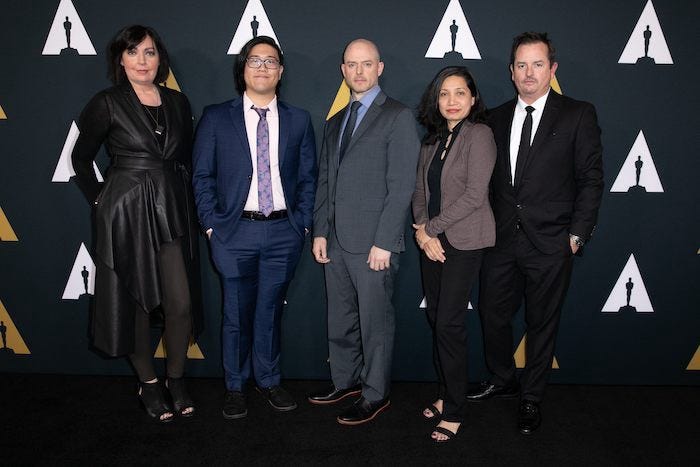
My interview with the 2019 Nicholl Fellowships in Screenwriting winner.
Sean Malcolm wrote the original screenplay “Mother” which won a 2019 Nicholl Fellowship in Screenwriting. Recently, I had the opportunity to chat with Sean his background as a screenwriter, his award-winning script, the craft of screenwriting, and what winning the Nicholl has meant to him.
Today in Part 2, Sean talks about how a photograph was the inspiration for writing his Nicholl winning screenplay Mother.
Scott: I was struck by a comment you made in your Nicholl’s speech. You submitted to the Nicholl quite frequently, beginning in, if I’m not mistaken, 1998 and you made this comment like, “What do these guys want from me?”
As compared to another comment you made later, let’s see if I got that quote, later on, where you talked about, “For the first time in my life, I started writing from my heart instead of my head” when you’re talking about Mother. Can you maybe talk about that evolution a little bit?
Sean: Yes, absolutely. I think for me, prior to Mother…and I wouldn’t say it’s the case every single time, but for the most part, it was sort of the “big idea” that would be the first thing that would come to mind. I would always start with the high concept “what if this scenario or this situation” and that was the thing that always drove me: the concept. I always have different ideas that intrigue me, and so I was jumping around my genres a lot, but basically chasing that high concept.
What I think now in retrospect, I might have spent too many years architecting stories and over-focusing on structure and concept. I would build these intricate plots and spend all this time making sure that logically everything was tight and held water, because I hate movies that have holes where you go, “that would never happen” or “that doesn’t make sense.” Then I would create the characters that were needed around that structure and pull them along like a marionette through the plot, forcing them to hit those gates.
What I now realize is that the organic, emotional, human part of why we watch films and why we love stories was getting second tier in my process.
When I wrote Mother…because the idea came from a photograph of a boy who was about the same age as my son, it was all about the character first. I had a character, but he didn’t have a story. I knew there was this boy I cared about, and I wanted to write about his circumstances, but that was all I had.
I built it from there, but it was always focused on the character first, and the events between him and his mother are a result of their character and their behavior, and not me setting out with a plot saying, “I want them to go here.” The plot developed much more organically from their behavior and response to their environment.
Now I’ve finally begun to understand what it means to say “character‑driven,” because people throw that term around all the time, and I couldn’t ever really understand, “what does that really mean? My story has characters, right? Doesn’t that make it character-driven?”
Maybe if I had gone to screenwriting school or had an MFA or something like that, I would have understood it, but I just had to learn that on my own. It was a like a lightbulb finally went off.
Now when I look back, I still love all the ideas and worlds that I created in my older scripts, but I can see that the characters are not quite as three‑dimensional as they could be if I were to rewrite them, and base it more around the character. And so I probably missed the mark on an emotional level. Maybe I will go back to them someday with that new perspective, who knows?
But you still have to move them through the plot, right? At the same time, it should be a result of their behavior and who they are and the circumstances and choices they make, versus pulling them through because you want to hit certain marks by certain pages or that kind of thing.
With my other stuff, it was always a tight form, from the beginning. You’ve got your plot nice and tight. It’s an interesting concept. It was a page turner, but they never had the type of emotional response in the reader that really sets a piece apart.
With Mother, it was the first time in my life, quite honestly, where there was more than one instance where I was writing, and I actually brought myself to tears while I was writing, because I was so in the scene and feeling what the characters were experiencing. I finally knew I was connecting at a deeper level.
Now, I don’t expect that to happen with every piece of material, but it sets a new bar for me now, where anything I consider, I have to find a way into those characters and try to be true to that. Or I know that I can’t really connect to the material and make it as good as it could’ve been. I don’t have to cry, but I have to feel it, not intellectually, but in the gut. In the heart.
Scott: A perfect segue to your Nicholl winning script Mother, which I’ve read and I was moved by it as well. Logline: “A Syrian mother trapped in Aleppo, becomes a sniper to defend her family.” That’s how it was described by the Nicholl folks.
As you mentioned, there was this photograph that grabbed your attention and moved you to write the story. Could you describe that photograph and then what sort of research did you do about contemporary life in Syria, on the civil war there, that led you to the initial iteration of what the story would become?
Sean: Yeah, of course. I was already very aware of what was going on in Syria before I ever stumbled on the photograph, but, essentially, I had been watching like the rest of the world, and as somebody interested in current events and global politics.
I was watching the Arab Spring as it morphed into the Assad regime attacking its own people, the protesters, and then it just devolved from there. That was the genesis of the war. It was because of how he treated the protesters, just shooting people in the street. Torturing the opposition members and dumping their bodies in the street; an absolutely ruthless fight to stay in power at any cost.
One night in 2016 I was working on another piece and I think I was procrastinating, as all writers do, and I was just looking at some article in “The New York Times” about the war. I stumbled on some photographs from a war photographer. I was just clicking through and they were shots from Aleppo, which was completely surrounded and being bombarded by barrel bombs full of nails and bits of metal and stuff. This is around the time that the Russians had begun to openly back Assad, and we had really done nothing in response. Assad had already crossed the “red line” when Obama was president, used chemical weapons, and we hadn’t responded. And the regime realized that the world wasn’t doing anything, and so it had just escalated to wide-open attacks on civilians.
The specific photograph that I came across was a boy who had just survived an airstrike. He was standing in the street, covered in white soot. He had somehow survived. He had these big dark brown eyes that reminded me of my son, and my son was seven or eight at that time. And I kind of lost it.
That photograph really struck me because I couldn’t believe that innocent children, civilians, were being subjected to this, and that the world was watching it, but nobody was doing anything about it. It wasn’t like, “OK. This is a war far away that I have nothing to do with and can’t see.” They were tweeting about it as it was happening to them. You’ve got people there who have cell phones, trapped in parts of the cities under siege, that are literally tweeting “we’re under attack. We’re civilians and we’re under attack by these military weapons.” Of course, the Russians and the regime were denying it and continue to do so. But they’re bombing hospitals full of babies, all that kind of stuff. It made me so angry, I just couldn’t believe it. I was just blown away that there was so much inaction in the world.
I guess it was a two‑fold combination of wanting to call attention to it, and use the tools of entertainment to maybe shine a little bit of light for people who are maybe less aware of what is going on over there. Plus just trying to imagine what it must be like, and somehow find a story to tell, and maybe some hope in that, if any could be found.
So I started doing research. I realized I would never know who he was. I would never probably go there, although now that could change someday because of the script. But I knew I would never find out what really happened to him. There are thousands of him, really. Tens of thousands. But I began reading a lot of online articles. There are a lot of websites, Syrian resistance and European newspapers, even the BBC covers the war much more in depth, because it’s a lot closer to their doorstep, and they have the whole “refugee migration into Europe” issue.
You just start searching around and finding stuff. I think a few weeks in, or maybe a month or two, and I came across an article about a woman whose children had both been killed in an airstrike. She had become a sniper for the rebels and was fighting the regime. I knew that was really compelling, though a separate story. But now I had a thing to hang the plot on: how does a person go from being a housewife and a mother with children, to becoming a sniper? That became the journey that I wanted to base everything on.
Scott: You put those two characters together then? The boy and the woman, and she’s the mother.
Sean: Yeah, I fused the two ideas together. It became on the surface, like you mentioned, what’s in the log line. It became more about her, and you could capture her arc in a single sentence and see it, which is hard to do. But for me, the emotional core was always the two of them, and their relationship. He was the ultimate empathy point in it, because he’s just a kid. And of course her love for him, and what she will do for him, resonates with us.
Here is a stage reading of an excerpt from Malcolm’s screenplay “Mother” featuring actors Tyrese Gibson, Rosa Salazar, Amandla Stenberg, and Wes Studi.
Tomorrow in Part 3, Sean describes what it was like to write a story about a young woman becoming a sniper.
For Part 1, go here.
For my interviews with every Nicholl Fellowships in Screenwriting winner since 2012, go here.
For my interviews with 53 Black List writers, go here.