Interview (Part 2): Sean Harrigan
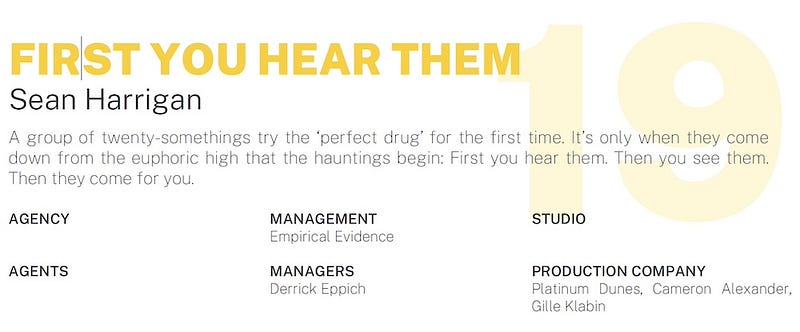
My interview with 2023 Black List writer for his script First You Hear Them.
My interview with 2023 Black List writer for his script First You Hear Them.
Sean Harrigan wrote the screenplay First You Hear Them which was named to the 2023 Black List. Recently, I had the opportunity to chat with Sean about his creative background, writing his Black List script, and the craft of screenwriting.
Today in Part 2 of a 6-part series to run each day this week, Sean discusses the challenges of writing his first horror screenplay.
Scott: It’s interesting, your commentary there, because the idea that these hauntings occur when the drug is wearing off. Aligns metaphorically with the withdrawal experience of someone trying to get off drugs.
Let’s talk about the horror angle. Your first crack at writing in the horror space. There are certain tropes specific to the genre. How familiar are you with horror tropes and such?
Sean: For me, I come from both an outsider and insider view. For a long time as a kid or even growing up as a teenager, even into college, I didn’t latch on to horror.
I remember seeing The Sixth Sense when it came out when I was a kid, and that scarred me for a month. That was one of the scariest things that that I could imagine. Just the idea that you could start seeing dead people at any time was terrifying to me.
The supernatural stuff was always what scared me growing up, so it never was a genre that I latched on to. Then I did a crash course in it, in a way, when I finally revisited it when I was older. And had a deep dive into seeing as many horror movies that I could.
I still wouldn’t consider myself a genre expert, but I do feel like I’ve seen a lot of the mainstream horror classics or even a lot of the indie ones that have come out in the last 10 or 15 years. It’s helped give me a sense of the horror tropes, while also coming in with a newer, slightly outsider perspective to hopefully find something fresh within them too. And connect to that little kid sensation of what would have scared me growing up.
There are people who have such a deep knowledge of horror and know it so well that you really have to be aware of what the tropes are so that you know if you’re playing with them, playing against them, or hopefully not, sinking into them.
Scott: One that you clearly were aware of is that you want to start off with a strong opening incident. You certainly do that. These two young women, Morgan and Lily, on a dark street, and breaking into a car, and there’s drugs involved, these pills. Then there’s this strange individual, like bent‑neck woman, I guess.
Lily doesn’t do very well with that, and Morgan sets up a mystery there. It’s not only just a really compelling and scary opening, it also does set up quite a few questions. It gets us curious, it gets us involved right away.
Sean: Yeah. I know a lot of writers say this, but I feel like those first 10 pages and that first scene specifically are always the hardest. They’re the ones that I spend the most time on and go through the most changes. I think because you’re not starting from a place of momentum and building from the previous scene.
So, I went through a lot of different versions with this one. There seemed like something interesting to me of playing with the irony element of it. Who is the person who you would least expect to be robbing a drug dealer? And then letting it unfold from there.
Then, by making it Morgan, it creates this specter across the story because she’s never seen alive again within the script, but she is this person that creates a lot of the impetus behind it. It was a way that you can also introduce her and emotionally latch onto her, while setting the tone and like you saying, setting up some of the mystery behind it.
Scott: Yes, because Morgan is tied to some of the key characters in the story. Of course, Morgan dies, there’s a payoff for Morgan later on in the story, so it’s not just a random event that happens. It actually is tied to the plot.
To your Protagonist character, Shae Howland, who you describe as, “24, Black, stares ahead at the building from the driver’s seat.” This is, it turns out, is a drug rehab center where her mother is supposed to be. Could you describe Shae’s situation at the beginning of the story, because she’s got several negative dynamics going on in her life?
Sean: She’s gone through a lot of different variations because in the first version of the script, as I mentioned, she was this Trainspotting-esque addict, who was already starting from that place.
Then, when I switched over to making the characters more relatable, I landed on the idea that she was instead somebody who never did drugs. But with that approach, I wanted to do it in a way that felt responsible.
I don’t want, ultimately, the movie to say, “If you do a drug for one time, you’re going to get addicted.” Even if no one’s going to take that away from the script, I wanted there to feel like some justification behind her journey. That’s where it helped having addiction already in her family.
She almost has rebelled so far from addiction in the fear of becoming like her mother that she’s become, in a way, an addict to not using, not touching anything. Having such fear of seeing how her mother turned out: an addict and somebody who’s been absent from her life. Her mother’s in the drug rehab center when we first see her. And her mother has fled from this drug rehab center, not for the first time.
So, really, Shae is almost a reaction to those things. She is somebody that is so far away and so fearful of those things that she’s afraid to engage in drugs, and in a way, that’s a larger extension of being afraid to engage overall in some aspects of her life that she is a little bit disconnected from her life.
Scott: Yeah. Using my own language system, she’s definitely in a state of Disunity at the beginning. She’s disconnected from a lot of aspects of who she is and what she could be doing. Literally, she goes to a bar on her birthday and she’s drinking water. She doesn’t drink alcohol even. She’s unemployed. She recently broke up with this guy, Carson, who comes back into the story. That’s Morgan’s brother. She has a fender bender. She just had a lot of bad things going on.
That’s also a reflection, like in the external world of her state of Disunity. It’s an interesting place to put her. You mentioned that word “reaction.” She does… starting off as very reactive to things. Then over time, she becomes much more proactive, which is an interesting nature of her arc.
Sean: Yeah. I think she definitely starts off as reactive, while also just mainly pushing to get through the day as it goes on. Going back to what we were talking about earlier with character logic, to justify her eventually taking the drug, the idea was really making it like, “What is the worst version of her day?”
How could we put her in the tree and start throwing rocks at her to get her to finally say, “OK, this has been such a terrible day. I want to let loose.” To have that feel logical and also earned within the script.
So she starts off as reactive to this awful day and then makes the proactive choice of going, “OK. I can do this. I am not my mom.” Her friend, Poppy, talking her into that and everything resulting from that choice.
Tomorrow in Part 3, Sean shares his thoughts about some of his script’s key characters and I offer a Jungian analysis of his story.
For Part 1 of the interview, go here.
Sean is repped by Empirical Evidence.
Twitter / X: @swharrigan
For my interviews with dozens of other Black List writers, go here.