Interview (Part 2): Scott Beck and Bryan Woods
The co-writers of A Quiet Place go deep into their background, creative process, and the evolution of their hit horror movie.
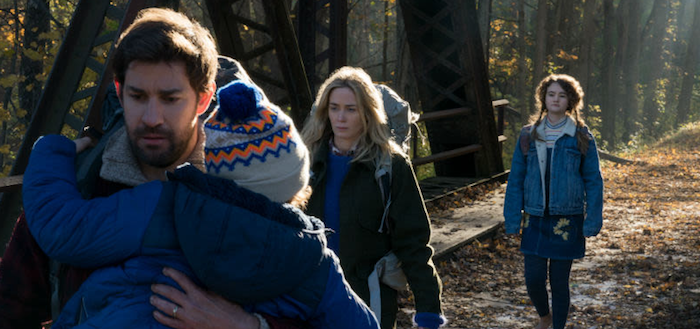
The co-writers of A Quiet Place go deep into their background, creative process, and the evolution of their hit horror movie.
As of today, the Paramount movie A Quiet Place has grossed $235M in worldwide box office revenues. Given the movie’s reported $17M production budget, that represents a ginormous ROI, but the movie is not only a success financially because critics have given the film an enthusiastic thumbs-up: Rotten Tomatoes (95%), Metacritic (82%), IMDb (8.1). Thus, it’s no surprise Paramount has announced a sequel is in the works.
Where did this movie come from? Who came up with the central conceit of the story? Who wrote the original screenplay which sold as a spec script?
The answer is longtime friends and filmmakers: Scott Beck and Bryan Woods. As it turns out, the two have been Go Into The Story followers for several years and with thanks to Joshua Caldwell, I ended up grabbing an hour of the writing duo’s time for an in-depth interview. It turned out to be not only a fascinating conversation, but also an inspiration for anyone who aspires to cinematic storytelling who resides far outside of Hollywood’s pearly gates.
Today in Part 2 of a six-part series to run each day through Saturday, Bryan, and Scott reveal how A Quiet Place went from concept to treatment to script to multiple Hollywood rejections to the one person who said “yes” to the project, a most unlikely filmmaker to champion such a ‘quiet’ movie:
Scott Beck: I think it was around like 2013. We were in post‑production on a film we had just written and directed called Nightlight. We were trying to figure out what the next project could be and, additionally, what the next project could be that, if everybody passed on the script, we could just go off to Iowa and make that movie on a very scalable level that didn’t require much in the way of budget. That’s when we came back to the silent film idea.
We thought about our home state of Iowa, how, “Oh, we could base this on a farm.” Then we thought about our inspirations of Alien and Jaws, and those are pure monster movies. That really started the genesis of the idea of having this genre bend into it where it is a monster that’s hunting based on sound.
All these ideas started congealing, and we had pages and pages written on this idea. We loosely started pitching it to friends, to various producers that we had relationships with. Just on a very nascent level we would tell them the conceit of the idea. What was really discouraging was nobody really saw the vision of the film.
They thought that a script that has no dialogue would be very tedious to read. They didn’t think it was more than a gimmick. That challenged us to really think about how we can elevate the material. Immediately we thought, “Oh, it needs to be about characters. It needs to be about family. It needs to be about something on a very thematic level.”
Even then, we put the idea away for a couple years just because we got inundated with other projects and things that hit a dead end, but the passion for A Quiet Place just stuck around. Eventually, we pulled it back out and started writing the script.
Scott Myers: I read where you did a 15‑page proof‑of‑concept to kind of test it out a bit.
Bryan: Yeah, exactly. It was a proof‑of‑concept in two different ways. In one way, we thought, “Oh, hell, maybe we’ll just go shoot this as a short in Iowa so that people can understand why we’re so excited about it,” because, again, it was falling on deaf ears.
Two, it was a proof‑of‑concept for ourselves as writers to experiment and see how challenging would it be…These are the questions we’re asking ourselves. How challenging would it be to convey backstory, to convey motivation, to convey concept without dialogue, without the usual crutch of being able to just have a character say something or exposit something?
We wrote those 15 pages and did nothing with them. We put them in a drawer. We were just like, “Eh, this is interesting. Maybe we’ll do something with this. We don’t really know what.”
We put it in a drawer and then we’re working on all these other…We had television pitches, feature things that we’re working on that are…Of course, the agent and manager are like, “Screen Gems really wants to buy this idea. You guys gotta write this thing over here, and you gotta write this thing over here. It’s like really hot. There’s a window for it blah, blah, blah.”
They were just directing our attention to these other things. It wasn’t until we had a tiny, little window months and months after we had written these 15 pages, a tiny little window where we were just in between projects, and we sent the 15 pages to my fiancée and Scott’s wife.
They read the 15 pages, and they were like, “Why are you guys wasting your time on all these other things. Drop everything you’re doing and write A Quiet Place. This is the cool idea. This is something you guys are clearly passionate about. Go write that.” That’s what got us off our asses.
Scott Beck: Yeah, and also what’s worth noting about the 15 pages is that we wrote that as very much like the short version of the feature version. It sets up the farmstead. It sets up the threat. It sets up the pregnancy. Pays off the pregnancy. There’s all the tension and then has the whole emotional beat that’s in the final film.
Going back to those 15 pages, it was very clear what the expanded story would be. It was just more about how do we get these character depths even more explosive on screen, and how do we ratchet up this family dynamic. Then the fun and games of it with all the set pieces and imagining where we could really play up to the strength of the high concept.
Scott Myers: Proving that in a world of no’s ‑‑ Hollywood, where everybody, basically the default mode is to say ‘no’ ‑‑ and you had all these people looking at you with these blank faces like, “Seriously? A movie with almost no dialogue?” Yet you managed to find one person to say ‘yes’, and, in this case, it was Michael Bay and his production company Platinum Dunes. He basically said to Paramount, “You got to make this movie,” and they stepped up and bought the thing.
Scott Beck: Yeah.
Bryan: I think as soon as people saw it on the page and it wasn’t just us pitching it, and they could see where our heads were at, it clicked. Platinum Dunes were the most unlikely partner for this project. The last thing we were thinking of is, “Let’s make a quiet, subtle movie with Michael Bay.”
[laughter]
Bryan: That was like a bizarre marriage, but I have to say, when we met with them, they completely got the vision. They completely got what we wanted to do with it. They completely echoed and contributed a lot of enthusiasm and vision for the project that was just eye to eye with what we wanted to do.
Michael, with his company, Platinum Dunes, they work a lot in the horror space, but they also take a lot of chances with young filmmakers. Being young writers ourselves we felt like we would be protected there after speaking with them. Yes, exactly as you said. They brought it directly into Paramount.
Paramount was very excited. Michael and the guys at Platinum Dunes ‑‑ Brad Fuller and Drew Form ‑‑ were able to push that enthusiasm over the edge by just calling up the president of the studio and just being like, “Why have you guys not made a deal on this movie yet? Why are we not making this movie yet? Why are we not filming it?”
They just were super aggressive, and Paramount made a really aggressive offer after that and bought up the script.
Scott Myers: That speaks to the synergy between what’s on the printed page, people connecting to it, then having a passion to carry the ball forward. So let’s dig into the story for A Quiet Place. Here’s how the plot’s described on the movie’s official website.
“A family of four must navigate their lives in silence after mysterious creatures that hunt by sound threaten their survival. If they hear you, they hunt you.”
Of course, that tagline echoes almost exactly this intricate seed you began the whole process with: “You make a sound, you die.”
[laughter]
Scott Myers: Talk about a pure story concept.
Scott Beck: Yeah, it’s funny. When we saw the official logline from Paramount, we had to dig back into our files, just out of curiosity of how we described… We always write out the loglines for our films very early in the process, just to figure out what the simple story is.
It’s amazing to see how relatively unscathed all these original ideas were, considering you’re partnering with a big producer, you’re partnering with a major studio. Usually, things get mixed up quite a bit in the process. It’s been fun to be a part of something that feels entirely faithful to the original conceit.
Scott Myers: It’s interesting because John Krasinski comes on as director, actor, and, eventually, co‑writer. I read the script and watched the movie. There are some changes, but it is substantially very much the same story as what you all wrote.
Scott Beck: Yeah. It’s been a fun process to see how things evolve. Certainly, the core conceit, the family, a lot of the set pieces are there. John, when he came on board as a filmmaker, we always say he was also coming on board as a father, too.
When he first got the script, he had his second daughter. I think it was only three weeks after she was born that he picked up the script. It hit him in a place of vulnerability, where he really responded to the idea of fatherhood and parents that are unable to protect their children.
His process on doing a pass on the script was very much injecting that into the characters and trying to bring all those themes as much to the surface as possible. Part of that is there’s a couple of scenes that he contributed that actually have dialog there.
I think they were there to really speak to the idea of how scary it is to be in a world where your children are even more vulnerable than ever. How can you really rise to the occasion and protect them? His lens, from being a father, was a very important lens, I think, to have on the film as a director and co‑writer.
Tomorrow in Part 3, Bryan and Scott share insights into how the mother’s pregnancy, the deaf daughter, and dropping into the story in media res emerged in their creative process for their original A Quiet Place script .
For Part 1, go here.
Scott and Bryan are repped by ICM Partners and Madhouse Entertainment.
Twitter: @beckandwoods.
For nearly 200 Go Into The Story interviews with screenwriters, filmmakers, and Hollywood insiders, go here.