Interview (Part 2): Murder Ink
My interview with Brandon Broussard, Hudson Obayuwana, and Jana Savage, the writing team behind the 2021 Black List script “Homecoming.”
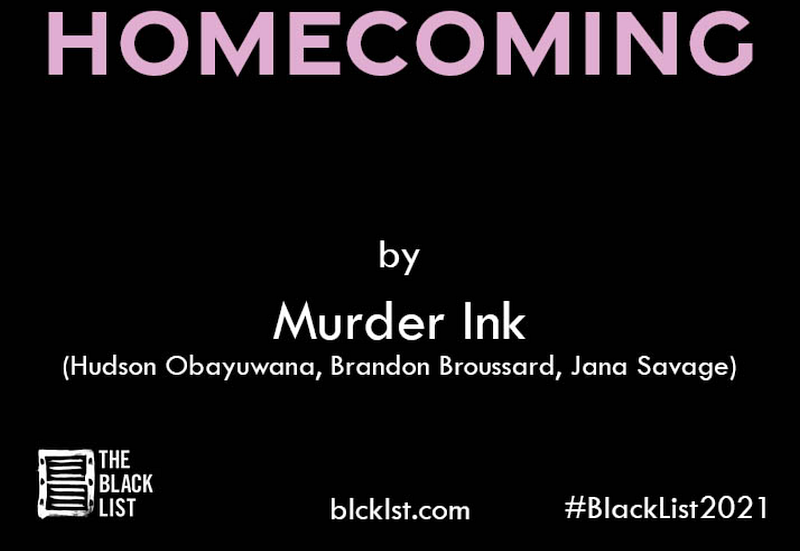
My interview with Brandon Broussard, Hudson Obayuwana, and Jana Savage, the writing team behind the 2021 Black List script “Homecoming.”
Murder Ink consists of three writers (Brandon Broussard, Hudson Obayuwana, and Jana Savage) who wrote the comedy feature script “Homecoming” which not only landed on the 2021 Black List, but also sold as a spec script to Lionsgate in January of this year. Recently, I had the opportunity to talk with the trio about their backgrounds, the inspiration and writing of “Homecoming,” and where their careers have gone after making the annual Black List.
Today in Part 2 of of a 6-part series to run each day through Sunday, Hudson, Brandon, and Jana reveal the inspiration for “Homecoming” and how they developed the project.
Scott: Let’s talk about “Homecoming.” Plot summary here:
“Ten years after graduation, one of New York’s most eligible bachelors and his eccentric wanderlust wingman try to pull their recently divorced friend out of his rut by taking him back to Howard University’s legendary Homecoming for the best weekend of their lives.”
The script made the 2021 Blacklist. I’m sure that many people supported it in the industry because it’s flat out funny, but I also imagine that the more enlightened in development also admired it because it’s a very well‑crafted script. The characters are entertaining, there’s a solid structure. Plus, there’s attention to more sophisticated screenwriting stuff, setups and payoffs, callbacks, runners, and so forth. I’m guessing that the inspiration must have been from you guys having gone to Howard. Talk to me about where the genesis of this came from?
Hudson: Jana, you want to talk about your experience there?
Jana: Yeah, let’s talk about my experience at Howard. I did not go to Howard, we already covered that.
Brandon: We can both chime in. Hudson and I we’re both promoters at Howard University and were throwing parties when we were there. We actually had to compete with a guy who owns the biggest clubs there and was notorious for having slapped a friend of ours who’s 6'6". A big brother that I would never think to slap. He had no problem slapping him. He made an insane amount of money from his parties, because thousands of people would go and he was charging $100 plus a pop.
The other quick thing I’ll say about Homecoming is that, my freshman year at Howard, I wanted to go home. I was homesick. I was like, “This isn’t for me. I made a mistake in choosing Howard.” Then people kept telling me, “Wait for Homecoming, see how you feel after that.” Sure enough, Homecoming happened and it was this life‑changing experience. It’s joy and hanging out with your friends like you’re in a movie, which is how we ended up writing a movie about it.
Hudson: Piggybacking on everything Brandon said, we’re very vocal about the fact that Howard was extremely instrumental in us being the men we are today. It’s this breeding ground of Black excellence. You have all these young people at a time in their lives where they’re trying to figure out what they want to do and gain their confidence. And you’re surrounded by people that look like you. The president is Black. The captain of the football team is Black. We have Rhodes scholars and frats. This cacophony of people from all over the diaspora and you see that, we’re not a monolith. You’re meeting people from the south and from France and from Nigeria and all over the place, is a special place to be figuring out who you are in your formative years. On top of that, it’s one of the best party schools in the country.
We wanted to hide the medicine in the candy of that environment and have this epic, fun, universal story that anyone could enjoy and relate to, but have this place that was very special to us as the backdrop for that.
Jana: We love writing all sorts of genres, but comedy is where we started and it’s pretty much in the DNA of everything we write, even if it’s not necessarily a comedy. We’re coming off an era where people didn’t want comedies, people didn’t want rom coms. There were all these important movies coming out but there was also a lot of trauma. We wanted to write something joyful. We wanted to see three Black men loving and having fun and experiencing joy. That was important as well. It’s obviously a big, broad comedy, but the higher purpose is to see people of color being successful and joyful. That felt revolutionary in this moment.
Scott: There’s a couple of story dynamics I want to ask you about that struck me as having universal appeal. The first is nostalgia. Hollywood’s completely mainlining nostalgia. It’s like all the TV shows, reboots and remakes or they recall the past. I was thinking about it as I was reading your script. There is nostalgia in the story itself. The characters are going to revisit their past.
It’s ten years past their time when they were in college. There are certain things going on that they remember and whatnot, but there’s also the feel of the script, in a way. The character types, the storylines, it’s like a contemporary retelling of a movie that I would have thought I could have seen in the ’80s or ‘90s.
Were you conscious of the whole nostalgia thing?
Brandon: I’m so glad to be having this conversation.
[laughter]
Hudson: One of our favorite parts in our process is the research. When we figure out what it is we’re going to write, we do research, which pre‑COVID looked like the three of us crammed together on Brandon’s sofa, watching movies.
When we did “#RealityHigh” for Netflix, we were watching “Clueless,” “Fast Times at Ridgemont High,” and all the John Hughes stuff . We were driving Brandon crazy because Jana and I were quoting all of these high school…
Brandon: Oh, my God.
Hudson: …teen movies word for word.
Even when we were doing this one, we were thinking about a lot of the films like “The Hangover.” We were thinking about Brandon’s all‑time favorite, which is “Swingers.” We’d get to go back and look at these movies and thinking about this core group of friends and their relationships.
That’s absolutely something that resonates with us in terms of looking back at old films that meant something to us and seeing what worked about them and applying some of those things to our characters and our story.
Jana: Not to speak for the Black men on the call, but something that I hear often from my partners is that when they were younger, they wanted to see people that look like them in certain genres.
With #RealityHigh it was seeing people of color in a John Hughes type movie and with this, it’s the idea of seeing them in a big, broad comedy. That’s what’s so exciting about doing this movie. We’re currently in the process of rewriting this script for Lionsgate and it’s interesting to have these conversations.
It’s very exciting to think about the actors and seeing them shine in that comedic way. Like you said, it’s so specific, but it’s so universal. That’s cool.
Brandon: Reiterating what she already said, we are huge fans of “Wedding Crashers,” of “Meet the Parents,” of “There’s Something about Mary,” going all the way back to “Animal House,” to “Old School,” and like Hudson said, “Hangover,” and “Bridesmaids.”
There aren’t Black broad comedies like that with the exception being “Girls Trip.” What Jana said, “Why can’t we see our story? Why can’t we turn the camera a little bit and see the same kind of film, but with people that look like us?”
Scott: I was thinking about that. I doubt that you were putting on your producer’s hat when you were making the decision to write this thing. I’m sure it was more like, “This seems like great fun and a great way to work a story in this context.”
Jana: We weren’t thinking about budget.
Scott: Beyoncé?
[laughter]
Hudson: Before we sent it out, we threw that little joke in the action line with like, “Unless you think we can actually get her, we don’t actually see Beyoncé.”
Scott: You totally broke the fourth wall there, but I think that was appropriate.
Howard University is one of the most notable HBCU schools. Your script also celebrates the place. I’m curious whether you were thinking, “You know what? From a producing standpoint, that’s an untapped thing.” Riffing off what Jana was saying, you could do a comedy in this type of space that would fill a vacuum in a way. Did that even come into your thinking at all?
Brandon: I know that Howard is a draw. I was more thinking that Homecoming was an untapped place. It’s such a huge event for Black people. One of the things we joked about was including a line like, “We know everybody got a text from their friend a week ago saying, ‘Are you going to homecoming?’”
It’s such a universal thing. Almost everybody Black in this country, especially if you’ve gone to an HBCU, gets that text. Then the idea that other people that aren’t Black don’t know about that is crazy to us. It’s like, “This is like New Year’s Eve.” This is just a universal thing that happens every single year that we either go to or don’t go to, but we’re very aware of it.
Hudson: We knew we were shooting for the stars. As a writer, people say, write what you know. There have been other movies set at fictional HBCUs and we knew that. To film at Howard, we were writing an environment, a campus, the surrounding area that we were familiar with and had that DNA of what we knew. People from DC have read it and said, “Man, we could tell you guys are really from Howard.” Producer-wise, we know we’re going to have to jump through some hoops to actually film at Howard.
Tomorrow in Part 3, Jana, Brandon, and Hudson talk about how the themes of nostalgia and regret are central to the story in “Homecoming.”
For Part 1 of the interview, go here.
Murder Ink is repped by APA.
Twitter: @BrandonQreative, @HuddyRozay, @TheSavageJana.
Instagram: @murderink_llc.
For my interviews with dozens of other Black List writers, go here.