Interview (Part 2): Kevin Sheridan
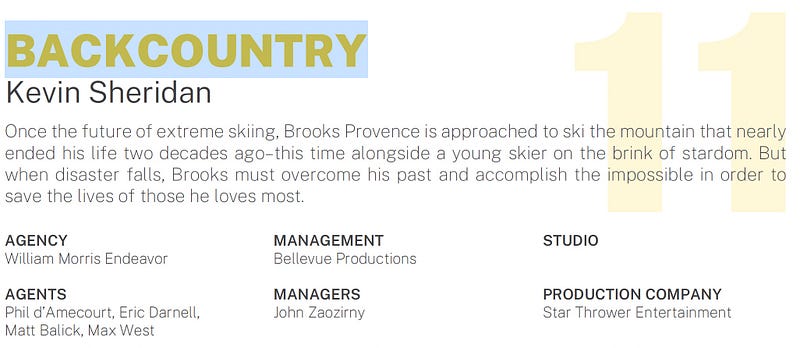
My interview with 2023 Black List writer for his script Backcountry.
My interview with 2023 Black List writer for his script Backcountry.
Kevin Sheridan wrote the screenplay Colors of Authority which landed on the 2022 Black List. Then his screenplay Backcountry was named to the 2023 Black List. I had the opportunity to chat with Kevin about his creative background, writing two Black List scripts, and the craft of screenwriting.
Today in Part 2 of a 6-part series to run each day through Sunday, Kevin discusses how in writing the Protagonist in Backstory, Kevin realized this: “He doesn’t get what he wants, but he gets what he needs.”
Scott: Let’s talk about the script “Backcountry.” It’s a terrific read. Here’s a plot summary.
“What’s the future of extreme skiing? Brooks Provence is approached to ski the mountain that nearly ended his life two decades ago, this time alongside a young skier on the brink of stardom. When disaster falls, Brooks must overcome his past and accomplish the impossible in order to save the lives of those he loves the most.”
Star Thrower brought this idea to you. What elements did they bring? Was it just, “We want to do an avalanche movie,” or what was it that they brought to you?
Kevin: They had come across this actual event about an avalanche that happened, and I was instantly drawn in. But in terms of access, the people involved really suffered. So, I didn’t think it was appropriate to use them specifically. But I kept researching. Talking to Dawn Wilson and Dale Atkins — an avalanche expert — And I was able to zero in on four avalanches that would be the basis for this movie. A lot of it was just tons of research, then me extrapolating a story from that research.
Scott: This Brooks character, you mentioned you feel a personal connection to him. It does seem like we have these stories…Not to put skiing necessarily like a sports‑type thing, but I was thinking about it. You’ve got stories where there are these protagonists who are dealing with failures, essentially, in their athletic performance, like “The Natural,” or “Moneyball,” or “Tin Cup”. Where did that narrative dynamic come from with regard to your Brooks character?
Kevin: I was trying to think about… who would need to be caught in an avalanche? Who would need that moment of redemption? Of seeing himself in a different light. And I slowly started forming this character of Brooks — who thinks he’s worthless to a certain degree. A failure…
In the screenplay, he initially gets his shot at redemption by skiing Alder Creek again. This beast that upended his life. But after he skis it, after he slays this dragon — — there’s not that hit. He doesn’t find what he’s looking for. It’s like he’s still the same person he was. But when the avalanche happens, that’s when he gets his moment of redemption. That’s when he heals in a way. There’s magic in this mountain and what it can do.
Scott: That’s a really interesting because the structure of the story … It’s like that Robert Towne quote: “The single most important question one must ask oneself about a character is what are they really afraid of?”
With “Backcountry,” it seems pretty clean.” This guy who had this trauma experience … I mean, he was in a coma for a month and couldn’t walk for six months after his fateful Alder Creek run.
As a reader, I’m going, “OK, so that’s going to be the pinnacle of the story.” It’s not the pinnacle of the story. There is that, as you said, slaying the dragon. You think it’s going to be reliving that Alder Creek run, but no, it’s something much bigger. Did you always have that in mind or did that evolve where it’s going to be not just the run, it’s going to be the avalanche?
Kevin: Yeah. I always had that in mind. I mean, I like the idea of someone trying to do something great and thinking that that’s “going to fix them” — and it doesn’t. To me, that was really interesting. God, you just referenced some great movies, too. Moneyball, and The Natural.
Sorry, it just got me thinking… No, that was always part of the game plan with Backcountry. I wanted to see him not get what he was hoping for after skiing it. Then realizing what really is of value in his life. He doesn’t get what he wants, but he gets what he needs. The mountain gives him what he needs. The mountain forces him to change.
Scott: Yeah, there’s a side from Teddy, he says, “I think a part of you has been stuck up on that mountain ever since you crashed.” So again, I’m thinking, “Oh, OK. He going to do the run and everything can be fixed.”
That’s not the case. It’s much more about surviving the avalanche and the community experience of these people he cares about, rescuing them.
Kevin: Yeah, very much so. He realizes what’s really important, what’s at stake and life is so short. When I was researching this, avalanches are such a traumatic event. There were so many reports I read on avalanches that just made my jaw drop. The power of these things. The devastation they can cause. And when you get caught in one — it’s like a frozen river of concrete traveling like a freight train downhill.
Scott: Was Brooks the first character who came to mind?
Kevin: Yeah. Brooks was the first.
Scott: The Protagonist?
Kevin: Yeah.
Scott: He was an expert skier, really dangerous type of skiing, had this terrible event happen. Now, he’s working at a Costco and married with a kid. Let’s talk about that family situation at the beginning of the story.
Kevin: I think it’s the first scene in the movie that really sums up everything for him. He’s sitting in his garage, with this old laptop out, and he’s watching old footage of that crash that upended his life.
He’s rewatching it and rewatching it. And it’s almost like he’s trying to find out what happened. Where did it all go wrong? Then his daughter comes in. She’s like, “What are you doing?” And he lies. He can’t tell her the truth. It’s a white lie, but it foreshadows a later lie that he tells.
Then he says, “One day, you and me are going to throw all this junk out.” And this is in regards to all his trophies, all his memorabilia from when he was a skier. Immediately, we get who Brooks is. Like, here’s a guy who’s still secretly caught up in his past. He’s still trying to figure out what happened. And then we understand his POV in regards to his past… That it’s all trash.
Also, he’s hiding who he is from his daughter who loves him so much. As you read in the script, she’s trying to understand her dad. Why he is the way he is. And she does it in a secretive way that that ends up helping in them all in the end.
Scott: There’s obviously an honest and authentic love that he has for his wife, Kara. Then his daughter, Lily. You do have a sense that he’s stuck in this job at Costco. I mean, there’s a moment there where he is asking for a raise. Then the guy says, “Well, I don’t know.” He’s stuck. That opening scene where he’s looking backward at the video of that terrible skiing incident in the past…
Kevin: There’s this thing. Trevor White and Tim White both who were so instrumental in putting this together. We had a long, long conversation about what happens to these athletes. What happens to these great extreme skiers, professional surfers, and snowboarders… What happens to them when they retire?
It’s such a short window. What does their life look like afterwards? Are they constantly looking in the rear‑view mirror and questioning the choices they made or are living in the past? How hard is it for them to embrace their new life?
What job opportunities are available to them? What skills do they have once they have to hang up the skis? What’s in store for them? Can someone go from racing in the Olympics to teaching ski school?
What we came up with was Brooks is — he can’t do it. He can’t put his face out there anymore. He can’t teach the kids. He really doesn’t want to be involved in the community, so to speak, because he views himself as a failure.
Scott: You’ve had this experience, I would imagine, as an actor. There’s a certain kind of adrenaline rush. How do you then replicate that like Brooks’ case working at Costco?
Kevin: Brooks still skies though. He skis when no is watching. When there are no cameras around. Personally, I don’t need that rush you get from acting anymore. I think I find it more staring at the page now and having the onus on me to deliver meaningful material. In a way, that’s a rush for me. Being alone in the arena.
Tomorrow in Part 3, Kevin talks about one of the core themes of Backcountry: “How many times have we done something in our lives that we think is going to fix us in some way?”
For Part 1 of the interview series, go here.
Kevin is repped by WME and Bellevue Productions.
Twitter: @Sheridankevin
For my interviews with dozens of other Black List writers, go here.