Interview (Part 2): Karen McDermott
My interview with the 2019 Nicholl Fellowships in Screenwriting winner.
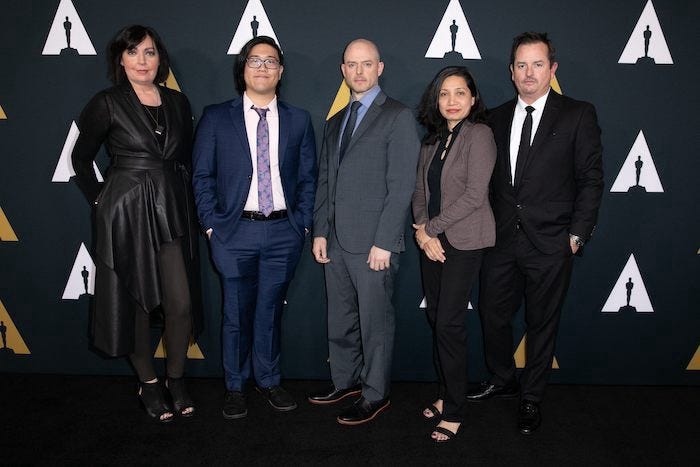
My interview with the 2019 Nicholl Fellowships in Screenwriting winner.
Karen McDermott wrote the original screenplay “Lullabies of La Jaula” which won a 2019 Nicholl Fellowship in Screenwriting. Recently, I had the opportunity to chat with Karen about her background as a screenwriter, her award-winning script, the craft of screenwriting, and what winning the Nicholl has meant to her.
Today in Part 2, Karen talks about how teaching screenwriting deepened her understanding of the craft and the inspiration for her Nicholl-winning script.
Scott: That sounds like quite a heroine’s journey in the vein of Joseph Campbell, in that the law thing was not the path you were supposed to be on.
Karen: Not the path.
Scott: As soon as you got on the path you were supposed to be on, things started lining up for you.
Karen: They started to click, yeah. In college, I thought, “Why isn’t everybody graduating with high honors? It’s so easy.” But that was only because I was doing the thing I’m good at, which is I came to learn a very narrow thing, this thing I’m good at.
Scott: You’re also passionate about it.
Karen: Yes.
Scott: That’s one of the key aspects of “follow your bliss.” It’s something that enlivens you. You said you read this one book before you wrote the script, the period piece on the ocean, which is, as you said, a really tough sell. After that, you said you learned more about the screenwriting. How did you go about doing that?
Karen: One of the first things I did was take a terrible seminar by some screenwriting guru. He opened with something like, “If anybody in this room doesn’t want to make a million bucks writing a blockbuster and is more interested in writing some intellectual indie exploring the meaning of life, then you should leave right now.”
I was like, “Oh, no. That’s me. [laughs] I should leave!” That guy went on talking about how to write a formulaic blockbuster, then he went around the room, tearing everyone’s loglines apart. I only had the cannibalism at sea script, which was about a murder trial and a judge making a decision. He was like, “An elderly judge CANNOT be your protagonist. Nobody cares about an old man making a decision. He has to be young! He has to be good‑looking! He has to be fighting a tangible threat!”
In retrospect, it was a good experience. Because now, as a screenwriting teacher, I have that as a reminder of how NOT to be. So that’s valuable.
Then, I had a couple of scripts second round at the AFF, so I started going to the Austin Film Festival. I went for five years in a row. I loved, still love those seminars. I was especially interested in anything taught by women. I figured they’d be less likely to tell me my protagonist had to be a 25-year-old male.
When I went to my first seminar by Robin Swicord, I thought, “This really resonates with me.” She was talking about theme, which I related to because of my study of literature. I understood theme. I watched her movies and studied them. I went to Lindsay Doran’s seminar about the psychology of storytelling.
I bought an entire library of books about screenwriting — the Syd Field and Save the Cat books. I read hundreds of scripts. I practiced. I submitted to the Nicholl, quarter-finaled, semi‑finaled, was selected for the Writers Lab.
Scott: This is the Meryl Streep program?
Karen: The Meryl Streep Writers Lab, yeah. In 2017.
Scott: Was this Lullabies?
Karen: No, it was the historical drama, The Custom of the Sea. My first script.
After that, I wrote a Dan Brown-type mystery, revisionist religious history, which quarter-finaled in the Nicholl, and a horror script, which I haven’t submitted anywhere — still tweaking. Then, I wrote Lullabies last year.
Scott: That sounds like that’s your fifth script.
Karen: Yeah, my fifth if you count a horrible rom-com.
Scott: During all this, you’re teaching at Cal State University Los Angeles, yes?
Karen: Right. I went there for my master’s, and as soon as I graduated in 2011, I started teaching composition there. And now I also teach screenwriting.
Scott: Let me ask you a question, because I’ve been teaching now first as an avocation, now as a vocation. I’m currently an assistant professor at De Paul University School of Cinematic Arts. I found that when I transitioned into doing teaching that I learned more about writing in some respects by doing that, because you have to formulate your thoughts.
Karen: Yes.
Scott: You have to actually think about your craft.
Karen: Yes.
Scott: Did you experience that as well?
Karen: Yes, totally. You don’t realize what you don’t know about a subject — the gaps in your knowledge — until you have to teach it.
Scott: And how to articulate it in a way that they can grasp what you’re saying.
Karen: Yes.
Scott: You’re still teaching at Cal State?
Karen: Still teaching. I have, right in front of me, three piles of final exams that I’m grading tonight after we’re done.
Scott: Well, let’s take your mind off that for at least a few minutes and talk about this very powerful Nicholl‑winning script, Lullabies of La Jaula. The logline: “Separated from her family during a desperate border crossing and held in a cage for migrant children, 14‑year‑old Dahlia Ramirez draws strength from the poetry of a Spanish revolutionary as she struggles to survive.”
I watched the video of the Nicholl ceremony when Eva‑Marie Saint and Peter presented you. Eva‑Marie Saint quoted you as saying, “I felt compelled to tell the story because I’m outraged that children are being caged in America,” and then you said, in your actual speech, “I wanted to put a face to the policy of family separation. I wanted us to see it through the eyes of the child.”
Karen: The eyes of the child, yes.
Scott: Was there a particular moment or incident in following this horrific thing that we’ve had with this regime in Washington that triggered your desire to write Lullabies, or did the impetus grow over time?
Karen: The desire to write about that topic was sort of always in the background. I felt like: how can you live as a writer during the time of an atrocity and NOT write about it?
But yes. There was a definitive moment when I decided “I’m going to write about this.” It was when I saw a YouTube video.
You might know this video. It showed a little boy, a toddler, who had been caged at the border. He was hysterical. He had been separated from his mother for so long that when she came to pick him up, he didn’t recognize her. So in this video, he’s crying hysterically as his mother — a stranger to him — is trying to embrace him. It was gut‑wrenching. Have you seen it?
Scott: Yes, yes.
Karen: That was the moment, and that little boy became a character in my screenplay (I made him a bit older, so he could talk): Hector. And that was the first scene I wrote. I didn’t know what else I was going to write, but the first scene was a boy in a cage who’s hysterical because strangers have come to get him — his parents, but he doesn’t recognize them.
Here is a fun video of the 2019 Nicholl winners receiving the news they have been selected:
Tomorrow in Part 3, Karen discusses how she was careful to avoid writing a ‘preachy’ movie and the role of poetry in her story.
For Part 1, go here.
Karen is repped by APA.
For my interviews with every Nicholl Fellowships in Screenwriting winner since 2012, go here.
For my interviews with 53 Black List writers, go here.