Interview (Part 2): Julia Yorks
My interview with the 2024 Black List writer for his script The Seven Guys You Date Before Marriage.
My interview with the 2024 Black List writer for his script The Seven Guys You Date Before Marriage.
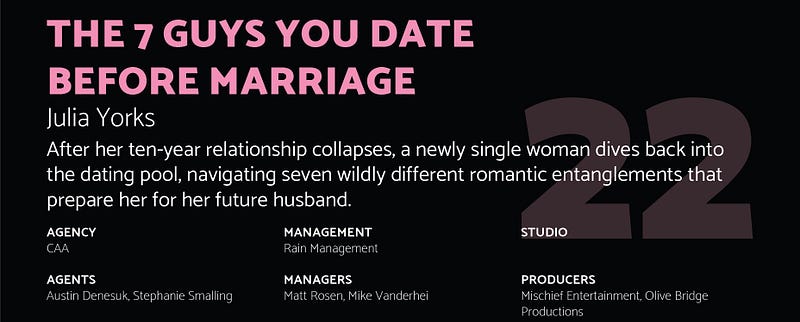
Julia Yorks wrote the screenplay The Seven Guys You Date Before Marriage which landed on the 2024 Black List. Recently, I had the opportunity to do a deep dive with Julia into her filmmaking background, writing her Black List script, and her approach to the craft of screenwriting.
Today in Part 2 of a 6-part series to run each day this week, Julia reveals what gave her the inspiration for her Black List script The Seven Guys You Date Before Marriage.
Scott: Well, let’s hope “The Seven Guys You Date Before Marriage,” A, gets made, B, you’re on set, and C, the director loves you and your writing.
Julia: I’m hopeful. I really love the script, and it was really fun to work on, and it ended up at such an amazing place being at Olive Bridge. I’m just really thrilled.
Scott: Let’s dive into your script because it’s a good read and there’s a lot of screenwriter‑ly stuff I’d like to discuss with you. Here’s a logline: “After her ten‑year relationship collapses, a newly single New Yorker dates the seven archetypes of guys to get unstuck in love.” What was the origin of this project?
Julia: But yes, what was funny, actually it was something that a producer brought to me and said, “Literally, I just have this title. What would you do with it?” I immediately knew what the movie was. I said, “It’s this. It’s the different archetypes. It’s the younger guy. It’s the older guy. It’s the one who’s not a guy,” and he was like, “Oh, my God. OK. Cool.”
I was like, “And trying to figure out, is it that she’s single forever and she’s going through these guys, or is it that she has this long term relationship and decides to date?” I wrote the first draft of this in 2021. So, it’s really come a long way. There have been many, many drafts, many iterations, but that’s kind of where it came from, and it’s been a really fun script to write and play with.
Scott: Having been a screenwriter for nearly four decades, my first thought was, “Oh, the title, that’s actually kind of convenient for a screenwriter.” You got these seven characters you’re going to meet. Well, that’s going to pretty much take up act two, so there you go.
Julia: Yeah. Oh, it’s true. You know, it’s funny. There was a movie called “What’s Your Number?” with Anna Faris that it was like she didn’t want to up her sexual number, so she went back and revisited all of the men that she had previously slept with to see if one of them could be her husband.
I was like, “Oh, that’s interesting because it has that similar…it’s like almost vignettes of men, and then you kind of have to figure out how to connect them all together. What’s the through line to connect them? I think that her mom passing and the diary and that kind of situation ended up being the through line to help us connect all of these men.
Scott: Yeah. That was very impressive what you did in the script because it could have been very easily felt very episodic, just going from one thing to the next, but you could see that there is a throughline in terms of her psychological growth, her arc.
Were there any movies other than, say, that one that were kind of reference points to you? Particularly for tone. When you said you knew it, were you going, “Oh, kind of like this, kind of like that?”
Julia: Yeah. Well, it’s so interesting having this discussion now because I’m going to do another quick pass of it before it goes to…We’re in the talent phase, and so it’s funny thinking about what it is and what it…certain small changes that will be made.
I think when I wrote it initially, it was when rom‑coms were just streamers. They were just streaming them. The era of the rom‑com had passed, and that’s why it’s so exciting to have this at Olive Bridge where they made “Anyone But You.” Speaking of Anyone But You and Glenn Powell, I thought “Set It Up” was such a cute, funny rom‑com with two amazing leads, and I just really enjoyed it.
So that was another one. Also, because I thought that that movie, I talk about it whenever I talk about the promise of the premise, particularly in a rom‑com. It’s two assistants. They want to set up their bosses so that they can get out of work, and they’re terrible bosses, and so much of the plot driver is that. That was a touch point, but then, of course, I watched so many romantic comedies because I just love a rom‑com.
Scott: Oh, I remember back in the day. I think it was that one summer about five years ago that Netflix came out with several rom‑coms, sort of out of nowhere because I was talking to managers and agents at the time, and they were saying, “We don’t even use the phrase ‘rom-com’. We say it’s a comedy with some romance.” They were trying to skirt around it.
Julia: They were, and so it was really interesting. I’ve never worked at the company before who said, “Make this bigger and more expensive.” You know? “Make these set pieces bigger.” So that’s what I did, and it was really exciting and fun.
Scott: Yeah. That’s funny to hear you say that because one of the things that you did, it’s like a love letter to New York, basically. Yankee Stadium, Metropolitan Museum of Art, all these wonderful iconic places because each of these little vignettes, they take place in these different environments.
Let’s talk about your protagonist, Avery. She’s introduced at a Brooklyn rooftop restaurant with her longtime beau, Noah.
She’s described as adorably high strung, and she thinks, like the perfect setup and the language that Noah is conveying is that this is going to be the big proposal that she’s been waiting for for years. But then there’s a nice twist where is a proposal, but it’s the people next door, the next table. Was that opening always present? You wanted to do that little twist at the beginning as a way of introducing…?
Julia: That one has actually always been there because I just think it’s really fun and funny and unexpected, and I love starting off…You just got to hook the reader. You got to hook the viewer right away. I just thought it’s every woman’s…not every woman’s, but it’s so many women’s dream of, like, “OK…”
Especially when you have a long-term partner, it’s like, “OK. We’re going to do it, and it’s going to be so magical and impressive,” and then it’s for somebody else. I also loved the idea of the person behind her who does get proposed to being like, “Oh, my God. It’s been three years. I thought he’d never ask,” and it’s like, “It’s been 11.”
I sat next to a girl at a wedding once, and she and her partner, now husband, had been together for 11 years, and she was at another wedding where she wasn’t engaged, and she was not having it.
Scott: I love the ending of that opening scene because too, it’s like we’re experiencing the scene from her perspective. Noah who’s gone off to relieve himself, comes back and he sees the fireworks. He goes, “Whoa. Cool. Fireworks.” So clueless, of course, he couldn’t quite know exactly what was going on in her mind.
So beyond just how you introduce her in that opening scene, how would you sort of describe Avery, her persona at the beginning of the story?
Julia: Well, you know, it’s so funny because this is something that might shift, which is why it’s so interesting to talk about now, but I always pictured her, which, again, potentially feels a little 2011 of it’s Jess from “New Girl.” Right? It’s that kind of adorkable character that I think…
It feels weird talking about this to not address something that I’ve been going through over the past year, which is that I have a very funny story about this script, which is that I had my last notes meeting for this script like three days after my husband said that he wanted to get divorced, and so I literally…
I tell this story. I picked myself off of the floor for this notes meeting, tried to put some makeup on and hopped on this notes call, and they were all like, “We can reschedule,” and I was like, “No.”
At this point, I had done three rounds of free notes. I’d been working on the script for so long. I just wanted to get it done. Their notes were so funny in hindsight because they were like, “OK. Well, what is their relationship status? Are they broken up? Are they separated? What is happening?” I was like, “Am I in an episode of Curb? I don’t know. This is a little meta.” You know?
Then at one point, they were like, “This script has so much calm, but it needs a little bit more rom.” I was like, “I guess my marriage did too.” You know? I was really throwing tears back and forth, and I made the joke of, “I’m going to be getting some material for the sequel, “The Seven Guys You Date After Marriage.” You know?
It was so uncomfortable. I felt so bad. I turned in this draft of the script two weeks after that happened. What’s so funny about it is because I’m going to do another pass of it, I am a different person than I was when I turned in this draft of the script. I think when I do another pass, Avery will be a different person too just because I’ve learned so much in this year.
So it’s actually so weird to see her on the page because she is…It’s a very innocent, adorkable, very endearing, almost naive character, and I love that, and I think it’s really sweet, but I also want to give her a little bit more for someone to chew on because I’ve had a lot more to chew on this year.
This script came in a very, very weird time. It’s been kind of a roller coaster with this script.
Scott: Yeah. It sounds like a sequel, like you could do the making of the movie, and then meanwhile, the screenwriter is having their own challenging storyline, where you’ve got the movie and the story behind the movie.
Julia: It’s true. You’re getting more than you bargained for with this interview.
Tomorrow in Part 3, Julia discusses how the Protagonist in her Black List script reflects the ambiguous nature of the whole dating scene.
For Part 1 of the interview, go here.
Julia is repped by CAA.
For my interviews with dozens of other Black List writers, go here.