Interview (Part 2): Jonathan Stokes
My interview with the 5-time Black List screenwriter.
My interview with the 5-time Black List screenwriter.
Jonathan Stokes has written five screenplays which have made the annual Black List. They are:
- Blood Mountain (2011)
- Murders & Acquisitions (2011)
- Border Country (2012)
- Tchaikovsky’s Requiem (2013)
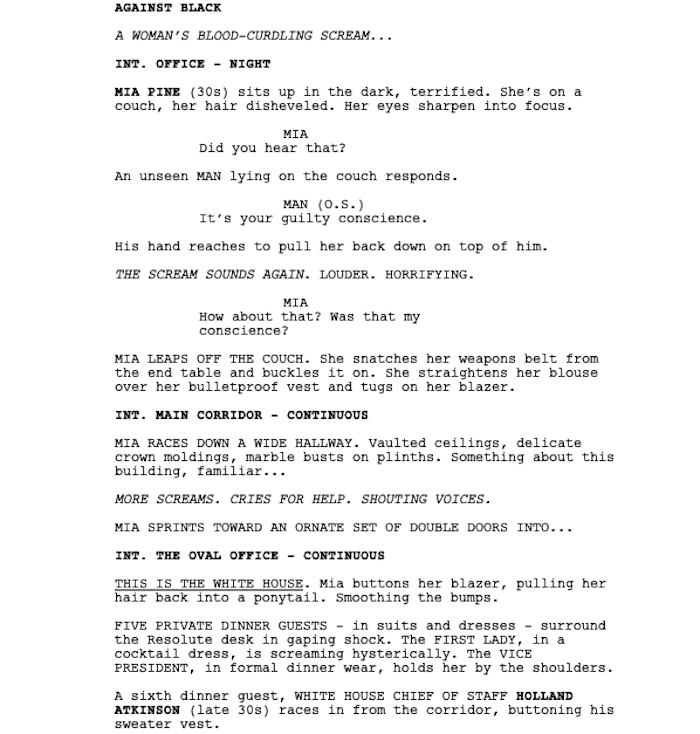
- Murder in the White House (2020)
For that reason alone, I thought it would be a great idea to interview Jonathan, but there’s much more going on with this prolific writer. For example, he is the author of four books including The Thrifty Guide to Ancient Rome.
I reached out to Jonathan to see if he’d be up for a Go Into The Story interview and he kindly agreed. We had a terrific conversation which could have gone on for hours.
Today in Part 2 of a 6-part series to run each day through Sunday, Jonathan shares how it took a decade of misfires and “doing everything wrong” before he had a professional breakthrough.
Scott: If I’m looking at it, you’re saying you moved out of 2000. Now, I’m sure you had some successes as a writer between them, but your first Black List script was 2011. That’s a decade. How long did it take you to find your footing as a writer?
Jonathan: I did everything wrong. I had no connections. I wrote 30 screenplays before I sold one. I spent years writing hundreds of sketches for Second City and IO — literally hundreds. I was in five different sketch groups, and it took me years to figure out that there was no career in sketch comedy.
The only show at that time that you could get hired to write sketch comedy for was “SNL”, and I still don’t know how you get hired on SNL. I was also writing thousands of pages of poetry, stuff that had no commercial value.
Scott: Was that just out of self‑expression? The poetry part?
Jonathan: Yes. I was also writing tons of short stories, novellas. Again, stuff with no commercial value. I think I was just writing out of a sense of passion and joy rather than thinking about it through a practical lens.
I just needed to be beaten down by adulthood, perhaps, before I started to figure out that I need to put food on the table. Instead of just thinking of a crazy experimental screenplay idea and going off and writing it, I needed to get more practical about, “Is there room in the marketplace for that?”
There was a real turning point for me at age 27 when breaking in started to become more inevitable. I could talk about that, if you like.
Scott: I’d like to get to that, but could I ask you a question?
Jonathan: Yes.
Scott: How many times during this bleak period of time did you say, “I got to bag this?” What was it that kept you going?
Jonathan: When I worked in finance, my boss — the most amazing boss I ever had in my life — shook my hand one day and said, “We’re making a gentleman’s agreement. We’re going to pay for you to get your MBA at NYU. In exchange, when you graduate, you work here as an associate for at least two years, and you’ll profit‑share on any deals you do.”
So I knew that by age 26, I would have solved the money problem. This was a $1 billion private equity company, and the deals I was working on were minimum $50 million deals with 20% carries. I could reasonably expect to make several million a year. I knew in that moment that chasing money was not going to do it for me, and that I wanted to pursue something different or harder perhaps.
I don’t think I fully appreciated that by choosing screenwriting I was choosing, perhaps, the most competitive job on the planet. I don’t think I anticipated just how incredibly difficult this career path would be.
I just knew that — whether I succeeded or failed at writing — I felt that choosing that path would be honorable.
Scott: This gets into Joseph Campbell territory, doesn’t it a little bit? “Follow Your Bliss.”
Jonathan: Yes.
Scott: I had a similar thing. I was going to graduate school, got a master’s degree. I was going to get a Ph.D., but I played music. I said, “I’ll take a year off because I’m really passionate about that.” That led to everything else.
Isn’t that interesting how it’s not the easiest path? Like Campbell says, “If you stumble upon a path, it’s probably not yours. You’ve got to create your own.” It’s authentic. It’s genuine.
Jonathan: What instrument do you play? I have to know.
Scott: Guitar. I wanted to be Jackson Browne. Then I found out there was Jackson Browne. I did a gig in Ventura, California once. A guy came up to me afterwards and said, “Wow. That song before the last song you played there, what album is that on?” I said, “It’s not been recorded.” “No, what Jackson Browne album was that on?” I had so replicated Jackson Browne I wrote a song that this guy thought was a Jackson Browne song. I said, “That’s about as far as I can go with that.”
Jonathan: [laughs]
Scott: That’s how I segued off into stand‑up comedy. Anyhow, it’s that whole point about…I tell my students all the time, the beginning of my first class, the final thing of the last class. I remind them: Follow your bliss.
I say, “You may not take anything else away from any of these classes, but find the thing that you’re passionate about, that enlivens, that brings you joy, that you have a talent for, you feel like you can share with the world.”
It doesn’t have to be a vocation. It could be an advocation. It could be anything. As long as you’re passionate about it, do that in your life, because that’s the path toward an authentic existence. If we’ve got one shot, why not? What else is a reason for living than to do something that you can bring meaning and joy to your life?
When I asked you what kept you going, it sounds like you said, “Well, I could always go do that, but that would slay me psychologically to go do the money path. I couldn’t do that.” Is it fair to say that that’s almost like a negative reinforcement, like, “No, I’m going to stick this out, because I know that that’s not the path for me”?
Jonathan: Absolutely. I had seen “American Beauty.” I saw Kevin Spacey wake up one day, and discover that he was 40 years old, and that he hated his life. My decision to quit finance, despite all of the rewards of finance, was really, really easy because I didn’t want to be Kevin Spacey in American Beauty. [laughs]
Scott: Let’s jump to this. You’re 27, you’ve talked about this break‑in moment. I’d be curious ‑‑ I’m sure everybody else would ‑‑ what was going on there?
Jonathan: I didn’t break in. I broke through. [laughs]
Scott: Broke through? OK, breakthrough.
Jonathan: The breakthrough. I don’t know how to tell the story succinctly.
I was 27, and I was becoming very embittered thinking that maybe screenwriting was not a meritocracy. I knew incredibly talented people who were gods of improv in LA, and they were driving a milk truck at age 44.
Meanwhile, I saw people that I felt were not as talented becoming very successful.
I felt like my writing was strong, but I wondered… do we live in a fair and just universe in which talented people are recognized? I really grappled with this.
Then, I got a temp job at the ArtCenter College of Design in Pasadena. I was a stenographer during the eighth term reviews for the graduating photography students. This was their last chance to get crit from their professors.
The three department heads doing this crit were outstanding in their field: one was a National Geographic photographer, one was a New Yorker editorial photographer, and one was a wildly successful commercial photographer.
These three professionals, despite having completely different sets of expertise, could open up a student’s “book” and within three seconds unanimously arrive at a conclusion as to whether or not this photography student had the goods.
This blew my mind because it suggested that maybe there was meritocracy in art. The professors were incredibly generous, and would take me with them to the faculty cafeteria every day, where I could bombard them with questions.
ArtCenter is the Harvard of art schools. I wanted to know, “Out of each class of 20 students — how many will become professionals?” The professors said, “One.” I said, “Can you tell which student it will be?” They said, “100 percent. And you can, too, if you come back next week…”
I came back the next week, and sat in the back of the room as the students came in for their “live crit.” 19 of the 20 kids would show their work, and the professors would say, “We notice you’re only shooting natural light. We’ve got $3 million worth of lighting equipment at this school. Why aren’t you using any lighting equipment? What images are you looking at? What art exhibits have you been to recently?” And 19 out of 20 kids would have lame excuses… “Well, you know, I broke up with my boyfriend, and I’ve just been really stressed, and I just haven’t had any time.”
Then one out of the 20 kids would come into the room on fire. They’d turn in twice as much work as the curriculum required. They’d know every photographer, every camera, every light. Every museum exhibit, every magazine, every photography book. 1 out of the 20 students lived and breathed their art. It was so obvious. There was meritocracy.
From that moment on, I feel like I overcame my bitterness, and I redoubled my efforts. I spent every possible hour sitting on the floor of Barnes & Noble’s until I had finished reading every single screenwriting book. I couldn’t afford the books, but nobody at Barnes & Noble ever hassled me as I read them for free. I will be a loyal Barnes & Noble customer until the day I die for that.
I watched every movie with a stopwatch and a notebook, writing down all the story beats. I went to the woodshed, and I started with Aristotle, and went through everyone from Georges Polti, to Lajos Egris, to Pen Densham, to Michael Hauge. I made it like my own private PhD.
If you want to be a well-regarded expert, like a doctor, we accept that you’re going to need 10 years of schooling, and residency, and sacrifice before you have any right to puncture someone with a scalpel.
If you want to be a valuable lawyer, we accept that it takes a decade of law school, clerkships, the bar, and working your way up in the firm, before you’re considered an expert.
When it comes to screenwriting, we have these unrealistic expectations of overnight success, or even overnight competency. Every few years a 22‑year‑old will sell a script out of the blue, but that’s the exception that proves the rule. One should expect to put in at least a decade of sweat equity before mastering a craft.
Arnold Schwarzenegger talks about he would never go to the gym and dread a workout. He would go to the gym with a smile on his face because no matter how much pain he pushed his body through, he knew he was getting close to his goals.
I just started taking pleasure in the suffering. In finance, you don’t question working 90-to-100-hour weeks. I took that work ethic into writing. Even though I had a day job as a piano teacher, I just made it my mission that I was just going to put in the hours, and if I never broke in as a screenwriter, that’s OK because piano teaching is an honorable job.
I was content to just spend the rest of my life writing my ass off with screenplays, whether or not it ever paid me a dollar. I just made it my mission just to write with every spare minute that I had.
Tomorrow in Part 3, Jonathan and I discuss whether and how to think in terms of a story’s marketability when deciding to take it on as a spec project or not.
For Part 1 of the interview, go here.
Twitter: @jonathanwstokes
Website: https://www.jonathanwstokes.com/
Jonathan is repped by UTA and Management SGC.
For my interviews with dozens of other Black List writers, go here.