Interview (Part 2): Jake Disch
My interview with 2023 Black List writer for his script The Adults in the Room.
My interview with 2023 Black List writer for his script The Adults in the Room.
Jake Disch has made the annual Black List two times: In 2018 for his script Gunfight, then in 2023 with The Adults in the Room. Recently, I had the opportunity to chat with Jake about his creative background, the craft of screenwriting, and the challenges associated with writing a story based on actual historical events.
Today in Part 2 of a 6-part series to run each day this week, Jake talks about the inspiration for his 2023 Black List script The Adults in the Room and the research he did on the subject.
Scott: Let’s talk about the script that made the 2023 Black List, “The Adults in the Room,” which is another “based on a true story” project. Here’s a plot summary.
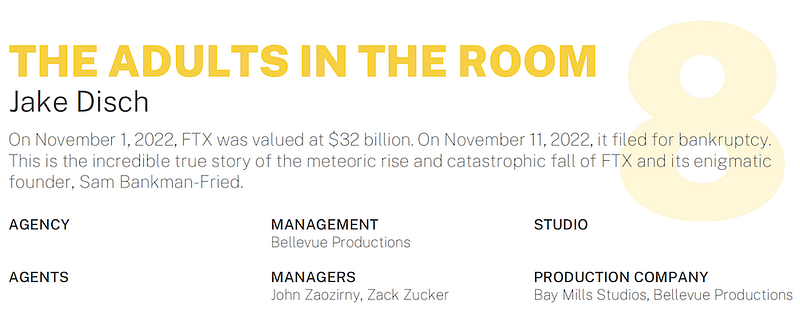
“On November 1st, 2022, FTX was valued at $32 billion. On November 11th, 2022, 10 days later, it filed for bankruptcy. This is the incredible true story of the meteoric rise and catastrophic fall of FTX and its enigmatic founder, Sam Bankman-Fried.”
Obviously, this was a huge news item. Was there a specific moment in tracking this where you started to think, “You know what? That sounds like a great movie?”
Jake: Honestly, I had just signed with new representation, and we were looking for the first thing we wanted to work on together. They sent me an article about Sam Bankman-Fried. I knew a little bit about crypto. I knew almost nothing about Sam Bankman-Fried.
They sent this to me right as the crash was happening. It was still in progress. I read about it, and my attraction to the material was not really about crypto. It was this guy, Sam Bankman-Fried, and how people just bought in so hard to everything he was selling. A lot of that was because of his philosophy of effective altruism.
I went down the rabbit hole of effective altruism first, thinking like, “This sounds like a good, noble thing. Commit your life to making the kind of money that can help you create positive change.” I think that when you put it into practice, it becomes troublesome, obviously, as we saw with SBF.
Whether or not you believe he was entirely genuine with it, I guess, is another question. That’s where I came in. Even though the guy who invented it is Scottish, I saw this philosophy of making as much money as you can to make the world a better place, it’s a very uniquely American idea of doing good. It’s all about how much money you can have.
That was my way in. What is this idea? Why is it so attractive? What happened here that made it all fall apart?
Scott: Yeah, the movie, a couple of comps come to mind when you read the script, obviously “The Big Short,” the way that they explain complex financial things, but then the “The Social Network,” because Zuckerberg and then this SBF character. I remember that moment in “The Social Network” where he says, “You think a million’s sexy? No, billions.” Your guy’s like “a trillion.”
So your reps at Bellevue, they sent you an article?
Jake: Yeah, they sent me a couple of articles about SBF and FTX as it was collapsing and said, “This feels like your kind of world.” I said, “I hate crypto, but I’ll take a look at it.”
SBF has a…there’s a reason we all keep talking about it. You can’t take your eyes off him.
Scott: When they said your world is already…you had done “Gunfight,” which was based on a true story. Had you done other things like that based on true stories? Was it just based off the fact that you’ve done “Gunfight” that they said, “Hey, you may be interested in doing this?”
Jake: Yeah. I had also written a true crime, comedy thriller that is set up over at XYZ currently. They had read that as well. All three of these scripts have in common this kind of big, brash, very ambitious, let’s say just weird white guy with a lot of hubris attached to him.
SBF lined up right in that sweet spot of the other two main characters in those two projects.
Scott: Let’s, let’s talk about this enigmatic character, your story’s central character, Sam Bankman-Fried. This is how you introduce him in the script. “Sam Bankman-Fried, 30, aka SBF, with hair like he stuck his finger in an electrical socket and a nervous livewire energy to match.”
Jake: It’s so easy to look at the story, and I feel like a lot of people leapt to this judgment, that he was entirely a fraud, that the effective altruism from the ground up was a front for him to be able to take this money and pull off this scam.
But the great thing about most of these people from a writer’s perspective is they all love to talk. They’re on podcasts, they’re doing interviews, even after this, obviously, SBF was all over the news, doing every interview. Anyone who wanted to talk to him, he talked to.
There’s tons of content out there to pull from, and I never got even the smallest hint that this was a scam from the start, including from people I talked to who knew him. He really seemed to live and breathe this stuff.
That was really interesting to me, that the immediate reaction of the public was, “Oh, this guy is a fraud. He lied about trying to help people and stuff.” What he really is, is a gambler. He will keep flipping a coin over and over and over until you take the coin away from him.
His reasoning is that, “If you take enough risks, often enough, you’re going to have enough that pay off and you will win in the end,” which we saw didn’t work out. He looks at everything analytically, mathematically.
I found him, as I was reading about him and listening to him, he’s honestly not that mysterious, I don’t think, when you really start trying to dig into who he is.
He’s an absolute math whiz. He’s the guy who doesn’t seem to know how to show he cares about people so he found a quantitative way to become a good person. He wanted to feel like a good guy. He said, like, “I can objectively be a good person using this effective altruism angle and the money that I can make from it.”
That’s who I think he was. I do think there are plenty of stories about him being not a nice guy, if you went against him and things like that. I do show those in the script.
I think that anytime you go from living in an apartment with six people in Berkeley to a penthouse in the Bahamas, and naming the Miami Heat Arena after your company and all this other stuff, you’re not going to be the same person. I think there’s a lot of ego, there’s probably some narcissism involved. I’m not a psychiatrist, so I shouldn’t go too far down that road [laughs].
I think, earnestly, he wanted to do good. His own sense of risk versus reward led him down this path. I found him really interesting because of that and his openness to talk about this stuff.
Scott: Let’s talk about this other character, Nishad Singh. The story is told through his perspective. This is how you introduce him, “Nearby, Nishad Singh, 27, paces, phone to his ear. Lanky with messy black hair and glasses, Nishad’s a nerd’s nerd: fast-talking, smart, and conflict-averse. Usually.”
There’s a wonderful bit of business where his glasses are broken and he’s got a chopstick, right?
Jake: Yeah.
Scott: Then there’s a sign of his own journey. At some point he gets a new set of glasses, and it’s like, “OK, so…slippery slope.”
Jake: The chopstick thing is real. Even when he was a millionaire, he never replaced his glasses.
Scott: He was the director of engineering at FTX. Was he another podcast guy?
Jake: Not nearly as many as with SBF, but yeah, he was around…I haven’t checked to see if they’ve pulled it down yet, but FTX had its own company podcast. SBF was on it multiple times. Nishad was on it. Caroline Ellison was on it. Shaquille O’Neal was on it. Steph Curry was on it. Incredible stuff.
Nishad, the reason I picked him as the eyes of the story is that he, by all accounts, according to everything I’ve read, everything I’ve heard, during and after the trial even… I wrote the script before the trial, but Nishad seemed to be the most caught off guard, the most blinkered. His glasses were the most rose-colored about this stuff.
He was genuinely crushed and felt betrayed by everything that happened, whereas everyone else seems to have, somewhat at least, known the danger that they were wading into as they were doing it. Not to absolve him because it’s certainly not impossible that he knew more than anyone’s let on, but he seemed like the most relatable of the group.
I knew it couldn’t be through SBF. You can’t make him the central guy and be with him in every scene because he’s frankly exhausting to be around. [laughs] That’s how I landed on Nishad.
Tomorrow in Part 3, Jake discusses some narrative choices he made to adapt historical events and real-life characters into a screenplay.
For Part 1, go here.
Jake is repped by Bellevue Productions.
@jake_disch
@jakedisch.bsky.social
For my interviews with dozens of other Black List writers, go here.