Interview (Part 2): Filipe Coutinho
My interview with 2023 Black List writer for his script Patsy.
My interview with 2023 Black List writer for his script Patsy.
Filipe Coutinho has made the annual Black List three times: In 2021 for the screenplay Whittier (co-written with Ben Mehlman), 2022 for Jambusters, then in 2023 with the screenplay Patsy. I had the opportunity to chat with Filipe about his creative background, his latest Black List screenplay, and the craft of screenwriting.
Today in Part 2 of a 6-part series to run each day through Sunday, Filipe Reveals how he decided to write a biopic about the 1950s singer Patsy Cline.
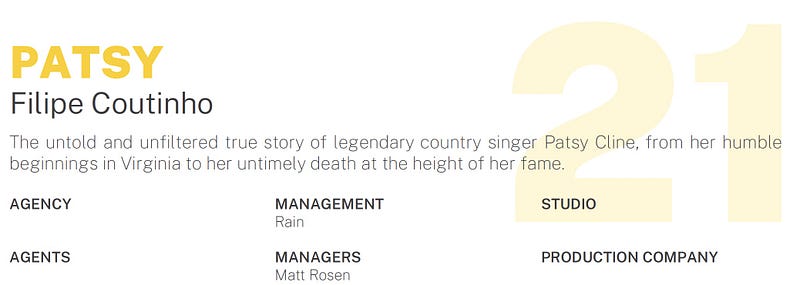
Scott: Let’s talk about your second annual Black List script: “Patsy.” Here’s a logline that was provided by the Black List.
Filipe: Sorry, can I interrupt you for a second?
Scott: Yeah, go ahead.
Filipe: I was actually on the Black List last year as well, with “Jambusters.”
Scott: That’s right. You’re just like hitting it every year.
Filipe: I’ve been very lucky that people have connected with my scripts, which have been very different from each other.
Scott: I talk to a lot of managers and generally, they prefer writers who focus on one genre because it just makes it easier for them to sell that writer. This is an action writer, this is a comedy writer, this is a horror writer. You have written considerably different material, including “Patsy” which is a biopic. Is it just you following your passion, you’re just going to write it regardless of whatever the genre is?
Filipe: Pretty much. I’ve talked quite a bit with my manager about this, because I’m making his life more difficult. I’m also making my life more difficult, but I’ve also tried in the past to write what I thought people would want to read, and it just isn’t as good. I’m someone who’s very driven by passion and an innate need to tell a certain story. If I don’t feel it, I don’t think I’m going to write a good script. I’m often drawn by character and I think that if you look at “Whittier” or “Jambusters” or “Patsy,” I’m sure you’ll find thematic similarities in terms of those three protagonists, and that is true for all my other characters too. For me, genre is just the makeup I put on top of the story. I try to find the best genre to tell the story of a person I’m fascinated with.
Now, in terms of Patsy Cline, it’s different because we’re talking about someone real, someone who had a full life. And, of course, a biopic comes with a certain degree of expectations, which I try to fulfill. But at the end of the day, I try to follow my heart as much as possible.
And part of the reason I do it is that writing a script is an overwhelming lot of work, as everyone knows. If I’m going to spend months, sometimes even years, on something, I’ve got to have the passion, and I have to be able to go back to that well and be re‑inspired. If I’m writing something that I don’t care that much for, that makes things very difficult for me.
Scott: Sometimes the single hardest thing to do in writing is just to get your ass in the chair to do it, and if you’ve got that passion, that’s going to help you get to that point.
Filipe: Yeah. And I also believe that people will connect with the things that you’re passionate about more than anything else.
Scott: Let’s unpack your journey into this script. “Patsy” the logline here:
“The untold of an unfiltered true story of legendary country singer Patsy Cline, from her humble beginnings in Virginia, to her untimely death at the height of her fame.”
First of all, you’re a young fellow growing up in Portugal. Patsy Cline is a woman who became famous in the late ’50s and early ’60s with country music fans before she crossed over into the pop music market. How did you intersect with her as a musician?
Filipe: I can’t tell you the first time that Patsy Cline came into my life, because I feel like she’s always been a part of my life. I had a pretty eclectic music taste since I was a kid, and I always gravitated towards older music.
Patsy Cline was a part of those early playlists that also had The Beatles and The Stones, and Otis Redding, and Aretha Franklin. There was “Walkin’ After Midnight,” and there was “Crazy,” and there was “Sweet Dreams.” All the hits most people know and love. But it wasn’t just about the songs being great, which they are. It was something about her voice that activated a part of my brain that told me, ‘this person means something to you’. I don’t think I knew that at the time, but I can look back and identify it in terms of how my body reacted to hearing her voice. This is beyond the lyrics, beyond the music, this is actually the timbre of her voice, if you will.
About how the writing of the script came to be. I was looking for my next project, I believe two or so years ago, and, well, I love music‑driven projects.
You are looking at me and you can see my background [posters of the Velvet Underground and Bob Dylan]. I was thinking, ‘is there an artist I love that people might connect with? Is there a story that hasn’t been told?’
Patsy came into my mind, and I decided to read a biography to learn more and see if there was something there. As I was reading, I was like, “I understand exactly why this person means so much to me.” It’s something that I understood through her voice all those years ago but now I finally knew why. I didn’t grow up in the south in the ’50s as a woman in a patriarchy, but I felt like I connected very deeply to the way she used her voice as an artistic outlet.
Once I finished the book, I was like, ‘I’m going to reread it immediately because I want to make it’. And that’s what happened.
Scott: On the title page, it mentions two books. Did you secure the rights to those books?
Filipe: The truth is, I did not secure the rights to those books. On the advice of people who know better than me, I decided to go ahead and just write it.
What they told me was, “you don’t have the clout or the money to get these books, that’s just the truth. You can write the script, and when the time comes, the right producers will secure the rights for you. You’ll also need the Patsy estate to be on board, so it’s a long road no matter how you slice it.”
That sounded fair to me and I embarked on the journey with my eyes wide open.
Tomorrow in Part 3, Filipe discusses some of the unique challenges that arise when writing a “snapshot bio.”
For Part 1 of the interview series, go here.
Filipe is repped by Rain Management.
Twitter: https://twitter.com/filipefcoutinho
IG: https://www.instagram.com/filipefcoutinho
Letterboxd: https://letterboxd.com/fifeco/
For my interviews with dozens of other Black List writers, go here.