Interview (Part 2): Chris Parizo
My interview with 2023 Black List writer for his script Kazan.
My interview with 2023 Black List writer for his script Kazan.
Chris Parizo has made the annual Black List two times: In 2020 for his script Viceland, then in 2023 with Kazan. Recently, I had the opportunity to chat with Chris about his creative background, the craft of screenwriting, and the challenges associated with writing a biopic like Kazan.
Today in Part 2 of a 6-part series to run each day this week, Chris discusses how he learned screenwriting and the inspiration for writing Kazan.
Scott: How did you get into screenwriting?
Chris: I used film in my English classes to teach symbolism and theme and elements of the hero’s journey. I used Joe Versus the Volcano to teach the Joseph Campbell hero.
“Empire of the Sun,” my favorite movie of all time, is how I taught symbolism because it’s chock-full of packed symbolism to the point where Spielberg’s basically puking it out onto the screen. I’m like, “If you guys don’t see the symbolism in this, I don’t know what to tell you.”
I also was always cracking jokes about being a failed writer. A student said to me as a joke, “Why don’t you write movies? You’d be good at it!” I was like, “Ha ha ha. Nobody writes movies!” Then flash forward five years later, I actually gave it a shot and she was right. I should have listened to her a lot sooner.
Scott: How did you learn to write screenplays?
Chris: The screenwriting subreddit and this website called “Go Into the Story,” is how I learned.
Scott: Well, there you go.
Chris: My wife and I were in Boston and we got hit…this was February of 2015, we got hit by these four, five back-to-back blizzards. Snow was above my head. Car was literally buried. Couldn’t open our front door. My wife and I were locked in our apartment for nine days. We literally couldn’t open the front door. And we had a two year old and one more on the way.
I was inspired by fatherhood. I had a story in my head, and that student’s words were always in there. I googled how to write a movie and the screenwriting subreddit popped up.
I spent one day reading the top posts on the subreddit. In 2015 r/screenwriting was such a magical place with so many gifted writers there. Pro and amateur. Working and “had-worked.” I posted the script to the subreddit for feedback.
Screenwriter Robert Cargill, of all people, was active at the time, and we started chatting. I learned from Chin Ho! how important networking was to an artistic career, and never let an opportunity go.
Seymour Stein, the man who signed Talking Heads, The Ramones, and Madonna came to see Chin Ho! at CBGB’s once. We had a song that we knew he liked called “Incoherent” and wanted to check us out. At one point he came and leaned against the wall next to me after our set, and I chickened out saying something to him. Then he left. Later I read in a Rolling Stone article where he said he always gives his artists a chance to stick their necks out and prove they want it. Madonna came to his hospital bed when he had open heart surgery or something to get signed. That’s how he knew who was hungry enough to want it. To take the risk and talk to him. And I was too scared to even say hello.
I always wondered if that was a missed opportunity to rock stardom.
Wasn’t going to happen again. I basically reached out to Cargill, told him my Seymour Stein story, and said, “Dude, can you give me 30 minutes of your time?” He said yes. He read the script and basically gave me my first masterclass in screenwriting. I learned more in that 30 minute conversation than ever before. Cargill.. if you’re reading this. I love you.
Then I changed that script around based on the notes he gave. Not every one of them. But about 70%. I spent two years writing and rewriting it, probably about 16, 17 times while doing other scripts. Then I found Going Into the Story, and I found Michael Tucker’s “Lessons from the Screenplay” YouTube channel.
And there was a guy on the subreddit named Matt Lazarus, aka Cynical Lad, who was a working screenwriter at the time. He was a fellow Vermonter. He was working in LA and I connected with him, talking through email and such about the industry and scripts. He was my Save the Cat. That’s how I learned. He sadly passed away a few years ago.
I try to get the name “Lazarus” into every script I write, or get someone to call someone a “cynical lad” to honor his memory.
I learned strictly from what I could find on the Internet and just doing it.
Scott: That approach worked out for you because you’ve had two scripts make the annual Black List, “Viceland” in 2020 and the script we’re going to talk about, “Kazan” which made the list in 2023. What’s that experience been like, making the Black List?
Chris: Unbelievable, two different experiences. The first time I made it with “Viceland,” it was a COVID year. My manager, John Zaozirny at Bellevue is a great guy. Incredibly smart. He got me a ton of generals, and I was able to make a lot of connections with people. But this was 2020. People had no idea if movies were going to ever return in 2020. If movie theaters were going to come back, much less want to hire someone to write a script. It was such an odd time. And a hard to break into Hollywood no doubt.
I had these great generals and I met a lot of wonderful and amazing people at these companies that I was dying to work with. People I felt were impossible to meet only a year before. Talking to Jonah Hill, Bad Robot, Legendary Films, etc. But they all ended the same. “Well, we’ll have to get back to you when this whole pandemic thing is over.”
So I went to John when the Viceland wave died down and said, “What’s next?” And he was like, “On the Waterfront.” I was like, “Let’s do On the Waterfront. Here we go.” So we started working on the Kazan story.
The Black List in 2023 was such a different experience.
People are eager. People are open. People want ideas. Or they have ideas so they want writers. I signed with Chris Ridenhour at IAG. He immediately got me into pitch meetings on two big biopics. Some IP’s that are out there. Some production companies have sent materials to me to pitch on, and I’m developing a story from the ground up with another development exec.
And Kazan was perfect for me because it also incorporates The Crucible by Arthur Miller — one of those despised things I read in high school that I fell in love with on the tour bus. And then taught it in my American Literature classes. I know it backwards and forwards.
Scott: That’s a perfect segue to Kazan. Here’s the summary of it as provided by the Black List.
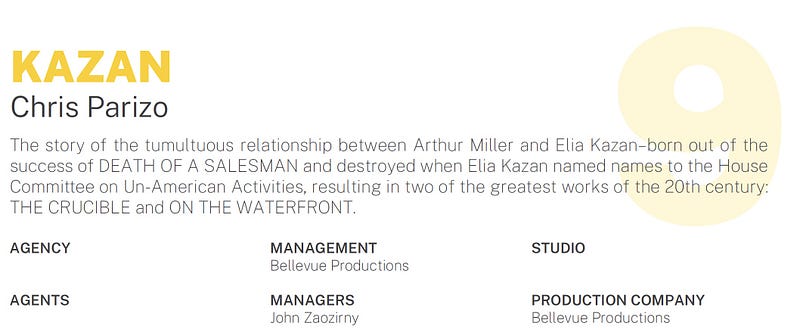
“The story of the tumultuous relationship between Arthur Miller and Elia Kazan, born out of the success of ‘Death of a Salesman’ and destroyed when Kazan named names to the House Committee of Un-American Activities, resulting in two of the greatest works of the 20th century, ‘The Crucible’ and On the Waterfront.”
What was the inspiration for taking this on? Is this something you had talked to John about before, or John mentioned this to you. How did you land on this?
Chris: One of John’s absolute favorite movies is “A Face in the Crowd.” We talk about A Face in the Crowd a lot, and it’s a Kazan film. He’s a big fan of that golden era. We knew Viceland was our little punk-rock, Aaron-Sorkin script; the way that we pitched it, we wanted to do something bigger. Something that was celebrating that golden era of Hollywood and something that aimed for the fences. And I think John likes me as a writer because I don’t fear that. I’ll take risks and aim high. If we want to write something aimed at Spielberg then we write something that’s aimed at Spielberg. Damn the torpedoes.
And that era of McCarthyism where Kazan and Miller dwelled was very familiar and aligned politically to where we are now. It makes me yearn to be in the classroom again. Where being on one side of the political spectrum damns you to the other side. Damns you depending on the point of view of who you’re talking to. Or raises you up.
When we started talking about Kazan and Miller, it was this idea of, maybe we should find a way of breaking that story, that friendship. Let the heart of the story be these two gentlemen who hitch their horses together to try to overcome incredible odds and make it on Broadway on their own… and then do it. Together. Then what happens when one of them excels further and the other one feels left behind? And how would you pivot your political views and ethics to better yourself professionally?
That was really interesting to me because that idea of taking the next big step to better yourself is a part of my psyche. I know that feeling of never being satisfied with what you have and where you are. And how protective of what I’ve done, and how far I’d go to preserve it and protect it. To keep doing it. That’s definitely inside me as it was Kazan. That’s a theme in almost of every successful script I ever wrote. They all have that element.
The protagonists believe that there’s something — even if they don’t know what it is — in them that’s untapped. Bigger than them. Kazan knew he had that in him. Miller was fine where he was and what he accomplished, and would never sacrifice his scruples. Kazan couldn’t. He could never be satisfied, and I get that part of being a creative.
We decided to focus in on their friendship and what happens when they start sacrificing each other to actually achieve their dream; by sacrificing each other, they go on to achieving the greatness they were both pressing for: Miller’s The Crucible, and Kazan’s On The Waterfront.
Tomorrow in Part 3, Chris reveals how he approached writing the story’s two characters: Kazan and Arthur Miller.
Chris is repped by Bellevue Productions.
chrisparizo.com
https://www.imdb.com/name/nm8446483/
www.slamdance.com
For my interviews with dozens of other Black List writers, go here.