Interview (Part 2): Allison and Nicolas Buckmelter
My interview with the 2018 Nicholl Fellowships in Screenwriting winners.
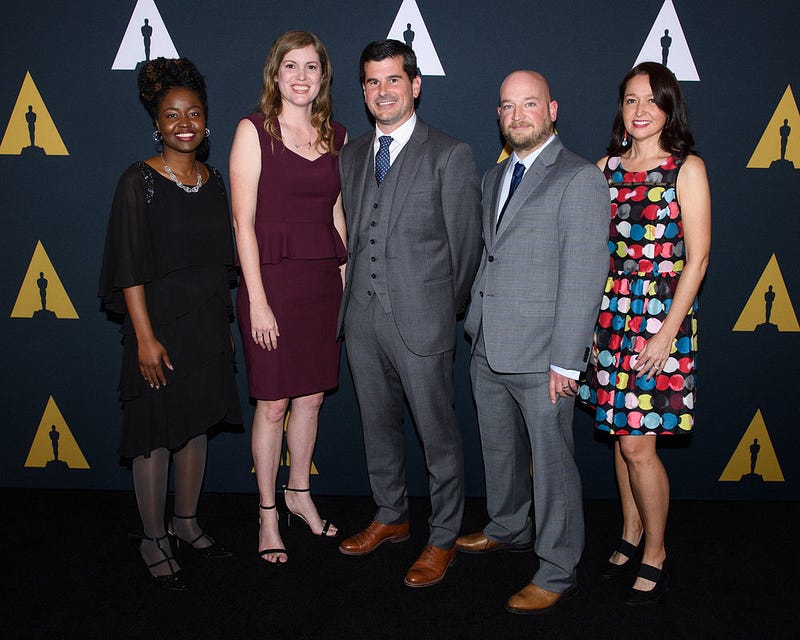
My interview with the 2018 Nicholl Fellowships in Screenwriting winners.
Allison and Nicholas Buckmelter wrote the original screenplay “American Refugee” which won a 2018 Nicholl Fellowship in Screenwriting. Recently, I had the opportunity to chat with the married couple about their backgrounds, their award-winning script, the craft of screenwriting, and what winning the Nicholl has meant to them.
Today in Part 2 of Allison and Nicholas discuss how focusing on writing romantic comedies, they were inspired their Nicholl-winning screenplay “American Refugee.”
Scott: I’ve read where you were initially writing these romantic comedies. Now you’re more drawn to what you would call “character‑driven thrillers grounded in reality.” Maybe you could unpack how that came about and what that means a little bit more.
Allison: We really like writing romantic comedies. They’re surprisingly challenging to write. I don’t think they’re always given the credit they deserve in terms of craft. They’re more difficult to write well than they might seem. We really like character driven stories. It doesn’t matter if it’s a thriller or romantic comedy. We’re all about character.
Nicolas: At some point, most writers we know go through this process where they’re trying to read the tea leaves, they’re trying to read the market. They’re trying to see, “What can I put out there that’s going to be sellable, that’s going to be timely?”
Allison and I came to the conclusion that it’s almost impossible to have your pulse on that because it seems that no one really does have their pulse on it, or it’s impossible to figure out. We started writing things that we thought mattered to us. We were entering a very strange time in our nation’s history, and the mood was ominous.
We sensed certain things in the zeitgeist, and we wanted to capture the types of feelings and the types of conversations that people around us were having. We wanted to craft stories relevant to what people around us were talking about and feeling.
We stopped worrying about what the market wanted and started writing things that we thought were urgent, that had meaning to us, and that we had a deep connection to. That felt better.
Allison: “American Refugee” was the first script we wrote where we thought, “We want to write this because it would be interesting to write,” not because, “Oh, I think it can sell,” or “I know a friend we can give it to who might like it who works for so and so.” It wasn’t any of that. It was just, “Let’s write this story.”
When you were asking about how we got to thrillers, originally, I was a little turned off with thrillers because, to me, when I heard the word thriller, I would think of something like James Bond or some character who knows all the answers, knows exactly what to do when they’re in a really drastic situation.
Once I realized you can write a thriller about a family, a teacher, or everyday people, I realized those are the kinds of thrillers I’m drawn to because, when you’re watching them, you worry more for that character, and you can feel as much on the edge of your seat as you would if you were watching a CIA operative or someone really skilled.
Scott: Let’s talk about “American Refugee” because it’s interesting what you just said. I’ve been a screenwriter for over 30 years and I know a lot of screenwriters. When they’re asked, “What should I write?” almost invariably professional writers will say, “Write something you’re passionate about. Don’t pay attention to the market.”
That’s the default mode, and it exhibited itself with your script, “American Refugee,” which did win the Nicholl Award in 2018.
Here’s how it was described at the Nicholl ceremony, the plot. “With missiles raining down on American cities and the nation under martial law, a rural family has no choice but to seek shelter in a neighbor’s bomb shelter where the danger inside is potentially greater than the danger outside.”
This is right around the time, 2015, when you first started thinking about this, and we know what happened in 2016 with the election there. You’re very sensitive to the zeitgeist, but there’s also, it looks like from my research, some specific aspects of your respective backgrounds that fed into the emergence of the story.
For example, Allison, you have a sister and brother‑in‑law who live on a farm in rural Oregon. Is that correct?
Allison: Yeah. They had just bought 40 acres outside of Portland. They were learning to raise chickens and grow vegetables and be sustainable, do all these things that they hadn’t grown up doing. There was that learning curve there. I was thinking about them being surrounded by countryside, among people with a particular perspective. Where they live is very rural. Most people there have lived there for generations, but my sister and brother-in-law have really taken to the community and love their neighbors, so it’s not at all like in American Refugee [laughs].
That took a leap of faith on their part. It got us thinking about a family in a rural setting who weren’t from there, who weren’t equipped. I think there is that idea that if things became bad in America, if there was martial law or if it felt dangerous in any way, you would seek refuge in the countryside.
We were thinking about a family, a family that’s not equipped to rural living.
Scott: A fish out of water dynamic you can exploit.
Allison: Yeah.
Scott: Nicolas, if I’m not mistaken, I read somewhere you had some grandparents or something that had to flee from Europe during the communist era or something. Is that right?
Nicolas: My grandparents and my mother were born in Czechoslovakia when it was still called Czechoslovakia. My grandparents had already lived through the German occupation during the war. Along came the Soviets at the end of that decade, and my grandparents saw the writing on the wall.
They saw authoritarianism on the horizon, and they hired a smuggler to get them out of there.
Allison: Which could be a movie in itself, their story.
Nicolas: Yeah. They eventually made their way to the United States. My grandparents were very patriotic about it. They loved America. And the America they encountered was the place of refuge for people the world over who were seeking asylum or a better life.
That had been true about America throughout my whole childhood, as long as I can remember, until recently, when it began to feel like cracks were forming in the edifice. The nationalism, the gun violence, the massive wealth gap, the huge ideological divide, the hostility toward immigrants — all of it suggesting that America might no longer be that place of refuge.
Allison and I began asking, “At what point do those cracks become fissures and then a collapse? At what point would one have to flee as my grandparents did? When does that time come? And if it comes, would we be prepared for such a situation?” The two of us came to a resounding no on that answer, that we probably would not be prepared.
What we wanted to do was create a story where we had two families, each on either side of this pretty serious ideological divide that we’re seeing in America now. We wanted to have these two families have to depend on each other, work it out and move forward together, or die, and we saw this as a microcosm of the dilemma that America as a whole is facing.
That’s where we were coming from.
Here is a staged reading of a script excerpt from “American Refugee” with actors Jamie Chung, Lily Collins, Ken Jeong and Blair Underwood.
Tomorrow in Part 3, Allison and Nicholas discuss the two families at the center of their story, and how they explored various levels of conflict between characters.
For Part 1 of the interview, go here.
For my interviews with every Nicholl Fellowships in Screenwriting winners since 2012, go here.
For my interviews with 53 Black List writers, go here.