Interview (Part 2): Adam Best
My interview with 2023 Black List writer for his script The Wolf in Chiefs Clothing.
My interview with 2023 Black List writer for his script The Wolf in Chiefs Clothing.
Recently, I had the opportunity to chat with Adam Best about his creative background, the craft of screenwriting, and his Black List script The Wolf in Chiefs Clothing.
Today in Part 2 of a 6-part series to run each day this week, Adam talks about the real-life inspiration for The Wolf in Chiefs Clothing and movies which influenced the writing of his Black List script.
Scott: I don’t think so either. It’s just we live in crazy times, man. [laughs] All right, so let’s talk about your 2023 Black List script, “The Wolf in Chief’s Clothing.” Here’s a logline.
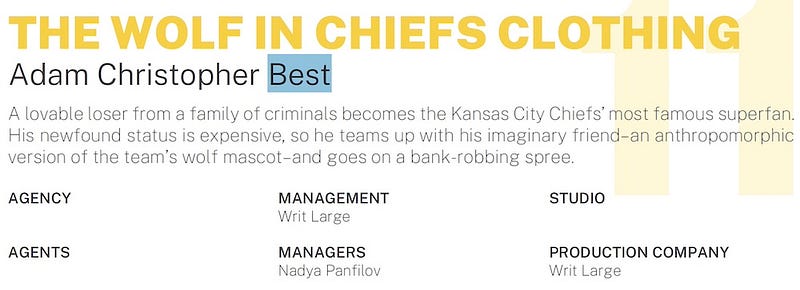
“A lovable loser from a family of criminals becomes the Kansas City Chiefs’ most famous superfan. This newfound status is expensive, so he teams up with his imaginary friend, an anthropomorphic version of the team’s wolf mascot, and goes on a bank robbing spree.” Now, you come from a football family, your grandfather played in the NFL, right?
Adam: Yeah, he did. Elmer ‘Beno” Best. He played for the Chicago Cardinals back when that was a team and the Green Bay Packers. Which comes in handy because I married into a Packers family. There’s still only one team for me, but I did marry into a Packers family.
Scott: Do you have any favorite football movies?
Adam: I feel like there’s a glaring hole with pro football movies. There’s not enough great ones. Which is weird given how much money the NFL generates. I enjoy Brian’s Song and Heaven Can Wait, but they are pretty old. Any Given Sunday, I think is highly entertaining; half a classic movie, half a disaster.
Maybe you can’t do one entirely about pro football? Hard to compete with the real on-field action. Jerry Maguire succeeded. Silver Linings Playbook had a dash of the NFL in it too. Maybe the way to do it is another genre, like a crime movie with the backdrop of football. Similar to how Point Break is a crime movie with the backdrop of surfing.
Scott: There was another Black List script, Draft Day which got made in 2014 with Kevin Costner. That’s interesting that there’s been a couple of Black List scripts featuring football.
Adam: Yeah, there was also “GOAT” and “Madden” in recent years. I think both of those, last I heard, are getting made. Football is maybe the most untouchable entity in American entertainment so it makes sense.
Scott: You have this conceit in the story, this imaginary mascot friend. How did you come up with that concept?
Adam: First off, I didn’t want to do another straightforward bank-robbing movie because there are so many classics: Dog Day Afternoon, Heat, Hell or High Water, Out of Sight, the list just goes on and on. I made the early decision to come at this from a different angle.
Another challenge I faced was that you have this lone-wolf bank robber. So how can I express his inner turmoil, the plotting to rob these banks, his metamorphosis? In between these fun action set pieces, we need to crank up stakes and tension.
I looked at Black Swan for inspiration, doing a more comedic version of something like that. Where the protagonist had to snap to reach their goal, plus more of a tragic arc. Since my character dresses up as a wolf mascot, I had the idea of his wolf pack being him and a heightened version of the mascot. Out of necessity, he invents both who he wants to be and the sounding board he needs. Kinda Tyler Durden-ish. Seemed to click with the lone-wolf aspect.
Scott: Let’s talk about your story’s protagonist, Gage LaFrentz. Here’s how he’s introduced in your script. “Gage LaFrentz, late 20s, has a dirty mop on his head and another one in his hand. He’s a janitor pulling graveyard. He’s weary from a lack of sleep, but also from a lack of living. He has dark circles under his eyes and soul.”
A really effective introduction. How did this character come into existence?
Adam: It’s very loosely based on a true story. There was a superfan who was robbing banks to afford traveling with the Chiefs and dressing up like a wolf. Not like in the same bus, plane, or anything. But so he could appear on TV and be visible in the front row.
That’s a true story, but it seemed more like a situation. We didn’t know a lot about him at the time. I wasn’t seeing the full arc or anything. So I used that loose concept as a springboard and went totally in my own direction, disassociated from the real story. I was watching… damn, what’s that movie with Drew Barrymore, the Red Sox movie?
Scott: Fever Pitch?
Adam: Fever Pitch, yeah. That had a nice long championship drought. The Curse of the Bambino for the Boston Red Sox. Almost 90 years. That drought gave credibility to the protagonist’s actions in a way. There is a desperation behind it that die-hard fans, of anything, can grasp. The Chiefs had a 50-year drought between Super Bowl wins. Great round number.
I thought that was the perfect year to move this story to. They say write what you know. I probably know more about the Kansas City Chiefs and being a Chiefs fan than anything else. It’s how the men in my family bond. I wanted to transmit this experience. I actually went to that Super Bowl with my family. I was very fortunate.
My dad promised me and my siblings that if they ever went back, he’d take us. He did, and they won. So I combined these two things: the magical 2019–20 season with the story that was inspired by something ripped from the headlines. Everything fell into place when I added the imaginary friend character as the antagonist.
Scott: Let’s talk about your Protagonist’s family, Gage’s family. There’s a mom and a sister and they are criminals. How did that emerge? You knew about the bank robbery, so did you do some reverse engineering when you were fleshing out the family?
Adam: Yeah. I came up with what I thought would be an interesting twist. A reluctant criminal. This kid from a family of criminals who actually didn’t want to become one. Unfortunately, the only way he knew how to come up with the money — the means to become this superfan and hold on to his small chunk of fame — was crime.
I liked the irony of him resisting that urge his entire life, but succumbing to it once he finally got his opportunity to be somebody. I’m a huge fan of the lovable loser archetype. Enjoy writing misfits and underdogs.
As for his family, usually, crime is a man’s world. Most of these characters are men. Not just the stars in these kinds of movies, but the supporting characters. I thought it’d be a fun twist to have a mother and sister be the key characters in his life. That felt like a fresh direction.
Scott: The mother literally had him take gymnastics in order to facilitate his bank-robbing skills, which, of course, comes in handy later on, for him being a mascot, a fan favorite. One of the benefits of that is that it takes some of the responsibility off his shoulders.
Both the mother and the sister, the sister is schooling him on how to rob banks, which is interesting because you had a challenge. How am I going to take a character who is a robber, a thief, stealing stuff, and make him a sympathetic character? Could you maybe talk a bit about that challenge?
Adam: There are a couple things I did. One, I actually talked to a real bank robber, a guy named Joe Loya, who was a bank robber in the ’80s and ’90s in California, and wrote a book. I had him on our podcast a couple times, got to know him. Felt like I started to understand what could drive a person to do this. It was actually just for my podcasting job but it gave me incredible insights.
He had a phrase. Something along the lines of “poverty mocks you.” He told me that once, and it stuck with me. I thought, that has to be what drives this. That sentiment is something anybody can relate to. Or anybody who isn’t an out-of-touch plutocrat or something.
Also, surrounding a flawed character with worse people is a good trick to make us more sympathetic. So I used that strategy. Succession is masterful at this. You like Cousin Greg because even though he has some nasty qualities, he is the wimpiest viper in the viper’s nest.
Additionally, having a protagonist who really, really wants a goal and is filled with passion helps. We all have goals and passions. For all his flaws, Gage is deeply invested in the Kansas City Chiefs. His fandom is pure.
Even though it goes back to his dad, who was also a bank robber before he died, it’s the one pure thing in Gage’s life. Sure, he’s doing illegal things to chase that purity, but regardless that purity is one of the reasons he’s still somewhat likable in the end.
Scott: There’s like these three drivers, it seems like, one is poverty and you establish that. The poor guy’s got a really shitty life at the beginning and this lousy apartment. He’s got bills and all that sort of thing. That would be a driver, and the Chiefs, his love for the team, but fame.
I have a theory that one of the reasons that reality TV has been so popular the last 20, 30 years is that people say, “God, I could be that person.” It’s like everybody wants to have their fame. Maybe you could talk a little bit about that aspect of it, that he gets caught up in that fame cycle.
Adam: Yeah, it’s a little bit of a commentary on that aspect of our society, whether it’s reality TV or social media. This whole influencer phenomenon, people can get caught up in it. The guy this was very loosely inspired by, I think was really caught up in his persona.
It can give people meaning. Sometimes it’s hollow, and sometimes it’s not. I don’t know. I thought that was an interesting aspect to explore. You mentioned three drivers, but there’s a fourth driver too, and that’s the love interest, Emerald Green.
She comes along and shows Gage a different path. Because his operating thesis throughout life is, nobody likes me for who I am, and they never will. Society has conditioned him to think that way. Same with his family. Then a person shows up who genuinely likes him.
The tragic thing — even more tragic than him going to prison or making a giant fool of himself — is rejecting that love. Rejecting someone who actually loves him for who he is. Emerald cares about Gage; not the Chiefsaholic figure, the bank robber, or anything else. She simply cares about who he is inside and he can’t accept that.
Tomorrow in Part 3, Adam reveals how and why he came up with the imaginary character Wolfie for his 2023 Black List script.
For Part 1 of the interview series, go here.
Adam is repped by Writ Large.
https://www.youtube.com/channel/UC3CdquRsu60VZcbGMfr1WgQ\
https://arrowheadaddict.com/
https://twitter.com/adamcbest
For my interviews with dozens of other Black List writers, go here.