Interview (Part 2): Aaron Chung
My interview with the 2019 Nicholl Fellowships in Screenwriting winner.
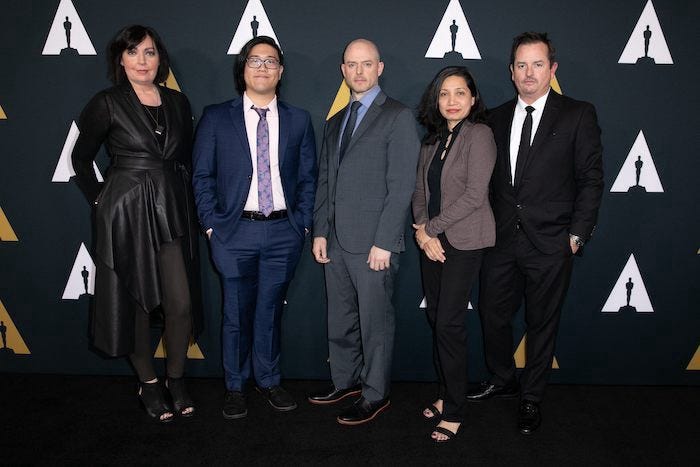
My interview with the 2019 Nicholl Fellowships in Screenwriting winner.
Aaron Chung wrote the original screenplay “Princess Vietnam” which won a 2019 Nicholl Fellowship in Screenwriting. Recently, I had the opportunity to chat with Aaron about his background as a screenwriter, his award-winning script, the craft of screenwriting, and what winning the Nicholl Award has meant to him.
Today in Part 2 of a 6 part series to run each day through Saturday, Aaron reveals the inspiration behind his award-winning screenplay “Princess Vietnam.”
Scott: Because the reason I was so struck by it, not only just personally, because I tell my students all the time that now more than ever, we need stories that put a human face on the other, so that we can empathize with people…
Aaron: Yes.
Scott: …and live their experiences vicariously through storytelling. I was struck by it, because in reading your script, it really is there. That sensibility is quite self‑evident in your script Princess Vietnam.
The themes of empathy, connection, and understanding ‑‑ they run throughout that script. The logline: “In 1980, a lonely Vietnamese girl befriends and falls in love with an imaginative Irish girl as they struggle against racial prejudice in their small town.”
Let’s begin at the very beginning. What was the inspiration for this story?
Aaron: I would say there’s two major inspirations to me taking on this project. One of them is my own growth. I was a very self‑isolated child growing up. It’s hard enough that I felt and looked so alien compared to the other kids that it was hard for me to open up socially.
In my self‑isolation, I would often escape into daydreams and fantasies and be that weird kid who would be kind of quiet in the bus ride and just think up stuff. That sentimentality served these two characters who also daydream a lot, and they also want to fantasize and wish for something better and through that, they found each other and found love and found something that I think we’re all searching for.
As for the other inspiration, there is a short personal essay that Cherelle Higgins wrote, which was all about living in Margaret Thatcher’s UK and how there was a rise of a skinhead movement in her neighborhood
Scott: I don’t know if you saw that movie Blinded by the Light. Are you familiar with that film that came out in the summer?
Aaron: Yes. I watched it, and I really liked it.
Scott: Yes. Same period of time, like 1980, I believe. Right?
Aaron: Mm‑hmm.
Scott: These two central characters in your script, you have a personal connection to both. Let’s talk about Fable and Aisling. As you crafted the story, did you consider Fable to be its protagonist, or are they co‑protagonists in your mind?
Aaron: I would consider them both co‑protagonists. I mean, when I first crafted and outlined the story, I considered them both to have equal amounts of screen time and equal amounts of development and arcs to go through.
Scott: That’s obviously one of the major signs of a protagonist character, a character who goes through significant transformation. Let’s talk about Fable. This is how you introduce her in the script. “Fable Su, 16, Vietnamese American, underweight, drags her feet on the sidewalk, her head pointed at the ground. She hugs her backpack like a stuffed bear. The torn strap dangles. The school uniform’s beat to hell.”
How would you describe this character and her lot in life at the beginning of this story?
Aaron: Someone who’s just been through hell and is still going through it, someone who takes pain quietly, and someone who’s in the path of adulthood, but is still trapped in her own childlike demeanor.
Scott: That hell ‑‑ what are the key elements, the dynamics that she experiences in her life that lead to that kind of hellish kind of experience?
Aaron: Well, it’s being beaten, punched, tortured, and isolated because of something that’s beyond her control. She was born as someone who’s different, and she can’t change that.
Because of that, there are people who want to get her, who feel that she’s lesser and insignificant, and she’s reminded of that every day until, I don’t know…It’s something that I think a lot of especially Asian American children around my generation feel. They can’t feel like they’re a part of a certain group, and they beat themselves up because of it.
Scott: That’s an interesting choice of words. She experiences a physical abuse on the part of these bullies who we’re going to talk about in just a bit, but then she also beats herself up psychologically. Is that right?
Aaron: Yes, I would say that’s correct.
Scott: Let’s talk about Aisling, this other co‑protagonist here. Here’s how you introduced her in the script. “Fable scopes out the cafeteria” ‑‑ this is at school ‑‑ “then stops at Aisling Walsh, 16, Irish American, tomboy, looking in Fable’s direction, a pale girl with natural red hair. She wears a leather jacket over her uniform.”
Let’s talk about this character. How would you describe her life circumstances at the beginning of the story?
Aaron: Tough on the outside, but definitely a facade, a very apparent facade that she has built herself around. Actually, in my newer draft that I finished, I described that leather jacket that she wears as an armor to her. I think that’s very much telling of who Aisling is, is a person who likes to wear layers, who likes to wear armor, and guard herself from other people and even her own emotions.
Scott: Both have challenging family situations. Could you describe Fable’s relationship with her mother?
Aaron: They’re very close, I would say. They’re close, but there’s always that divide that Asian American children have with their parents. Asian American kids will have this distance when it comes to culture, language barriers, perspective, because Asian parents are so… they’re rooted in who they once were. Both Fable and her mother, there’s that divide, but at the same time, there is the fact that they are the only two Vietnamese people in this small town, so they have to rely on each other.
Scott: She’s also got a complicated relationship with the male figures in her life, both of which are no longer living. Could you unpack that a little bit?
Aaron: One of Fable’s biggest arcs to overcome is her feelings of hate towards people, because love and hate’s a huge theme in my protagonists, I would say, and Fable’s hatred towards her stepfather, who she only sees as this soldier, just this Vietnamese killer, and she kind of ignores who this man could have really been and why he did certain things.
Because at the end of the script, she realized that much as she wants to hate her stepfather, she can’t, because he brought her and her mother to the safety of America. Even though Fable’s mother was already pregnant by the time they met, he still found love in her and found ways to protect her. That’s what Fable kind of learns at the end.
Here is a stage reading of an excerpt from Malcolm’s screenplay “Princess Vietnam” featuring actors Tyrese Gibson, Rosa Salazar, Amandla Stenberg, and Wes Studi.
Tomorrow in Part 3, Aaron discusses the “naturalistic pace” of the script and how he hit on the idea of including three animation scenes.
Aaron is represented by MGMT.
For Part 1, go here.
For my interviews with every Nicholl Fellowships in Screenwriting winner since 2012, go here.
For my interviews with 53 Black List writers, go here.