Interview (Part 1): Scott Beck and Bryan Woods
The co-writers of A Quiet Place go deep into their background, creative process, and the evolution of their hit horror movie.
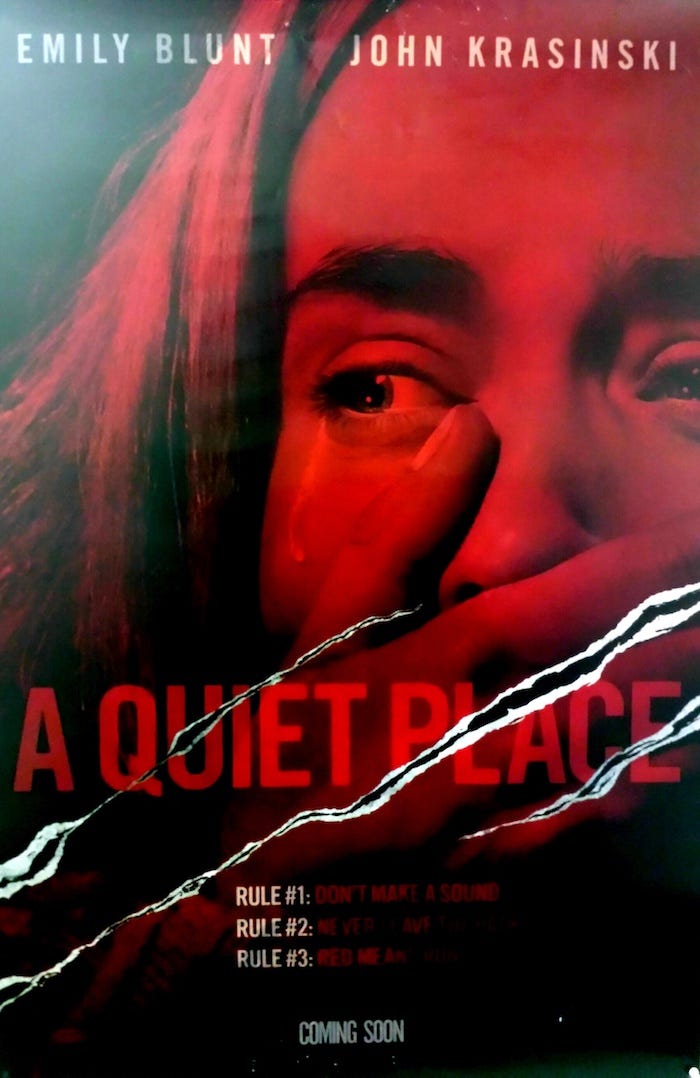
The co-writers of A Quiet Place go deep into their background, creative process, and the evolution of their hit horror movie.
As of today, the Paramount movie A Quiet Place has grossed $235M in worldwide box office revenues. Given the movie’s reported $17M production budget, that represents a ginormous ROI, but the movie is not only a success financially because critics have given the film an enthusiastic thumbs-up: Rotten Tomatoes (95%), Metacritic (82%), IMDb (8.1). Thus, it’s no surprise Paramount has announced a sequel is in the works.
Where did this movie come from? Who came up with the central conceit of the story? Who wrote the original screenplay which sold as a spec script?
The answer is longtime friends and filmmakers: Scott Beck and Bryan Woods. As it turns out, the two have been Go Into The Story followers for several years and with thanks to Joshua Caldwell, I ended up grabbing an hour of the writing duo’s time for an in-depth interview. It turned out to be not only a fascinating conversation, but also an inspiration for anyone who aspires to cinematic storytelling who resides far outside of Hollywood’s pearly gates.
Today in Part 1 of a six-part series to run each day through Saturday, Bryan, Scott, and I discuss how the pair met in middle school, received their version of a film school education while in high school, then in college came up with the kernel of an idea: “If you make a sound, you die.” That was the starting point for what has become the phenomenon which is A Quiet Place.
Scott Myers: Let’s start in Iowa, Bettendorf Middle School where I believe you two met and discovered you shared a mutual interest in Star Wars. Could you take us back in time and tell us about how you began your cinematic journey together?
Scott Beck: Bryan and I first met when we were 11 years old. At the time, neither of us knew we had an interest in making movies. We just had a mutual friend that introduced us and, over talking, discovered that we both used our action figures to make stop motion movies. Because we had that interest, we joined forces because nobody else we knew was making movies.
It progressed quickly from there where we started talking about screenplays at a very early age and writing short scripts. One of our first films we produced, we were probably 12 or 13 years old. It was about friends that hang out, have a sleepover, and then aliens invade.
It’s an absolutely terrible, terrible film that Bryan and I also acted in, but that was our first go at things. After that point, when we were in high school, that’s when we started thinking about writing for a career, directing for a career. We just took our ambitions to the next level.
It was the year of, let’s see, 1999, so it was the year of The Sixth Sense, American Beauty…
Bryan Woods: Magnolia. One of the best years in cinema as far as the years we’ve been alive and digesting movies. It was incredibly inspiring to be watching movies. Then we would try to replicate that by making micro‑budget feature films.
At the time, our heroes ‑‑ like Paul Thomas Anderson or Martin Scorsese ‑‑ we were making these really ambitious, a lot of characters, like big ensemble dramas and making them on a micro‑budget level, and just doing our damnedest to emulate our heroes, and failing miserably, of course.
Making the movies from beginning to end, learning how to shoot, learning how to record audio, doing audition sessions with local actors, and learning how to screen a movie in front of a local audience, and hand out test cards. Basically, the whole process of filmmaking in our own young, high school naive type of way.
Scott Myers: These are some of the titles I’ve seen, like Amber, Shades, The Bride Wore Blood?
Bryan: Yeah.
Scott Beck: Those were all movies that we made basically for no budget. Just using our friends or doing casting calls in Iowa where we grew up. That, for us, was very much our film school, those years in high school, just immersing ourselves in the process.
Scott Myers: M. Night Shyamalan, evidently, is a big influence for each of you. Particularly, I think, The Sixth Sense and Unbreakable. What specifically is it about Shyamalan that inspires you?
Bryan: A couple of things. Since we have the time, I guess I’ll start at the beginning. When we saw The Sixth Sense for the first time, it really got us excited about films as an art form. Being a writer, that script is so beautifully crafted. That ending, it just hits you out of nowhere.
It really blew our minds and it made us feel like, “Oh wow, we would love to do that for an audience someday. We would love to write a movie.” Then his follow‑up Unbreakable is a great… it’s so beautifully directed. You really feel the directing of the screenplay. That inspired us to make films. There’s that.
I think, on a global level, what we love about his films is that they are often very flashy, high concepts that feel at home in a summer blockbuster market place, but they’re executed with the craft, and detail, and love of any film that you would find at the art house.
For us, Shyamalan’s movies are articulated in such a way that impresses us as much as a Francois Truffaut film.
Scott Beck: I think what we respond to the most is just how layered his stories can be. If you want to watch his films just for entertainment sake, they will deliver, but if you want to dig underneath there and find metaphors, the thematic levels, and the allegories, they’re all there.
You can unpack it and go seven layers deep with his films. That’s what we always appreciate about genre storytelling, when you can do more than just scare the audience, you can tell a story that has intelligence.
Scott Myers: You do your ‘film school education’ in high school. Then you two decide to go to college at the University of Iowa. Did you do much honing of your screenwriting and filmmaking skills there?
Scott Beck: Certainly like at University of Iowa, we took various writing classes. We weren’t in the formal writers workshops. The fiction writing classes there were certainly informative. I think, for the most part, to get critiqued and get feedback, what’s working or not working, rather in your writing, which I look back on and I laugh.
In college, when you open it up for discussion, people were very reticent to offer constructive criticism. Yet, that’s the most important thing that I think anybody can have in their young writing career and also throughout life. You should always be able to learn from your current work.
I think that’s what we always were honing in on during our years at University of Iowa, in just making these films in general. It’s not just resting on our laurels, but figuring out, why didn’t this work? Why isn’t this making an audience laugh, or why aren’t they terrified? Certainly, those years were very important to us at Iowa.
Scott Myers: In fact, in December 2005 you win the MTV’s Best Film on Campus competition. I think you got a development deal with MTV out of that. Is that right?
Scott Beck: [laughs] That’s a funny story in and of itself actually.
Bryan: We had won a development deal as the prize for this nationwide filmmaking competition to basically develop a movie with MTV Films. The problem [laughs] that we found ourselves in was that MTV Films’ company was collapsing at that time. By the time we had gone through the work of negotiating a deal, they didn’t even really exist anymore.
We found ourselves more or less without anything. The prize was null and void ostensibly. What we did is we tried to turn that into an opportunity by introducing ourselves to David Gale who, at the time, was the president of MTV Films. He was transitioning into the head of their new media division. We just introduced ourselves.
We said, “Hey. Here’s who we are. Here’s our interest in film. Here’s what we love about your career and all the amazing movies you’ve made.” He’d presided over a lot of terrific films. One of our favorites being Alexander Payne’s “Election.” We were very aware of David’s filmography, and we’re big fans. We just kept bugging him.
We basically kept saying like, “We have this thing. The deal’s not…It’s gone, but would you be open to hearing some ideas for some projects? Can we pitch you some ideas?” He was very generous with his time, and we were able to pitch this idea for this project called “Spread.”
It’s about a sexually transmitted disease that takes over this campus. It was kind of like It Follows meets Contagion before both of those things existed. He was able to help us get a very, very, very tiny budget to go back to our home state of Iowa and shoot a little pilot presentation for it.
We’ve always looked at David as a great mentor in our careers and somebody who helped us out when he really didn’t have to.
Scott Myers: When you’re at the University of Iowa, as I understand it, you had the genesis of this idea for A Quiet Place. There was a simple premise ‑‑ there was a quote I saw in one of your interviews ‑‑ “If you make a sound, you die.” How did you come up with that story conceit?
Scott Beck: When we were at University of Iowa, there were two things that really led us to this idea. One, we were exposed to a lot of great silent films, or films without much dialogue. It was Charlie Chaplin, it was Buster Keaton, and this French filmmaker named Jacques Tati who worked in the post sound era.
His movies really activated sound as a storytelling device, but there was a lack of dialogue in his films. What we found so brilliant about that was he was able to convey so much about character, about emotion, intent, and humanity through simple visual storytelling devices, and we found that super fascinating.
At the same time, we were taking this nonverbal communication course at the University of Iowa, and that just led us to witnessing how often people communicate without saying a single word.
We found that to be very powerful and beautiful, and thought, “What if we took that knowledge, combine it with Charlie Chaplin, Buster Keaton, Jacques Tati, and then additionally combine that with our love of genre filmmaking, such as Alien or Jaws, or Hitchcock. That felt like that was the formation of a very interesting type of film.
Scott Myers: If that’s the case, basically you hatch that idea at the University of Iowa, I think it’s safe to say you’ve amortized the cost of your education in a huge way.
[laughter]
Scott Beck: Certainly. Certainly.
Bryan: It was weird because it wasn’t like we were like, “Eureka! Here’s a movie idea.” It was just like, “Oh, someday it would be very cool to make our silent film.” That’s what we kept calling it, our silent film, but it always felt like a gimmick. We didn’t have a story. We didn’t have characters. We didn’t really have even a core idea. It was just that concept.
It wasn’t until many, many years later where we started crafting the story of what A Quiet Place eventually became.
A trailer for the movie A Quiet Place:
Tomorrow in Part 2, Bryan and Scott reveal how A Quiet Place went from concept to treatment to script to multiple Hollywood rejections to the one person who said “yes” to the project, a most unlikely filmmaker to champion such a ‘quiet’ movie.
Scott and Bryan are repped by ICM Partners and Madhouse Entertainment.
Twitter: @beckandwoods.
For nearly 200 Go Into The Story interviews with screenwriters, filmmakers, and Hollywood insiders, go here.