Interview (Part 2): Charlie Wachtel and David Rabinowitz
My conversation with the co-writers of the movie BlacKkKlansman.
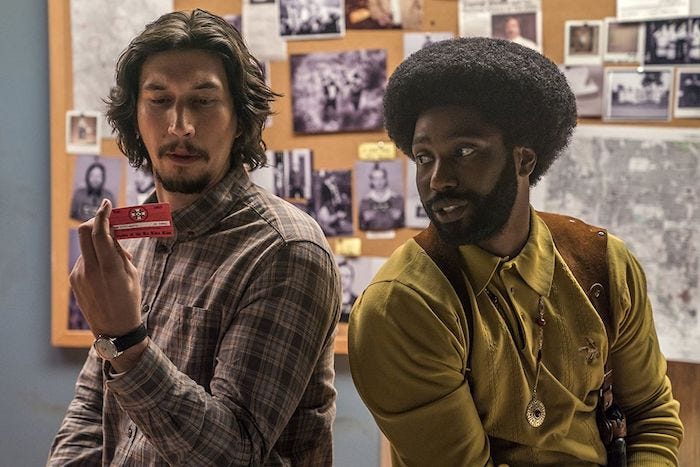
My conversation with the co-writers of the movie BlacKkKlansman.
The provocative movie BlacKkKlansman opens in North America this weekend. Directed by Spike Lee and starring John David Washington and Adam Driver, it was originated and co-written by screenwriters Charlie Wachtel and David Rabinowitz.
Today in Part 2 of my five-part series interview with Charlie and David, they discuss how they found out about the true story the first black police officer in Colorado Springs, Colorado and how he helped to infiltrate the KKK.
Scott: How many scripts did you write before you landed on BlacKkKlansman?
Charlie: Together, we had only written one thing before. It was a TV pilot that had gotten us a couple meetings with managers. We thought we had a nice thing going together, so we’re like, “Let’s do it again.”
David: Then BlacKkKlansman is the second thing.
Scott: Let’s talk about your movie BlacKkKlansman which is scheduled to go wide in North America beginning August 10th, directed by Spike Lee, starring John David Washington, Adam Driver, Topher Grace, and Alec Baldwin.
Plot summary “It’s the early 1970s and Ron Stallworth is the first African American detective to serve in the Colorado Springs Police Department. Determined to make a name for himself, Stallworth bravely sets out on a dangerous mission infiltrate and expose the Ku Klux Klan. The young detective soon recruits a more seasoned colleague, Flip Zimmerman, into the undercover investigation of a lifetime.”
It’s currently sitting on a 96 rating on Rotten Tomatoes. It was a spec script which you two wrote. It’s a true story based on a book by Ron Stallworth. Is the book how you found out about it?
Charlie: Yes. It all started, we were looking for the next project to work on together. We were keeping our ears and our eyes open. I was doing the one thing that I shouldn’t have been doing at the time, which was I was on Facebook.
I was scrolling on feed and somebody had posted a story about Ron Stallworth. I read the article, I saw at the bottom of the article there was a link to the book on Kindle. Ordered the book, read the book, sent it to David, David read it and we both got excited about it. We thought like, “This probably has to be set up somewhere in development.” Sure enough, it wasn’t.
David: We contacted the author, Ron, his manager, and the publisher. We basically said, “Hey, if no one has the rights, we want the chance to adapt this.” We sent them a one sheet with our vision. We also sent them a piece of paper that said, “We have the right to adapt this on spec.” We never got the rights ourselves.
Charlie: We didn’t have an agent or a lawyer at this time.
David: Yeah, we didn’t have… It was a nonexclusive right to adapt this on spec. They were fine with it.
Charlie: The takeaway is we never secured the rights to this, which was scary.
Scott: I guess you must have assumed that if someone liked the script, they would then secure the rights.
David: That was the hope.
Scott: That one sheet you sent to Ron, what made you think it seems pretty obvious to me, but I’m just curious what made you think, “This is a movie”?
Charlie: First off, for practical reasons, we were trying to establish ourselves as genre writers. Thrillers was what we were looking to do. This is something that we saw and were immediately like, “We’re both fascinated with the KKK. There are not that many movies about the KKK.”
This is something while, on the surface, it does have a lot of comedy, we could make it mostly a thriller and that’s something we can execute.
David: It’s also just an automatically compelling thing. You see the title, BlacKkKlansman, that communicates so much in two words. That’s the title, that’s the main character, that’s the premise, that’s the hook, that’s the high concept.
Just those two words, they do a lot of heavy lifting. Then, when you talk about character, it’s like, “Who is this Ron Stallworth? What type of guy would do this and infiltrate the KKK?” Well, that’s a character worth hanging out with for a full movie.
Scott: I was going to ask, “How much research did you do?” Did you go up to Colorado? Did you meet with Ron?
Charlie: We met Ron in Newport Beach because he was in town for a book signing and I think he was also meeting with his publisher who lives out there. We drove down to meet with him and really to interview him and kind of pick his brain.
At this point, we had already been in outline mode and we wanted to be as accurate as possible. We wanted to also ingratiate ourselves with Ron and hear more about his story.
David: We did some research, but it was mostly the book and Ron… they were our two biggest resources that we kept coming back to over and over again.
Scott: What was your writing process like? First of all, do write together in the same room or you’re just swapping things off online or by distance?
David: We outline together generally and then write separate.
Charlie: We do very, very detailed outlines and then after those are done…For that, we sit in a room together and build. Once those are done, we divide it up. If we’re doing a feature film we’ll say, “OK, one person takes act one and act three, the other person takes act two. We write it and then we swap.
The rest of the process is pretty much we continue to swap until there’s a point where we’re either stuck on something, feel we need to go back to the drawing board, or something like that.
Scott: Do you remember what year it was when you discovered the book?
Charlie: Yes. It was…
David: July, 2015.
Charlie: Yes. July, 2015. From that date until the time we had an offer, it was only seven months.
Scott: Seven months, wow.
Charlie: That’s the discovery of the project until the offer on the script.
Scott: That’s actually a pretty quick turnaround. You’re talking about maybe writing the script in four or five months maybe, something like that?
David: Yeah.
Charlie: Yeah. If anything, I think maybe the outlining and the research took longer than the actual drafting.
David: The actual writing of the first draft went pretty quick because we had done so much research and such extensive outlining.
Charlie: Also, because we were terrified. We had a fire under us. We didn’t have the rights to this thing.
David: Yeah, it was a race against time.
Tomorrow in Part 3, Charlie and David discuss how the controversial nature of the story’s content is particularly relevant to our current cultural discourse about race.
For Part 1 of the interview, go here.
Twitter: @therealcwach, @BlacKkKlansman.
For 100s more Go Into The Story interviews with screenwriters, TV writers, producers, filmmakers, and industry insiders, go here.