Interview (Part 1): Amy Berg
My Q&A with a top Hollywood TV showrunner.
My Q&A with a top Hollywood TV showrunner.
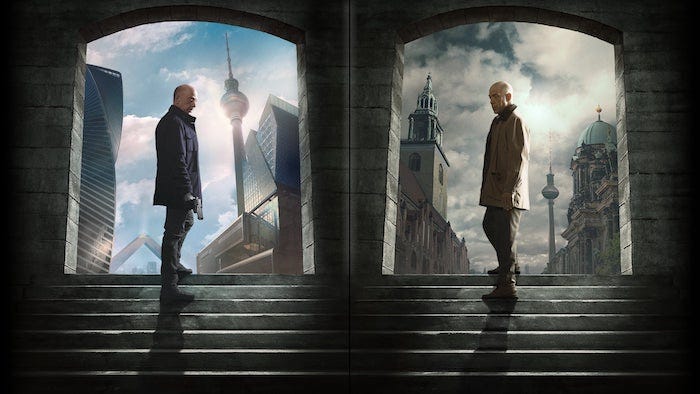
Amy Berg is a writer and TV producer whose credits include Leverage, Person of Interest, Eureka, Caper, Da Vinci’s Demons, and the current hit STARZ series Counterpart. I crossed paths with Amy several years ago the way many writers do nowadays: via Twitter. In 2017, I reached out to Amy to do an interview and what followed was a months’ long back and forth via email.
Here is Part 1 of our Q&A in which Amy talks about how she wound her way into Hollywood:
Scott Myers: Looking at your writing and producing career in Hollywood, it’s a challenge to know where to begin because you’ve written so many different types of content: kiddie comedy, crime dramas, sci-fi, soap operas, historical fiction, comic books. So why not start at the beginning. I believe you grew up in Northern California. How and when did you develop an interest in writing? Were television and movies a big influence on you in your youth?
Amy Berg: I lived in my head when I was a kid. I wasn’t a loner, but certainly I never minded being alone. There was nothing better than being punished and sent to my room. Reading was my thing. I consumed books. I was always at the library looking to upgrade the material we were given in school.
The first movie I ever remember seeing was Empire Strikes Back. I was way too young to be in that theater, but my cousin was babysitting and wanted to see it. Holy shit, my mind was blown.
My passion for TV wasn’t really unearthed until middle school when I fell madly in love with Star Trek: The Next Generation. I was in the official fan club and everything. Massively obsessed. And now I’m good friends with half that cast and most of the writers, which never ceases to amuse my inner nerd.
When my family’s house was robbed in the late ’80s, we lost basically everything. I had a big coin collection that was passed down over generations that was taken, but the insurance forms put a cap on the total of certain things. My mom was determined to get our money back somehow, so she came to my brother and I and asked, “What do you want?” It was like Christmas. We could pick anything we wanted, something that we didn’t have before. I asked for a video camera. Everything changed that day. I started looking at the world from a storytelling perspective. But not for a second did I think I would do this for a living. I had no family connections. I didn’t know a single person in the city of Los Angeles, for that matter. Even when I went off to college, I was undeclared and totally clueless. Just a big fan of words and the things you could do with them.
It wasn’t until an English professor pulled me aside one day that my worldview changed. She’d assigned us to write a paper exploring character motivations in Hamlet. Out of boredom, I decided to frame the paper as though I was a theater director staging a performance of it. She made me read it aloud to the class and then afterwards asked me if I’d ever considered going to film school.
Scott: I was going to go directly to “How did you break into Hollywood,” but your personal backstory gave me a jolt! Three key events: Empire Strikes Back which blew your mind; a robbery which led to you getting a video camera; a paper you wrote for an English class which led to the idea of film school. Before we jump into your professional life as a writer and producer, I’d like to take those key events in your personal history and get a bit metaphysical, if you don’t mind. Do you look back on those ‘plot points’ in your own life as Fate? Obviously you made choices and worked really hard to get where you are today, but do you also think Destiny plays a role in a writer’s life or for that matter any of our lives? Or is it all just about hard work, learning the craft, and networking?
Amy: Many moons ago I worked with Peter Dinklage, who has a very practical take on the idea of destiny and luck. He hates those words because he feels like they cheapen the hard work people do to put themselves into position for success, not to mention the physical and psychological toll required to get there. I think he’s absolutely right about that.
For me, it took a while to figure out my path and I can’t help but think that the universe somehow directed me towards it. I’m the daughter of a grocery store manager and a stay-at-home mom from a relatively small town in Northern California. Entertainment was a distraction. The idea that it could be an occupation wasn’t in the cards. I didn’t know anyone who worked in film or television and I was hundreds of miles from the nearest studio. Growing up, I wrote specs of Star Trek: The Next Generation in my head…. I mary sue-d the shit out of that show. Of course, I didn’t realize that this was writing. I was just a kid with an overactive imagination.
Once writing became the endgame, it really was all systems go. I wrote my first episode of television when I was less than a year out of school.
Scott: Located so far away from L.A. and not going to film school, how did you go about learning the craft to the point where you were able to write those early TV scripts? And how did you go from script to breaking into the business?
Amy: Well, as it turns out, I’m actually a pretty good listener.
When my professor told me to consider film school, I started looking around. My parents didn’t know what to do with the idea and I didn’t want to start over from scratch, so I only looked at places that were inexpensive where I could wrap up a degree in two years. There was really only one option and that was San Diego State. The film program there was impacted and you had to have at least 3.5 GPA to even be considered for admission. Basically it was a really intensive program for really serious students, but we were surrounded by a party school atmosphere. I fucking loved it. And I met some amazing people, many of whom I’m still friends with today. In fact, my BFF, the guy who helped me produce CAPER, is someone I made movies with back in San Diego.
It was guerrilla filmmaking at its best at SDSU. Digital had already arrived, but the department couldn’t afford the technology upgrade so when I got there they were still shooting on 16mm. It was an extraordinary experience. Film school must be so easy for folks starting out now… I mean, you can really do it all on your phone.
As much as I enjoyed my time there, nothing can prepare you for being on a real soundstage or in an actual writers room. I think the most important takeaway from film school was learning how to work with other people. Especially in an environment with a hundred other students who all want to direct. Someone is gonna have to hold the boom. You learn how to work with other egos and how to stifle yours when it’s your turn to wrangle cable.
In my last year, I applied for the DGA Training Program. Solely out of fear. I didn’t want to be an assistant director, but I also didn’t want to move to LA without a job of some sort. I don’t know what the process is these days, but back then there were multiple stages: IQ tests, group interviews, individual interviews. It took two months and I made it all the way to the final interview and it was me sitting across from a dozen DGA members peppering me with a thousand questions. It got to the point where I stood up and said, “Sorry, but I don’t think this is for me.” And I walked out of the room.
I moved to LA after graduation without a job and without knowing anyone aside from my roommate who was getting a degree in social work at USC. Needless to say, I was cursing that professor’s name. What the hell was I getting into?
I applied to be a producer’s assistant from an ad in one of the trades and wound up with a job working for some EPs writing for Nickelodeon live action shows. A few months later, I was working alongside them as a writer myself. But that is its own crazy story.
Tomorrow in Part 2, Amy goes into her time as a production assistant and how she parlayed some spec scripts landing a TV writing gig.
Follow Amy on Twitter: @bergopolis
For more exclusive Go Into The Story interviews with screenwriters, TV writers, filmmakers, and industry insiders, go here.