Interview: Kelly Fremon Craig
Conversation with the writer-director of Are You There God? It’s Me, Margaret.
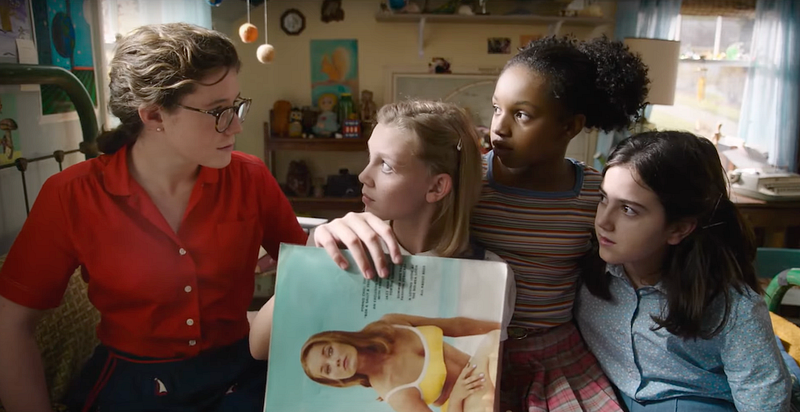
Conversation with the writer-director of Are You There God? It’s Me, Margaret.
From IMDb:
First published in 1970, the novel Are You There God? It’s Me, Margaret by Judy Blume is considered a children’s classic. It has never been out of print since its initial publication; in 2010, Time Magazine put it on a list of the 100 best novels published since 1923, and in 2012 it made Scholastic Parent & Child Magazine’s list of 100 Greatest Books for Kids. However, starting almost from its first publication, it has long also been one of the most challenged and banned books in America: parents, administrators, and politicians have often tried to get the book removed from school libraries and reading lists both because of its honest examination of puberty and menstruation and because it depicts a girl who is given the freedom to decide for herself what religion she is interested in adhering to.
It’s now a movie thanks to writer-director Kelly Fremon Craig. Here is an excerpt from a Slashfilm interview.
When I interviewed you and [executive producer James L. Brooks] for “The Edge of Seventeen,” he said the key to a universal story is specificity. This movie is nothing but specific moments. I was not an 11-year-old girl in 1970, but everything felt so granular to the point where I cringed and I laughed and I recognized it. Can you talk about finding those moments?
I think that’s the magic of Judy Blume. That’s why I fell in love with her books. There was so much truth in those details. I found myself in those, so in a lot of ways I was trying to deliver her. You know what I mean? And in a lot of ways when I think about it, she shaped me as a writer, because I got, at that age, how important that was, to see yourself reflected in those little details. All those things are important to me.
I also like the tiniest things. I like, especially at this age, to see all the messiness. I liked that her hair was not done great, and it was greasy. I liked that people’s clothes are rumpled and their shoes are dirty, those type of things. There was actually one thing that just knocked me out. When I walked into the costume room and Anne Roth, who’s a legendary costume designer, just being in her presence, you learn so much, but I walked in and she had put Margaret in one dingy, white sock and one clean, white sock. And I said, “That is it. That is it. That’s the age. That’s exactly right.” And that’s a detail that probably no one … it doesn’t really show up anywhere in the movie, but I know that it’s right, and that feels good.
In this film and in “The Edge of Seventeen,” there’s a detail I wish more coming-of-age movies really latched onto: How when you’re that age, every day is the most important day of your life, and every event is a defining moment. There’s no such thing as yesterday or tomorrow. Today is all that matters.
Yes, exactly. I feel like the stakes feel so enormous at that age. Everything feels like life and death. And when you look back, you can laugh, because it’s kind of funny, but at the time it’s not at all.
— —
Can you talk about how you wanted to make a movie to make sure we kill that dead, the idea of there being a “girl book” or a “girl movie”?
I so want to kill that dead. I am so desperate to kill that dead. Because there is this feeling that if you’re a girl, you can watch a boy movie, but if you’re a boy, you can’t watch a girl movie. And I think that’s so silly and ridiculous. But I have to say, what’s exciting about this is, when boys and men do come to see it, I think most of them walk in, “Oh, this is not going to be for me,” and then they’re surprised. They’re surprised that they relate. So it’s exciting to see that surprise, but I hope we get to a place where they’re not surprised.
There is a great question and answer which speaks to what we do as screenwriters.
I want to talk about you as a filmmaker. I feel like film journalists are invested in flashy filmmaking, “Oh, look at that 10-minute long tracking shot,” but I love how you shoot your movies. Your camera serves the characters. Your camera seems to ask, “Where can I serve these characters in their emotional needs in this moment?” Can you talk about your filmmaking choices and how you choose to film your actors and make sure you’re getting to the emotion of these scenes?
That is … I’m so glad you noticed that, because I really do think that way. I’ve never said to myself, “Ooh, you know what would be cool? If we shot it like this.” I don’t think in terms of cool film stuff or even aesthetic design. Everything is just is gut level, sort of emotionally based. It’s like, “Where do I emotionally want to be in the scene?” Sometimes I want to be right up with someone where it feels almost too intimate, too close. Other times I want them to be just teeny tiny in the frame where you just feel like there’s all this empty space around them, and it’s sort of like there’s a loneliness. It makes me feel lonely when I look at it. So everything is very, “How does it make me feel?” I’m constantly referring back to this part of my myself and waiting for a certain feeling to happen. And when it clicks, I’m like, “There it is.” So I’m moving around the place trying to figure that out.
Where do I emotionally want to be in the scene? How does it make me feel? I tell my students all the time that when they write a scene, they must get in touch with the characters and their respective emotional states. What are they feeling? How are they bringing those feelings into the scene?
Yes, people want to be entertained by what they experience on screen, but equally as important, they want to feel something.
In the wonderful TED Talk presented by Pixar filmmaker Andrew Stanton (Toy Story, Finding Nemo, Wall-e), he observes that it’s critical to “make me care.” The “me” is the audience. And how do we do that? Through the characters’ emotional experience amidst a compelling plot.
This is an essential point screenwriters need to have in mind every single time we write a scene.
Here is a trailer for Are You There God? It’s Me, Margaret.
Twitter: @KFremonCraig
For 100s more interviews with screenwriters and filmmakers, go here.